Table of Contents
An eventing horse is the equine equivalent of a triathlete: a horse asked to be elegant and obedient on Friday in the dressage arena, brave and athletic on Saturday across country, and careful and supple on Sunday in the showjumping ring. Few sports demand such a complete combination of physical and mental attributes from a single horse, and few horses can deliver all three phases at the top of their game.
This guide covers what makes an eventer an eventer — the breeds and conformation that suit the job, the temperament that makes the difference between a good horse and a great one, the British Eventing grading system, what to look for when buying, what UK prices look like in 2026, and the realistic costs of competing through the season.
What Is an Eventing Horse?
An eventing horse is a horse trained and bred to compete in the equestrian sport of eventing — a three-discipline test of dressage, cross-country and show jumping over one to three days. Eventing originated as a cavalry test for officers' chargers, designed to assess obedience, courage and recovery. The modern Olympic version retains the spirit of that original test in remarkably pure form. British Equestrian describes it neatly as a sport that combines three phases in a single competition.
The horse must produce three distinct performances in close succession:
- A precise, supple test of obedience and athleticism on the flat (dressage).
- An attacking, brave round of solid fences over varied terrain at speed (cross-country).
- A careful, accurate round of breakable show jumps the day after a hard cross-country (show jumping).
Most horses are exceptional at one of these. An eventer is exceptional at all three at his level — which means an honest 7 in dressage, an athletic 7 over a cross-country track, and a careful 7 over coloured poles. The horse who is a 9 in dressage but a 5 in cross-country is a dressage horse who occasionally events. The reverse is a one-day horse, not a serious eventer.
The Three Phases Explained
Dressage
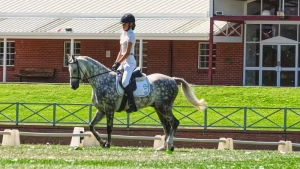
The dressage test sets the tone of the competition and produces a penalty score: lower is better. At BE80 level the test asks for basic walk, trot and canter on both reins with simple transitions and a few small circles. At 5* level the test demands collected, extended and lateral work to a near-Grand Prix standard. Most weekend amateur eventers compete to BE Novice or Intermediate, where the dressage requires elastic, rhythmical work in walk, trot and canter, with accurate transitions and at the higher levels some lateral work.
Cross-country
The defining phase. The horse and rider gallop a cross-country course of solid fences over open countryside, including water complexes, drops, banks, ditches and combinations. Time penalties accrue for being slow, refusal penalties for stopping, and elimination follows three refusals or a fall. The horse must read the terrain, jump committed at unfamiliar fences, and finish with the energy and composure to perform the next day.
Show jumping
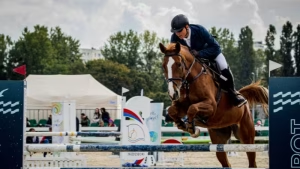
The Sunday morning showjumping is the tactical phase. After a hard cross-country the day before, the horse must be sound enough, supple enough and careful enough to clear a course of breakable poles, often at the maximum height for the level. Tired horses lose confidence; sore horses knock poles. The phase rewards horses who recover quickly and riders who can ride a balanced, accurate round with a tired horse.
For more detail on each discipline see our guides on dressage and show jumping. The full one-to-three-day format is explained in our note on the three-day event.
British Eventing Levels: BE80 to 5*
British Eventing (BE) is the national governing body for the sport in the UK. The levels run from grass-roots BE80 up to international 5*, with two distinct grading systems running in parallel — BE classes for affiliated competitors and FEI-graded international events. Understanding the levels is essential when buying or producing an eventing horse. The current rulebook and grading detail are maintained by British Eventing.
| Level | Cross-country Height | Cross-country Speed | Typical Audience |
|---|---|---|---|
| BE80 | 0.80 m | 435 m/min | First-time eventers, young horses, returning amateurs |
| BE90 | 0.90 m | 450 m/min | Confident grass-roots competitors |
| BE100 | 1.00 m | 475 m/min | Experienced amateurs and young horses progressing |
| BE Novice | 1.10 m | 520 m/min | Serious competitive amateurs and most professional yards |
| BE Intermediate | 1.15 m | 550 m/min | Aspiring professionals and produced horses |
| BE Advanced | 1.20 m | 570 m/min | Top amateur and professional level |
| FEI 1* | 1.10 m | 520 m/min | International introduction; equivalent to BE Novice |
| FEI 2* | 1.15 m | 550 m/min | International equivalent of Intermediate |
| FEI 3* | 1.20 m | 570 m/min | Advanced international |
| FEI 4* | 1.25 m | 570–580 m/min | CCI4*-L includes Bramham, Blenheim |
| FEI 5* | 1.30 m | 570 m/min | Pinnacle of the sport: Badminton, Burghley, Kentucky, Adelaide, Pau, Maryland |
The progression is not just about jump height — the technicality of the cross-country, the dressage demands and the fitness required all increase steeply. A horse that is comfortable round BE100 may take two seasons of careful production to step up to BE Novice. Skipping levels rarely ends well.
Breeds That Make the Best Eventing Horses
The British eventing scene has long been dominated by a handful of breeds and crosses that produce the right combination of stamina, athleticism, brain and bone for the sport. If you are weighing up eventing horse breeds for the first time, start with the four groups below.
Irish Sport Horse
The historic foundation of British eventing and still the most common breeding for top-level horses. Typically a Thoroughbred crossed with an Irish Draught (TIH × TIH or 7/8 Thoroughbred × 1/8 Draught), giving stamina and gallop from the TB and bone, brain and jumping ability from the Draught. Many of Britain's modern eventing legends — Toytown, Headley Britannia, Mr Stickler — carried Irish Sport Horse breeding. See our profile on the Irish Sport Horse.
Thoroughbred
Pure Thoroughbreds remain hugely competitive at every level for riders who want speed and stamina, and they are increasingly affordable as ex-racehorses re-train into eventing careers. Top Thoroughbred eventers excel at the cross-country phase but require sympathetic dressage production. See our notes on the Thoroughbred.
Continental Warmbloods
KWPN, Holsteiner, Hanoverian, Selle Français, Westphalian and Oldenburg eventing lines have transformed the upper levels of the sport over the past 25 years. Modern warmblood eventers combine the rideability and dressage talent of their warmblood breeding with enough Thoroughbred percentage to gallop. The Dutch Warmblood (KWPN) eventing-bred stallions in particular are a global force, while the Hanoverian contributes power and scope to many modern crosses.
Anglo-Arab and other crosses
Anglo-Arabs (Thoroughbred × Arabian) are valued for stamina and toughness, particularly at the long-format levels where heat and recovery matter. Connemara crosses (Connemara × Thoroughbred) produce smaller, agile eventers ideal for Pony Eventing classes and BE100/Novice level. Crosses with native breeds (Irish Cob, Welsh Cob × TB) crop up at grass-roots level with notable success.
Conformation: What to Look For
The eventing horse's job dictates the conformation. Specifically, look for:
- An athletic, balanced frame. Neither a heavy hunter type nor a lean racing greyhound — somewhere between, with good depth through the heart, well-sprung ribs and a strong, rounded loin.
- A long, sloping shoulder. Critical for galloping efficiency and a comfortable canter.
- Strong, well-defined legs with adequate bone. Cross-country horses pound their forelegs harder than any other discipline. Look for short cannons, broad flat knees, well-developed flexor tendons. Bone measurement at the cannon should be at least 8 inches for a 16hh horse, more for heavier types.
- Hard, well-shaped feet. A hoof:body ratio that suits cross-country surfaces. Thoroughbreds with poor feet struggle.
- A powerful, well-coupled hindquarter. The engine for both gallop and jumping power.
- Honest, kind eye. Conformation does not start at the legs. The horse's expression matters.
- Movement. Long, ground-covering walk, elastic trot, balanced and uphill canter. Knee action — particularly the high, hovering action favoured by some warmblood disciplines — is a disadvantage in eventing.
Temperament: The Eventer Brain
The brain is non-negotiable. An eventer must be:
- Brave enough to attack a solid fence at speed, including unfamiliar combinations and water.
- Trainable enough to produce a precise dressage test on the flat without losing his eventing edge.
- Intelligent — he needs to read terrain, understand combinations, and make split-second decisions in mid-air.
- Honest — refusing tendencies are difficult to retrain and dangerous in cross-country combinations.
- Sound nerved in the warm-up arenas at events, where many horses crowd into a small space with riders schooling intensively.
- Recovery-quick mentally as well as physically — yesterday's hard XC must not weigh on his mind in tomorrow's showjumping.
Old-school British eventers — Toytown, Headley Britannia, La Biosthetique-Sam — were famed for their characters as much as their performance. The pattern repeats. Look for a horse with a slightly cocky self-assurance, an interest in his surroundings, and the willingness to put his ears forward and have a go.
How to Buy an Eventing Horse in the UK
The UK eventing horse market is one of the most active in the world. Buyers can find horses through:
- British eventing yards. Top professional yards (Mark Todd, Tim Price, Pippa Funnell, Ros Canter and many smaller specialists) regularly produce horses for sale at all levels.
- Specialist sale platforms. Whickr, HorseQuest, Horsemart, Equinet and ehorses all carry significant UK eventer inventories.
- Sales auctions. Goresbridge Go For Gold, Brightwells, and Tattersalls Ireland Sport Horse sales feature event-specific catalogues.
- Word of mouth. Eventing yards constantly source horses for clients; reaching out through your trainer or coach is often the best route.
What to insist on:
- Five-stage vetting as a minimum — never less for a serious eventer purchase. Include radiographs of the front feet and hocks, and consider blood tests where relevant.
- BE record check. Ask for the horse's BE registration number and verify the record yourself on the British Eventing website. Be very wary of unexplained gaps or eliminations.
- Trial. Two viewings, the second including riding the horse yourself or by your trainer, and ideally a small outing or jump school.
- Provenance. Ask who started the horse, who has produced him, and to what level. The lower-level career often tells you what the upper-level capacity will be.
For more on buyer due diligence, see our guides on how horses are measured and the broader horse care archive.
UK Prices in 2026
Eventer prices vary enormously by level, breeding and competition record. Realistic UK 2026 budgets:
| Level / Profile | Typical Price |
|---|---|
| 4–5 year old, lightly produced, BE80/90 type | £8,000–£15,000 |
| BE100/Novice horse with results | £15,000–£35,000 |
| Intermediate horse with consistent placings | £35,000–£75,000 |
| Advanced and proven 4* horse | £75,000–£200,000+ |
| 5* contender with results | £250,000–£1m+ |
| Ex-racehorse retraining for eventing | £3,000–£8,000 |
The market has firmed up post-pandemic and shows no sign of softening. The shortage is at the BE100 to Novice level, where buyers chase a limited number of well-produced horses with proven records and clean vettings.
Training and Bringing on an Eventing Horse
An eventer's career typically spans 8 to 15 competitive years if managed well. The classical production schedule:
- 4–5 years old: Backed and brought into work; first BE80/90 outings in the second season.
- 5–6 years old: Consolidate at BE90/100; introduce BE Novice if the horse is producing well.
- 6–7 years old: Eligible for the prestigious BE Young Horse classes (5yo and 6yo championships at Osberton).
- 7–8 years old: Step to BE Intermediate / FEI 2*; first long-format experience.
- 8–10 years old: Targeting FEI 3* and 4*; this is where careers either step up or plateau.
- 10+ years old: Top-level career at 4* and 5*. Eventing horses peak later than racehorses or showjumpers because the experience demands cannot be rushed.
Training is split between flatwork (typically 2–3 days a week), jump schooling (1–2 days), conditioning work including hill work, gallop work and hacking (2–3 days), and rest. A typical Novice-level eventer covers around 25–35 km of varied work per week.
The Major UK Events
The UK calendar is the world's most competitive. Headline events:
- Badminton Horse Trials — first weekend in May, the world's most famous 5*. Held on the Badminton Estate in Gloucestershire.
- Burghley Horse Trials — early September, Stamford. Often considered the toughest 5* track in the world; see the Burghley official site.
- Bramham International — June, West Yorkshire. CCI4*-L for U25 riders and senior 4*-L.
- Blenheim Palace Horse Trials — September, Oxfordshire. CCI4*-L and 8/9-year-old championships.
- Barbury Castle — early July, Wiltshire. International 3*/4* and BE classes.
- Houghton Hall — May, Norfolk. Major Nations Cup venue.
- Belton International — April, Lincolnshire (when held). Season-opener at advanced level.
- BE National Championships — Gatcombe Park, August. The peak of the domestic season.
The grass-roots equivalents (BE80 to BE100) are run at over 100 venues across the country between March and October. A horse going to a one-day event at Cirencester Park, Chatsworth or Hambleden is competing in the same sport, on the same scoring system, as the horses jumping the Vicarage Vee at Badminton. Browse our wider equestrian sports coverage for related disciplines.
The True Cost of Eventing
Owning an eventing horse is expensive. Annual budgets for a horse competing at BE100/Novice level in 2026:
| Item | Annual Cost |
|---|---|
| Full livery | £8,400–£12,000 |
| Farriery (every 5–6 weeks) | £900–£1,500 |
| Vet, dental, vaccinations | £600–£1,200 |
| Insurance (£15,000 horse) | £900–£1,500 |
| BE registration and entries (12–16 events) | £1,500–£2,500 |
| Lessons and coaching | £1,500–£3,000 |
| Transport / fuel / overnight | £800–£1,500 |
| Equipment, supplements, sundries | £500–£1,500 |
| Total | £15,100–£24,700 |
Higher levels add training fees, more frequent competition, occasional international entries, and the costs of lengthy seasons away. Successful 4* and 5* horses typically have owners (often syndicates) precisely because the costs are beyond a single competitive amateur.
Frequently Asked Questions
What is an eventing horse?
An eventing horse is a horse trained and bred for the sport of eventing — a three-discipline test of dressage, cross-country and show jumping over one to three days. Eventers must combine athleticism, courage, trainability and stamina to produce three different performances in close succession.
What breed makes the best eventing horse?
Irish Sport Horses (Thoroughbred × Irish Draught) have historically dominated the sport, with modern continental warmbloods (KWPN, Holsteiner, Hanoverian) increasingly competitive at the top levels. Pure Thoroughbreds and Anglo-Arabs both produce talented eventers. The right cross matters more than the specific breed — a horse needs Thoroughbred speed and stamina with enough bone and brain from the cross.
How tall should an eventing horse be?
Most successful event horses stand between 16hh and 17hh, though notable champions have ranged from 15hh (Headley Britannia at the lower end) to 17.2hh. Suitability is more about athleticism, scope and balance than absolute height. Pony Eventing exists as a separate competitive structure for ponies up to 14.2hh.
How much does an eventing horse cost?
UK 2026 prices range from £3,000–£8,000 for an ex-racehorse to £8,000–£15,000 for a 4–5yo lightly produced BE80/90 prospect, £15,000–£35,000 for a BE100/Novice horse with results, £35,000–£75,000 for an Intermediate horse, and £75,000–£1m+ for Advanced and 5* horses. Annual running costs typically run £15,000–£25,000 at amateur Novice level.
What age do horses start eventing?
Most horses make their BE80/90 debuts as five-year-olds, after a season of unaffiliated outings as four-year-olds. The BE 5yo and 6yo Young Horse championships are the main targets for early career. Horses typically peak in performance terms between ages 10 and 14, with sound horses competing well into their late teens.
What is the difference between eventing and show jumping?
Show jumping is one phase of eventing — the Sunday morning round of breakable fences. Eventing also requires a dressage test and a cross-country round of solid fences over open country. A specialist show jumper is bred for explosive power and care over poles; a specialist eventing horse must add stamina, gallop and bravery to those qualities.
What are the levels of British Eventing?
BE80, BE90, BE100, BE Novice, BE Intermediate and BE Advanced for affiliated competitors, with parallel FEI grading from CCI* through CCI5*. Heights run from 0.80 m at BE80 to 1.30 m at 5*, with cross-country speed requirements increasing through the levels. Most amateur eventers compete at BE100 to Novice level.
Where are the major UK events held?
The UK has the world's most competitive eventing calendar, headlined by Badminton (May, Gloucestershire) and Burghley (September, Lincolnshire) — both 5* — and supported by Bramham, Blenheim, Barbury, Houghton, Belton and the BE National Championships at Gatcombe. Over 100 venues run BE-affiliated events at lower levels through the season.
Can a Thoroughbred ex-racehorse become an eventing horse?
Yes — many ex-racehorses retrain successfully into eventing, particularly at BE80 to BE100 level. Their natural speed and stamina suit cross-country, and the dressage takes patient retraining away from the racing canter. Charities like the Retraining of Racehorses (RoR) provide support and dedicated competition classes.
How long does it take to produce an eventing horse?
From backed at four years old to competing at BE Intermediate/FEI 2* typically takes three to four years of careful production. Top-level (4*/5*) horses are usually 10 years old or more before they peak. There are no shortcuts — eventing demands experience that compounds over seasons, not months.
For more on related disciplines and breeds, see our coverage of dressage, show jumping, the Irish Sport Horse and the Thoroughbred. Authoritative external resources include British Eventing and British Equestrian.