Table of Contents
Table of Contents
The biomechanics of horse movement is the study of how a horse’s skeleton, muscles, tendons and ligaments produce the gaits of a horse — the patterned, repeating sequences of footfalls that carry the animal across the ground. Every walk, trot, canter and gallop is the visible result of a precise interaction between bone, soft tissue and the elastic recoil that turns muscular effort into forward motion. Riders who understand this machinery school more accurately, vets diagnose lameness sooner and trainers protect their horses from injury for longer.
This guide breaks the natural horse gaits down into footfall, beat and suspension; explains the structural anatomy that makes each gait possible; covers the ambling and lateral gaits of breeds like the Icelandic and the Paso Fino; and shows how rider weight, saddle fit and arena surface change the equation. Whether you ride dressage, jump, race or hack out, the principles of equine biomechanics are the same.
What Are Horse Gaits and Equine Biomechanics?
A gait is a coordinated, repeating pattern of limb movement. The horse uses different gaits to travel at different speeds without wasting energy — in the same way a car uses different gears. Horses have four natural gaits: walk, trot, canter and gallop. Some breeds, such as the Icelandic horse, the Tennessee Walking Horse and the Paso Fino, have additional ambling gaits including the tölt, running walk and paso. These extra gaits are the result of selective breeding and a known genetic mutation (DMRT3) that affects gait coordination.
Biomechanics is the engineering side of that locomotion. It looks at:
- Footfall pattern — which legs leave and strike the ground, and in what order
- Beat — the audible rhythm of each gait (a four-beat walk sounds 1-2-3-4)
- Stride length — the distance covered between successive ground contacts of the same hoof
- Stance and swing phases — the time a hoof is on the ground supporting weight versus moving through the air
- Suspension — brief moments when no hoof is in contact with the ground (only present in trot, canter and gallop)
- Limb loading — the peak force passing through each leg, which can exceed two-and-a-half times bodyweight at the gallop
For more on gait-specific terminology, see our entries on overtracking, self-carriage and lateral movement.
The Walk: The Four-Beat Foundation
The walk is a four-beat lateral gait with no moment of suspension — at least two hooves remain on the ground at all times. The footfall sequence is left hind, left fore, right hind, right fore (or its mirror). Average ground speed is roughly 6–7 km/h.
Because the walk has no aerial phase, peak limb loading is the lowest of the four gaits at around 0.6–0.8 times bodyweight. That makes it the safest gait for warming up, cooling down and rehabilitating an injured horse. The British Horse Society recommends a minimum of ten to fifteen minutes of walk at the start of every schooling session for this reason.
A correct, swinging working walk shows clear over-track — the hind hoof landing in front of the print left by the corresponding fore hoof. Over-track is the simplest field test of throughness: a horse that is tense in the back, stiff over the loins or sore in the hocks will short-stride and lose over-track first.
The Trot: Two-Beat Diagonal Power
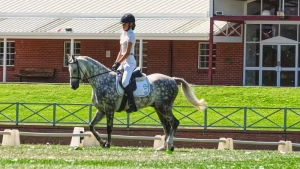
The trot is a two-beat diagonal gait with two short suspension phases per stride. Diagonal pairs of hooves move together: left fore with right hind, then right fore with left hind. Average speed is around 13 km/h, but extended trot in elite dressage horses can exceed 20 km/h.
The diagonal pairing is biomechanically efficient because it cancels out roll and yaw — the horse’s spine stays remarkably level, which is why the trot is the gait dressage uses to assess soundness and symmetry. Any unevenness shows up immediately. Vets routinely use the trot in straight lines and on circles for the AAEP lameness scale (0–5).
The trot has multiple variations:
- Working trot — balanced, forward, the foundation gait of schooling
- Collected trot — shorter, higher steps with more weight on the hindquarters
- Medium trot — longer strides with controlled cadence
- Extended trot — maximum stride length while keeping the same rhythm
- Passage and piaffe — the highly collected dressage variations with prolonged suspension
Read our companion piece on horse trotting for rising vs sitting trot, diagonals and common rider errors.
The Canter: Three-Beat Rhythm With Suspension
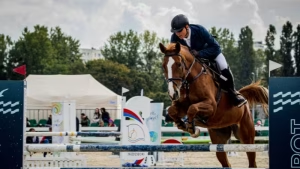
The canter is a three-beat gait with a clear suspension phase. On a left-lead canter the sequence is: right hind (beat 1), then left hind and right fore together (beat 2), then left fore alone (beat 3) — the leading leg. After beat 3 there is a moment when all four feet are off the ground. Average ground speed is 19–25 km/h, depending on collection.
The leading foreleg is the one that reaches further forward and lands last; the horse should be on the “correct” lead for the direction of travel (inside lead on a circle, otherwise the horse becomes unbalanced). A horse that is “disunited” or “cross-cantering” has the front and hind on opposite leads — uncomfortable and a flag for back pain, hock issues or saddle fit. A clean flying change requires a balanced transition through the suspension phase.
At the canter, peak fetlock extension on the leading foreleg can reach 90° on landing — an enormous loading moment for the superficial digital flexor tendon (SDFT). This is why SDFT injuries are so common in jumpers and racehorses, and why eccentric loading work (controlled trot poles, raised cavaletti) is included in modern canter conditioning programmes.
The Gallop: Four-Beat Flight
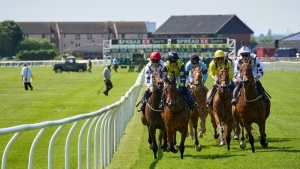
The gallop is the fastest gait. It looks like an extended canter but the diagonal pair (which struck simultaneously at canter) breaks apart into two separate beats, giving four distinct hoof falls per stride. A typical gallop sequence on the right lead is: left hind, right hind, left fore, right fore, suspension.
A Thoroughbred racehorse at full gallop covers 16–17 metres per stride with a stride frequency of around 2.3 strides per second. Top thoroughbreds reach speeds above 65 km/h, with peak limb loads exceeding 2.5 times bodyweight on the lead foreleg as it lands. The legendary Red Rum and Frankel were exceptional partly because of unusually efficient gallop mechanics — longer effective stride and higher recovery of elastic energy in the tendons.
Ambling and Lateral Gaits: Tölt, Pace and Paso
Beyond the four natural gaits, a group of breeds known as “gaited horses” produce additional intermediate, four-beat patterns prized for their smoothness. These ambling gaits sit between the walk and the canter in speed but, crucially, keep at least one foot on the ground at all times — so the rider feels almost no vertical bounce. The genetic basis is the same DMRT3 mutation that influences gait coordination across all horses.
- Tölt — the signature gait of the Icelandic horse. A four-beat lateral gait with the same footfall sequence as the walk but at trot-to-canter speeds, ridden with no suspension and a famously still saddle
- Pace — a two-beat lateral gait where the legs on the same side move together (left fore and left hind, then right fore and right hind). Fast but rolling; the basis of harness racing in Standardbred pacers
- Running walk — the trademark of the Tennessee Walking Horse, a four-beat gait that overreaches the front print by up to 50 cm with a characteristic head nod
- Paso — the rapid, even four-beat gaits of the Paso Fino, ranging from the collected classic fino to the ground-covering paso largo
Gaited breeds are not the only horses with movement worth studying for its own sake. The high, elevated trot of the Friesian and the cadenced, collected action of the Andalusian are the result of conformation and selective breeding for expression, while the Dutch Warmblood has been bred specifically for the elastic, suspended movement modern dressage rewards.
Bones, Tendons and the Spring of the Stride
The horse has no muscles below the knee or hock. Locomotion in the lower limb is purely mechanical — powered by the elastic stretch and recoil of tendons, especially the SDFT, the deep digital flexor tendon (DDFT) and the suspensory ligament. The lower limb is essentially a pogo stick.
Three structures matter most for gait efficiency:
- Superficial digital flexor tendon (SDFT) — the “springy” tendon that stores and releases up to 40% of the energy required for each stride. SDFT injuries (commonly in the mid-cannon region) are among the most career-limiting in sport horses
- Suspensory ligament — the broad “hammock” that supports the fetlock and prevents over-extension under load. Suspensory desmitis is a frequent diagnosis in dressage horses
- Stay apparatus — a system of tendons and ligaments that lets a horse stand and even sleep on its feet without using significant muscular effort
For more on tendon and ligament injuries, see our entries on equine tendinitis and proximal suspensory desmitis. Repeated overload of the navicular region can also degrade movement — see our guide to navicular syndrome.
The Back, Pelvis and Engine of Movement
Forward motion comes from the hindquarters. The lumbosacral joint — where the spine meets the pelvis — is the only point in the equine spine with significant flexion-extension capability. Almost all of the “tucking under” of the hindquarters seen in collected work happens here. A horse cannot collect, lengthen or jump well if this joint is restricted, painful or asymmetric.
The back itself is a bridge. Spinal processes (the bony tops of the vertebrae) form the wither and the topline, while the longissimus dorsi muscle along each side of the spine produces lateral bend and helps stabilise the rider’s seat. When this muscle goes into spasm — from poor saddle fit, ill-advised tight side reins, or compensation for hind-limb pain — the horse hollows the back, drops the pelvis and trails the hocks. The result looks lazy or resistant; the cause is mechanical.
Conditions such as vertebral subluxation, sacroiliac joint disease and cold-backed horse syndrome all reduce the spine’s ability to lift and round — and the gait quality drops with it.
How the Rider Changes the Biomechanics
An adult human rider is typically 10–20% of the horse’s bodyweight. The British Horse Society’s long-standing rule of thumb is that the combined rider-and-tack weight should ideally not exceed 15% of the horse’s bodyweight, and never exceed 20% for sustained work. A 2020 study in The Veterinary Journal reinforced that horses carrying loads above 20% showed measurable changes in temporary lameness scores. A broader 2023 review in PMC on rider biomechanical effects sets out how gravitational and inertial forces from the rider feed into the horse’s stride.
Beyond raw weight, three things matter most:
- Saddle fit — an asymmetric or bridging saddle creates pressure points on the longissimus and concentrates load on a small area of muscle. The Society of Master Saddlers (SMS) recommends a fitting check every six months
- Seat position — a rider behind the movement loads the loins; a rider in front of the movement throws the horse onto the forehand. Both shorten the stride
- Hand contact — backwards-pulling hands restrict the cervical (neck) extension that initiates each stride. The horse can’t use its “balancing pole”
Skilled riders work with the horse’s biomechanics rather than against them — following the swing of the trot, allowing the head and neck to descend in canter, using a well-timed half-halt to rebalance, and timing aids to a phase of the stride when the horse can actually respond.
Gait Analysis, Injury Prevention and Training Applications
Modern horse gait analysis no longer requires a referral to a research lab. UK referral hospitals such as the Royal Veterinary College use inertial measurement unit (IMU) systems — the Equigait or Lameness Locator devices — to record asymmetry of head and pelvis movement at trot. These are now part of standard pre-purchase exams for sport horses above £15,000. Governing bodies including the FEI draw on the same biomechanical research to set rules on movement, welfare and acceptable training methods.
For trainers and owners, three practical applications follow:
- Pole work and cavaletti — raised poles set at trot or canter distances increase joint flexion and recruit the postural muscles, building strength without the concussion of a hard surface
- Hill work — uphill work develops the gluteals and the hamstrings; controlled downhill work strengthens the stifle stabilisers
- Conditioning surfaces — shock-absorbing surfaces like fibre-and-sand or waxed footing reduce SDFT loading by 10–15% versus hard tracks. Hacking on roads should be at walk only
For warm-up and cool-down protocols, see our guides on horse stretches, cooling down after exercise and horse pole exercises.
Frequently Asked Questions
What are the four natural gaits of a horse?
The four natural gaits of a horse are the walk (four beats, no suspension), the trot (two beats, two short suspension phases), the canter (three beats with a single suspension phase) and the gallop (four beats with a long suspension phase). Some breeds have additional ambling gaits such as the tölt or running walk.
What are the five gaits of a horse?
“Five-gaited” horses, such as the American Saddlebred, perform the walk, trot and canter plus two man-made gaits: the slow gait (a measured, four-beat ambling gait) and the rack (a faster, brilliant four-beat gait with high knee action). Gaited breeds like the Icelandic horse instead add the tölt and the flying pace.
What is the smoothest gait for a horse?
The smoothest gaits are the four-beat ambling gaits of gaited breeds — the tölt of the Icelandic horse and the paso of the Paso Fino. Because at least one hoof stays on the ground throughout, there is no moment of suspension to throw the rider upwards, so the saddle stays remarkably still even at speed.
What is suspension in horse gaits?
Suspension is the moment in a stride when all four hooves are off the ground. It is absent at walk but present in trot, canter and gallop. Greater suspension generally indicates more athletic, expressive movement and is highly valued in dressage and showjumping.
How heavy can a rider be without affecting the horse’s biomechanics?
The British Horse Society and most equine biomechanists agree that combined rider-and-tack weight should ideally not exceed 15% of the horse’s bodyweight, and never exceed 20% for sustained work. UK research (2020) showed measurable temporary lameness changes above the 20% threshold.
Can biomechanics analysis help with lameness diagnosis?
Yes. Inertial sensor systems such as Equigait and the Lameness Locator quantify head-nod and pelvic-hike asymmetry at trot, which are the two most reliable indicators of forelimb and hindlimb lameness. They are now used in many UK referral practices alongside flexion tests and diagnostic imaging.
Last updated: June 2026 by the Bit & Bridle editorial team.