Show jumping is the most watched and most accessible equestrian discipline in the world — a sport that combines athletic horse power, precise rider technique, split-second decision-making, and a coloured course of knockable obstacles built specifically to be jumped clear and quickly. Whether you are watching the London International Horse Show on TV, considering entering your first British Showjumping (BS) unaffiliated class, or trying to understand what the coloured poles, walls and water ditches actually mean in real competition, this 2026 guide covers everything from definitions and history to current scoring rules, BS and FEI levels, fault tables, and a practical route into competing for both UK and South African riders.
Table of Contents
What Is Show Jumping?
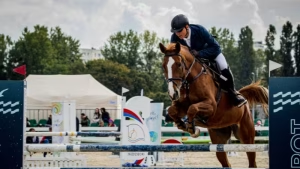
Show jumping is an English-style equestrian discipline in which a horse and rider negotiate a numbered course of jumpable obstacles inside an arena, aiming for a clear round (no faults) inside the time allowed. In Britain it is governed by British Showjumping (BS), and at international level by the Fédération Équestre Internationale (FEI). It is one of three Olympic equestrian disciplines alongside dressage and eventing.
The sport rewards three things: a careful approach (no fences down), an accurate line (no refusals or run-outs), and speed (often crucial in a jump-off). A typical national course in the UK is 8 to 14 numbered fences set at heights from 80 cm (cross-poles for novices) up to 1.60 m (the highest international levels), with combinations of strides between fences that demand the rider plan a precise route, pace and turning point well before the bell.
History of Show Jumping
The sport of show jumping has its roots in 18th-century English fox-hunting. The Inclosure Acts (mostly 18th to early 19th century) fenced off the countryside with hedges and post-and-rail, forcing hunting horses to jump fences routinely. By the late 19th century, “leaping competitions” had become regular features at agricultural shows in the UK and Ireland.
The first formal jumping competition is generally dated to the Royal Dublin Society Show in 1865, with the first international rules established at the start of the 20th century. Show jumping made its Olympic debut at the 1900 Paris Games and has been part of every Olympics since 1912. The Hickstead Showground in Sussex, opened in 1960 by Douglas Bunn, hosted the first FEI World Show Jumping Championships in 1965 and remains one of the spiritual homes of the sport. In 1974 the FEI established the modern World Cup series; in 2026 the FEI Jumping World Cup Final is held in Basel, Switzerland.
Rules and Scoring
Show jumping faults are scored simply, and the same rules apply at most BS and FEI levels.
Faults
- Knock-down: 4 faults per fence knocked down (a rail falling out of its cup)
- First refusal or run-out: 4 faults
- Second refusal: elimination at most BS and FEI levels (some unaffiliated classes allow three before elimination)
- Fall of horse or rider: elimination and mandatory veterinary check
- Exceeding the time allowed: 1 fault for every commenced 4 seconds over (BS Senior), or 1 fault per second under FEI rules
- Wrong course or jumping the wrong fence in the wrong order: elimination
- Blood on the horse’s flanks or in the mouth: mandatory elimination under FEI rules
Jump-Off
If multiple riders complete a clear first round inside the time allowed, they return for a jump-off — a shorter, often tighter and twistier course where the fastest clear takes the win. The jump-off is where the spectator drama happens: tight inside turns, banked corners, fast strides between combinations and the option to take a longer safer route or a tighter faster one. A 4-fault round inside the jump-off time beats a clear round outside the time, so the time penalty matters.
Types of Show Jumps and Fences
Verticals (Uprights)
A single plane of rails set vertically — the simplest and most-used fence type. Demands an accurate take-off point and a horse that lifts cleanly. Variations include the gate, plank and wall.
Oxers (Spreads)
Two sets of standards set apart, asking the horse to jump both height and width. Sub-types include the parallel oxer (front and back rails the same height), the ascending oxer (back rail higher — easier), the Swedish oxer (rails crossed in opposite directions) and the triple bar (three ascending rails).
Combinations
Two or three fences set at related distances (typically one or two non-jumping strides apart). A double is two fences; a treble is three. Combinations test the horse’s adjustability between fences and are usually placed mid-course.
Water Jumps
A wide, shallow ditch of water (typically up to 4.5 m wide at international level) marked at the take-off side with a small brush or hedge. Penalties apply for landing in or on the white tape on the far side. Water jumps used to be standard at most county shows but have become rarer in the UK in recent years.
Walls and Banks
Walls are typically built from lightweight blocks that fall on contact. Banks (such as the famous 10ft 6in Derby Bank at Hickstead) are solid earthen jumps, almost always reserved for the highest-level Derby-format classes.
Competition Formats
Table A (Faults Converted)
The standard format. Riders go for a clear round in the first round; clear rounds inside the time return for the jump-off. The most common BS and FEI format.
Table C (Time Only)
Time is the primary factor. Knock-downs add a few seconds (typically 4) to the rider’s final time but are not eliminating. Used at speed classes and in some indoor winter series.
Puissance
A high-jump competition over a small set of fences, ending in a single high wall. The wall is raised each round and the winner is the rider who jumps it cleanest. World record stands at 2.47 m (8ft 1¼in) set by Captain Alberto Larraguibel Morales on Huaso in 1949 — a record that has stood for over 75 years.
Six-Bar
Six fences set in a straight line, each higher than the last. Similar to a puissance but spread over multiple fences. A traditional finale class at indoor winter shows including the London International Horse Show at Olympia.
Derby
A cross-country-influenced format with banks, ditches, water and natural-style obstacles inside a show-jumping arena. The Hickstead Derby (held every August since 1961) is the world’s most famous example, and one of the very few major British classes that John Whitaker’s Milton was never allowed to contest, because the family who owned him barred him from it.
Show Jumping Levels Explained
British Showjumping (BS) UK Domestic Levels
BS classifies competitions by registered horse height/level. The standard 2026 BS classes are:
- British Novice / Discovery / 90cm: 0.85-0.95 m — entry-level grading classes for novice horses
- Newcomers / 1.00 m: 1.00-1.05 m
- Foxhunter / 1.10 m / 1.15 m: 1.10-1.20 m
- National 1.20 m / 1.25 m: 1.20-1.30 m
- National 1.30 m / 1.35 m / 1.40 m: 1.30-1.45 m
- Grand Prix / National 1.50 m+: 1.45 m and above
Horse grading by points won determines which classes a horse can enter, with progression upward through Grade C, B and A.
FEI International Levels
Internationally the FEI star system runs from 1* (entry international) up to 5* (the very top of the sport — Hickstead Derby, Aachen, Spruce Meadows, the London International, the Nations Cup series and Olympic competitions).
- CSI1*: 1.10-1.30 m
- CSI2*: 1.20-1.40 m
- CSI3*: 1.30-1.50 m
- CSI4*: 1.40-1.55 m
- CSI5*: up to 1.60 m
Pony Club and Unaffiliated
The Pony Club UK runs an extensive show jumping programme from 50 cm cross-poles upward, with the Mini Major and Pony Club Championships televised each year. Unaffiliated classes at riding clubs and schools across the UK run at 60-100 cm and are the entry point for most adult riders new to the sport.
The 2026 UK Show Jumping Season
The British show jumping season runs effectively year-round, with the heaviest concentration of major competitions running from April to October outdoors and November to March indoors. Key 2026 dates include:
- Bolesworth International: June 2026 (Cheshire)
- Royal Windsor Horse Show: May 2026 (Windsor Castle private grounds)
- Hickstead Derby Meeting: June 2026
- Royal International Horse Show at Hickstead: July 2026
- Horse of the Year Show (HOYS): October 2026 (NEC Birmingham)
- London International Horse Show: December 2026 (ExCeL London)
The road to the LA28 Olympics is now firmly underway: 2026 Nations Cup ranking events form part of qualification for both individual and team places in Los Angeles, where Show Jumping will be staged at the Galway Downs venue from 18-29 July 2028.
Major UK and International Shows
Beyond the BS calendar, the international show jumping season includes the FEI Jumping Nations Cup series, the FEI Jumping World Cup, the FEI Longines World Ranking and the Global Champions Tour (GCT). The GCT has become a serious commercial force in the sport, paying out millions in prize money at venues including London, Paris, Cannes and Doha each year, and counts top UK riders Ben Maher (gold medallist Tokyo 2020 individual) and Scott Brash (the first rider to win the Rolex Grand Slam) among its mainstays.
South African readers will find the SANEF (South African National Equestrian Federation) calendar running national show jumping events year-round, with the SA Derby at Inanda and the Cape Equestrian Champs anchoring the SA calendar. Top SA riders include Lorette Knowles-Taylor and Barry Taylor.
The Show Jumping Horse
The ideal show jumper has scope (ability to clear height and width), carefulness (a willingness to lift legs and not touch poles), a quick gallop, an adjustable canter, and the temperament to focus inside a jump-off. Breeds and types most commonly seen at international level include:
- Dutch Warmblood (KWPN) — see our KWPN profile
- Holsteiner, Hanoverian, Selle Français and Belgian Warmblood
- Irish Sport Horse (ISH) — see our Irish Sport Horse profile
- Thoroughbred for speed-driven classes
The pony equivalent at Pony Club and Junior level includes Welsh Section B and Connemara crosses, with Connemara-cross sport ponies particularly successful at British pony jumping competitions — see our Connemara profile.
Getting Started in Show Jumping
For UK riders new to the sport:
- Take lessons with a BHS-qualified or BS-registered instructor to build secure flatwork and a balanced jumping position
- Build up over poles, cavaletti, cross-poles and small grids before any course of show jumps
- Start at unaffiliated 50-70 cm at a local riding club or schooling show, then graduate to a BS-affiliated British Novice when you can jump 80-85 cm comfortably at home
- Register with British Showjumping (around £75 senior membership in 2026) and your horse for grading purposes
- Consider Pony Club membership for under-25 riders — the structured rallies, mini-shows and championships are the best development pathway in the UK
For South African riders, SANEF affiliation, regional grading via SA Showjumping and access to riding clubs through the Equestrian Sport Federation provide a parallel route.
Frequently Asked Questions
What is the meaning of show jumping?
Show jumping is an Olympic equestrian discipline in which horse and rider negotiate a set numbered course of jumpable obstacles inside an arena, scoring penalties for knock-downs, refusals and time exceeded. The winner is generally the rider with the fastest clear round in the jump-off.
Is show jumping harder than dressage?
Dressage usually demands more years of patient training to reach high marks; show jumping has more immediate physical risk and demands faster decision-making in real time. Most riders find dressage harder to score well in consistently, while show jumping is more forgiving of a single mistake but punishes a slip on take-off severely.
How many fences are in a show jumping course?
A typical national course has 8-14 numbered obstacles. Some fences (combinations or doubles/trebles) count as a single numbered obstacle but require multiple jumping efforts. International championship courses can include up to 14 obstacles with 16-18 jumping efforts.
How tall are Olympic show jumping fences?
At the Olympic Games, fences range up to 1.65 m (5ft 5in) in height and 2 m (6ft 6in) in width, with the famous Olympic water jump up to 4.5 m wide. Course designers build at the maximum allowed only sparingly through the round.
What is the difference between show jumping and eventing?
Show jumping takes place inside an arena over knockable, lightweight fences. Eventing is a three-phase test — dressage, cross-country over solid natural fences, and a final show jumping phase — and is judged across all three. Cross-country fences in eventing are fixed and do not fall down on contact.
How much does it cost to start show jumping in the UK?
You can compete at unaffiliated level for around £15-25 entry per class. BS membership for the 2026 season is around £75 senior, with class entries from £20 at lower levels. Lessons, training and a suitable horse are the main costs; second-hand horses suitable for British Novice and Newcomers level start at around £3,500-£8,000.