Table of Contents
Show jumping courses are among the most carefully constructed arenas in equestrian sport. Far from being a random collection of poles and planks, every show jumping course is a deliberate exercise in equine psychology, striding mathematics, and competitive fairness. Whether you are a spectator trying to make sense of what you are watching at Hickstead Royal International, a rider preparing for your first BS Discovery class, or a course designer studying for FEI Level 1 certification, understanding how show jumping courses work transforms your appreciation of the sport. This 2026 guide covers fence types, design principles, how to walk a course, FEI and British Showjumping height brackets, arena footing, and the rules that govern competition courses worldwide.
What Are Show Jumping Courses?
A show jumping course is the prescribed route of obstacles riders must complete, in order, within a defined time, with the fewest faults possible. Most British Showjumping (BS) courses contain between 8 and 13 individual fences, with a combination (double or treble) usually appearing somewhere on the course. FEI international courses typically run 12–14 fences with a 1.30m+ minimum height. The course designer's job is to test the riders without trapping the horses — every successful course balances rideability with technical demand, with no fence designed to cause a fall.
Faults are counted in three categories: knockdowns (4 faults per pole down), refusals (4 faults; a second refusal is elimination), and exceeding the time allowed (1 fault per started second over). The winner is the rider with the fewest faults; ties are settled in a jump-off (a shortened course ridden against the clock).
Types of Show Jumping Fences
Vertical (Upright)
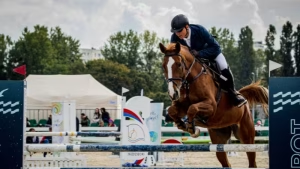
The simplest fence type — a single set of poles arranged vertically with no spread. Verticals test the horse's scope and the rider's stride accuracy. A poorly ridden vertical knocks down because the horse takes off too close or too far away; the bascule has to be near-perfect. Designers often use verticals immediately after a tight turn to test rideability.
Oxer (Spread)
Two sets of poles with a measured spread between them. Oxers come in three sub-types: square (front and back poles at equal height), ascending (back pole higher than front — encourages bascule), and Swedish/parallel (poles set at opposing angles for visual interest). Spread always increases with height — a 1.40m oxer typically has a 1.45m spread.
Triple Bar
An ascending three-rail spread. Rare in modern competition because the depth tests scope severely. Often the largest fence on a track when it appears.
Combinations (Doubles and Trebles)
Two or three fences placed at one or two related distances (typically 7m for one stride, 10–11m for two strides). Combinations punish wrong striding harder than any other element — a missed take-off at fence A means refusal or rail at fence B. Trebles, with two strides between three obstacles, demand precision over the entire sequence.
Wall
A solid-looking fence built of lightweight bricks or wood panels. Horses naturally back off a wall, so designers place them where rideability is tested. The Puissance class — the wall-only competition — uses progressively higher walls to find the highest jumper.
Liverpool
A vertical or oxer with a tray of water placed under or in front of the rails. Water-shy horses spook, hesitate, or stop — exactly the behaviour the designer wants to test. Famous on the British circuit at Aintree, where the Grand National's Aintree Open jumping courses feature multiple Liverpools.
Water Jump (Open Water)
A wide open ditch of water with a small "guide" fence at the front. Pure spread test — the horse has nothing visible to clear at height, so it must read the depth and stretch. Standard FEI water jumps are 4m wide; the maximum is 5m at 5* shows.
Joker Fence
A fence given a higher fault penalty (typically double points) in puissance, accumulator, and gambler's choice classes. Riders choose whether to attempt it or skip it for safer scoring.
Skinny Fence
A narrow fence, typically a single panel or filler less than 1m wide. Tests straightness severely — drift even slightly and the horse will run out. Common on indoor winter courses where space is tight.
How Show Jumping Courses Are Designed
FEI- and BS-affiliated course designers must complete formal training and certification (FEI Level 1 through 4, BS Course Designer through Senior International). Top international designers (Bob Ellis, Frank Rothenberger, Kelvin Bywater, Olaf Petersen) are commissioned years in advance for major shows. The design process for a typical national-level course follows a clear sequence:
- Set the difficulty. The designer is given a class height and faults distribution target (e.g. average 30% clear rounds for a 1.30m Foxhunter qualifier).
- Choose the opening fence. Always an inviting vertical or ascending oxer, on a long approach, so horses settle.
- Place the combination. Usually in the middle third of the course, on a strong line — the designer wants riders to come in straight, not from a tight corner.
- Build the testing questions. A skinny fence, a Liverpool, a related distance on a curve, or a tight turn to a vertical.
- Close with a strong galloping fence. Typically a wide oxer or triple bar — the last fence should test scope at the end of the round when horses are tiring.
- Measure all distances. Standard canter stride is 3.5m; the designer adjusts by the height bracket (longer for higher classes where horses jump bigger). Course distances are measured along the optimal line, not the shortest line.
- Set the time allowed. The "time allowed" is the course length divided by the agreed competition speed (typically 350–400 metres per minute at British national level, 400–450m/min at FEI World Cup level).
Course Walking: What to Look For
Walking the course is part of competition. Riders are typically given 10–15 minutes to walk the track before the class starts, accompanied by their trainer where allowed. The professional walk follows a strict protocol:
- Walk the optimal line first, exactly as you intend to ride it.
- Count strides between fences using a consistent stride length (1m per step = 3.5 normal canter strides between markers).
- Identify the line on every turn — note where you turn, where you straighten, where the horse should land.
- Look back at each fence from the take-off zone to spot any visual challenge (low sun, distracting backdrop, advertising banner).
- Walk combinations both directions — measure A to B and B to C separately. The course designer's set distance is critical here.
- Plan the jump-off route if the class includes one. Identify which corners can be cut and which would risk a refusal.
- Note the start and finish lines. The clock starts when the horse crosses the start line, not when entering the arena.
The relationship between course walking and competition success is direct. Professional show jumpers walk every track they ride, often two or three times. Top British rider Ben Maher famously walks a 5* track six or more times in different weather conditions before competing on it. The polework, gridwork, and adjustability built in structured jumping exercises are designed to give riders the rideability needed to execute a walked plan accurately.
Competition Formats Explained
| Format | How it works | Where used |
|---|---|---|
| Table A (Time) | Single round, fastest clear wins | Most national speed classes |
| Table A1 (Two Phases) | Two rounds in one — second phase only for first-round clears | Common at affiliated regional shows |
| Table A2 (Jump-Off Against the Clock) | First round, then jump-off for clear-round riders | Most BS classes and FEI Grand Prix |
| Table C (Time) | Faults converted to seconds added (typically 4 seconds per knockdown) | Speed classes and championships |
| Puissance | Wall-only, progressive height rounds until last rider clears it | Olympia, indoor winter circuits |
| Six-Bar | Six progressively higher verticals in a straight line | Big indoor shows |
| Accumulator | Points awarded for each cleared fence, joker doubles points | Junior and amateur classes |
| Nations Cup | Team format with two rounds, four riders per nation | FEI 5* Nations Cup series |
Jump Height Classifications
| BS Class | Height | Typical level |
|---|---|---|
| Cross-Poles | 40–60 cm | Lead rein, first ridden |
| Clear Round | 70–80 cm | Schooling, juniors |
| British Novice | 0.85m | BS introductory level |
| Discovery | 0.90m | Common qualifying class |
| Newcomers | 1.00m | Step-up from Discovery |
| Foxhunter | 1.10m | Major qualifying class |
| 1.20m Open | 1.20m | Open levels |
| 1.30m Open / Senior Foxhunter | 1.30m | Step up to international |
| FEI 1* / 2* | 1.30m–1.40m | International introductory |
| FEI 3* / 4* | 1.45m–1.55m | National Championships level |
| FEI 5* Grand Prix | 1.60m maximum | Olympic, World Cup, top World Tour |
Arena Footing and Going
The surface a course is built on directly affects safety and performance. Modern competition arenas in 2026 use one of four surface systems:
- Waxed sand-fibre (e.g. OBO Track, Andrews Bowen Combisand, Martin Collins): Premium UK affiliated surface. Stable, predictable, dust-free, with consistent grip.
- Sand-rubber blend: Common at intermediate venues. Looser feel than waxed sand-fibre, more concussive.
- Pure silica sand: Common at smaller venues. Cheap to install, demanding to maintain — gets deep when wet, hard when dry.
- Grass (turf): Outdoor traditional surface. Used at iconic UK venues including Hickstead and the Royal International. Highly weather-dependent — soft going slows the course, firm going risks soundness.
Footing affects rider strategy too. Tight rollback turns are easier on waxed sand-fibre than on grass. A wet grass arena penalises horses that anchor and reward those that can lengthen.
Indoor vs Outdoor Courses
Indoor and outdoor courses present very different challenges. Indoor arenas (most UK winter shows take place at indoor venues such as Bury Farm, Vale View, and Arena UK) are tighter, with rollback turns, vertical-heavy lines, and limited space between fences. Outdoor summer courses (Hickstead, the Royal International, Bolesworth) offer galloping space, wider spreads, and the chance to build to bigger fences without space constraints. Course designers adjust striding patterns to account for the difference — an indoor 5-stride line might become a 6-stride line outdoors due to longer canter strides.
FEI Course Designer Standards and Rules
The FEI's 2026 Jumping Rules govern all CSI courses (international). Key 2026 requirements include:
- Cup depth limits: Cup depths are restricted to encourage rails to fall cleanly rather than catch (5–8mm).
- Safety cups for back rails of oxers are mandatory — designed to release the pole on impact.
- Maximum spread: No more than the height plus 10cm for verticals; oxer spreads typically equal or slightly exceed the height.
- Mandatory ground line: A ground rail or filler at the base of every vertical to help the horse judge take-off.
- Hydraulic mounted obstacles: Required at 4* shows for safety.
- Time allowed: Calculated using 400m/min at 4* and 5*; 350m/min at lower levels.
- Course measurement done by the course designer using a measuring wheel, in metres from start line through every fence to finish line.
Iconic UK and International Show Jumping Courses
- Hickstead Royal International: Home to the famous Hickstead Derby (10ft 6in [3.20m] Derby Bank) and the Bunn family's most iconic obstacle, the "Devil's Dyke".
- Olympia London International: December's indoor festive show, with the Olympia World Cup Grand Prix and the famous Puissance class.
- Royal Windsor Horse Show: Royal Windsor Castle backdrop, with HM King Charles III's annual patronage.
- Aachen CHIO (Germany): Unofficial world championship of show jumping.
- Spruce Meadows (Canada): The CSIO Masters in September is one of the most prestigious 5* events in the world.
- Greenwich Park (London 2012): One-off Olympic venue, regarded as a benchmark in modern course design.
Famous Show Jumping Horses
Show jumping's greatest horses are remembered not for one course but for many. Milton, John Whitaker's iconic grey, dominated the international circuit in the late 1980s and early 1990s. His back-to-back World Cup titles and seven consecutive Nations Cup double clears still set the benchmark for consistency over a big track. Hickstead (Eric Lamaze) reached Olympic gold in 2008. Big Star (Nick Skelton) carried Britain to Olympic individual gold in 2016 at age 53 for his rider. Tooltime, ridden by current world #1 rider Henrik von Eckermann, has been a fixture of the world top ten for half a decade. Each of these horses combined extraordinary scope with the trainability required to navigate the world's most demanding courses.
Show Jumping Courses in South Africa
South African Showjumping (SASJ) governs the sport, with major venues including the Kyalami Equestrian Park (Gauteng), Shongweni Club (KwaZulu-Natal), and Stellenbosch Equestrian Park (Western Cape). The annual Bafana Cup and SA Derby (held at Shongweni since 1978) are SA's flagship events. SASJ heights and class structure parallel BS closely, with FEI 2* shows held at Kyalami throughout the year. The high altitude of the Highveld means horses fatigue earlier — designers adjust time allowed accordingly and place strong galloping questions earlier in the course than they might at sea-level Western Cape events.
Frequently Asked Questions
How many fences are in a show jumping course?
A typical show jumping course has 8–13 individual obstacles, with a combination (double or treble) appearing once on the track. Jump-off courses are shortened, usually to 6–8 fences from the original track.
How long is a show jumping course?
BS national courses are typically 300–500 metres long. FEI international courses run 450–600m, with international Grand Prix tracks regularly hitting 700m for the first round.
How do you walk a show jumping course?
Walk the optimal line first, count strides between fences (1m per step ≈ 3.5 canter strides), check approaches and turns, walk combinations both ways, and look back at each fence from take-off to spot visual challenges. Always plan the jump-off route as a second walk.
What is the standard canter stride distance?
3.5 metres (11ft 6in) per stride for an average warmblood. Course designers use this as the baseline, adjusting upwards for taller-jumping classes and downwards for ponies. One-stride combinations measure 7m; two-stride combinations 10–11m.
How tall are show jumping fences in 2026?
UK BS classes range from 0.40m (cross-poles) up to 1.30m (Open Foxhunter). FEI international classes run from 1.30m at 1* level to a maximum 1.60m at 5* Grand Prix and Nations Cup level. Puissance and Six-Bar classes push beyond these limits — the current Puissance world record is 2.47m, set by Captain Alberto Larraguibel on Huaso in 1949 and still unbeaten.
Who is the FEI course designer for the 2026 World Cup?
FEI World Cup Final 2026 (Switzerland) used the established 5* course designer panel including Bob Ellis (GBR), Frank Rothenberger (GER), and Olaf Petersen (GER). Course designers rotate at major events to maintain variety and remove any home-nation bias.
Further Reading
- Jumping Exercises for Horses: Polework and Gridwork
- Horse Pole Exercises for Control and Flexibility
- Homemade Horse Jumps
- John Whitaker's Million-Pound Horse: The Story of Milton
- The Pessoa Training System Explained
- Show Hunter Horse Breed Profile
- Dressage: The Art and Sport of Horse Training
External authority references: British Showjumping · FEI Jumping Department · The Hickstead Show Estate · The All England Jumping Course.