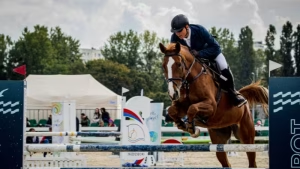
The show hunter horse is a British showing discipline with deep roots in traditional foxhunting. Today’s show hunter is no longer asked to gallop across country, but the type has been preserved in the show ring: a sound, well-conformed, well-mannered horse that moves with easy, ground-covering efficiency and looks like it could carry a field master across Leicestershire without turning a hair. This guide covers what show hunter judges look for, how UK and US show hunter disciplines differ, the classes and weight divisions available under Sport Horse Breeding of Great Britain (SHB(GB)) and British Show Horse Association (BSHA) rules, and how to prepare a horse to compete successfully.
Table of Contents
What Is a Show Hunter Horse?
A show hunter horse is judged on its ability to look and move like an ideal field hunter: a quality, correctly conformed horse that gives the impression of being a genuine pleasure to ride for a long day in the saddle. Unlike showjumping, which rewards raw scope, or dressage, which rewards collection, show hunter classes reward consistency, easy manners, and fluid, ground-covering movement. Classes are judged on conformation, movement, and ride, with the best-placed horse generally being the one that looks most capable of carrying an eight-stone adult down a three-mile hunt run and coming home sound and willing.
In the UK, show hunter classes are run under the rules of Sport Horse Breeding of Great Britain (SHB(GB)) and the British Show Horse Association (BSHA). Shows affiliated to either body carry national points and qualify horses for prestigious finals such as the Royal International Horse Show and Horse of the Year Show (HOYS).
A Brief History of the Show Hunter
The show hunter class emerged in the late 19th century as hunting families looked for a ring class that honoured the qualities of a good hunt horse: bone, substance, soundness, manners, and a long, easy stride. As foxhunting declined in size from the mid-20th century, the show ring became the place where the hunter “type” survived. Today’s winners still reflect that heritage — a modern show hunter should look like something you could happily ride all day across country, not a showjumper or a dressage horse dressed for the occasion.
The Irish Draught, Irish Sport Horse, and Thoroughbred dominate the breeding of top show hunters, with warmblood crosses increasingly common in the middleweight and heavyweight sections.
Show Hunter Judging Criteria
UK show hunter classes are generally judged in three phases: the go-round as a ride class, the individual show, and the conformation inspection. Some classes (flat classes) omit jumping altogether; working hunter classes include a rustic jumping phase first.
Movement
A show hunter should cover the ground with minimum effort. The walk should be relaxed, swinging, and four-beat. The trot should be straight, regular, and ground-covering — approximately a 12-foot stride at working trot is the ideal. The canter should be rhythmic and balanced, with a clear three-beat. The horse must be able to adjust stride length without losing rhythm or becoming short-necked. Exaggerated action, hollow movement, or daisy-cutting gaits are all marked down.
Jumping Style (Working Hunter)
In working hunter classes, fences are rustic and resemble those encountered hunting — post and rail, brush, gates, and logs rather than coloured poles. The horse should jump with a well-executed bascule, tight forearms, and a relaxed, even rhythm between fences. A horse that rushes, flattens over fences, or meets the take-off point in anything less than a balanced stride is penalised regardless of clean jumping.
Ride
In most UK show hunter classes the judge rides the horse. A good ride is one that goes forward willingly off the leg, stays on the bit without evasion, changes pace without fuss, and feels like a horse the judge would happily ride at home. Horses that pull, set against the hand, nap, or feel insecure in their balance go down the line no matter how correct their conformation.
Conformation and Manners
The conformation inspection rewards bone, correct limbs, a well-set neck, a good topline, and the overall impression of a horse built to carry weight and stay sound. Manners in the ring — standing quietly, moving off calmly, and accepting the judge’s handling — are worth real marks, as are general presentation and turnout.
Show Hunter Classes and Weight Divisions
UK show hunter classes are split primarily by weight-carrying capacity rather than horse size, reflecting their hunting origin. Weight divisions under SHB(GB)/BSHA:
- Lightweight Hunter: capable of carrying up to 12st 7lb (79.4 kg). Typically 16hh to 16.2hh. A quality, athletic frame with plenty of blood.
- Middleweight Hunter: capable of carrying 12st 7lb to 14st (79.4–88.9 kg). Typically 16.2hh to 16.3hh with more substance through the body and bone.
- Heavyweight Hunter: capable of carrying over 14st (88.9 kg+). Often 16.3hh to 17.2hh, with substantial bone (9 inches or more below the knee) and real presence, yet still required to move with quality.
Additional classes include:
- Small Hunter: horses 14.2hh to 15.2hh, judged on the same criteria as larger hunters but scaled for a smaller frame. Popular for adult amateur riders.
- Working Hunter: includes a jumping phase over rustic fences before flat judging. Height varies by section — novice to open.
- Ladies’ Hunter: ridden side-saddle by a female rider. Judged primarily on manners, way of going, and the elegance of the combination.
- Hunter Pony: for riders under 18. Separate sections for ponies not exceeding 122 cm, 133 cm, 143 cm, and 153 cm. Working Hunter Pony classes include a jumping phase.
- Hunter Breeding (In-Hand): young stock classes judged on conformation, movement in hand, and type. Foals, yearlings, two- and three-year-olds compete separately.
- Novice Hunter: for horses that have not won above a specified prize value. Allows young or inexperienced horses to compete without meeting open-level horses.
Show Hunter Horses: UK vs US Differences
The show hunter disciplines in the UK and US share a name and an ancestor, but they have diverged significantly.
- UK show hunter is primarily a flat and in-hand discipline, with a working hunter section that includes rustic jumping. The judge usually rides each horse. Weight divisions are central.
- US hunter (the “hunter” ring governed by USEF) is primarily a jumping discipline. Horses are judged over courses of 2’6″ to 3’6″ fences designed to mimic hunt country, with the judge scoring style, pace, and jumping form rather than speed or fault count. Weight divisions do not apply in the same way; classes are split by horse experience (Baby Green, Pre-Green, Green, Regular Working, etc.) and rider age or amateur status.
- Turnout also differs. UK show hunters are presented with plaited manes, pulled or plaited tails, and tweed jackets in muted country colours on the rider. US hunters are typically presented with button-braided manes, full clips, and riders in conservative dark coats.
- Type. UK winners tend to be Thoroughbred, Irish, or half-bred heavy-bodied horses. US winners tend to be warmbloods or warmblood-Thoroughbred crosses with a more modern, lighter frame.
Conformation and Type
A correct show hunter is built for weight, distance, and soundness rather than speed or spring. Key features:
- Well-set neck rising cleanly out of well-laid shoulders — not ewe-necked, not bull-necked.
- Deep girth and good heart room.
- Strong, short back with a well-muscled loin coupling.
- Sloping shoulder (around 45° to the ground) for a long, free stride.
- Good bone — 8 inches below the knee for lightweights, 9+ for heavyweights.
- Correct limbs with flat, hard joints and well-angled pasterns.
- Sound, well-shaped feet with adequate heel depth.
- Kind eye and intelligent expression — hunters should look genuinely willing.
A show hunter’s frame is carried slightly long rather than collected up. The horse’s nose should sit just in front of the vertical, with a relaxed topline rather than the round, compressed outline of a dressage horse.
Grooming and Turnout Standards
Mane, Tail and Coat
The mane is plaited — traditionally 9 to 13 plaits along the neck plus one at the forelock, sewn in with matching thread and set evenly along the crest. Tail is either plaited or pulled and banged (trimmed) below the hocks. Coat should be gleaming — a well-groomed show hunter carries the evidence of weeks of consistent strapping and feeding, not a last-minute bath.
Tack
Tack is plain and workmanlike. Flat leather nosebands, plain cavessons, and plain browbands without bling are the standard. Saddles are usually working or showing hunter cut in dark brown leather. Fancy stitching, coloured browbands, and heavy padded nosebands look out of place.
Rider Attire
A tweed jacket in a muted check, buff, canary, or beige breeches, a shirt with a stock or tie, plain black or brown long boots, a skull cap with a velvet silk or a traditional hunt cap (where still permitted by rules — PAS 015/VG1 hats are now mandatory in BSHA/SHB(GB) competition), string or leather gloves, and a plain hunting whip. Spurs should be blunt and plain. The overall impression should be of a horse and rider turned out to hunt, not to perform.
Tips for Success in the Show Hunter Ring
- Know the rules of the association. SHB(GB) and BSHA classes have slightly different conformation, weight, and turnout standards. Download the current rulebook before entering.
- School at home first. Show hunter judges ride your horse. If it does not hack out quietly, trot on from the leg, canter on both reins without fuss, and stand still to be mounted, it is not ready for a judge to ride it.
- Practise the individual show. A working trot on both reins, a bold canter on both reins, and a gallop on (for open hunters) are the backbone of the individual. Rehearse them away from the show ring.
- Stand the horse square. Traditional show hunter stance is with the legs slightly open — near fore and off hind fractionally forward of their opposites — so the judge can see all four legs independently.
- Get a second eye. Trainers, professional producers, and experienced show grooms see things from the ground that the rider does not. An hour with someone who has produced winners is worth ten hours of solo schooling.
- Present quietly. Hunters are meant to look understated. Over-polished hooves, excessive quarter markings, and loud clothing all work against you.
Frequently Asked Questions
What is a show hunter horse?
A show hunter is a type rather than a breed — a sound, correctly conformed, well-mannered horse judged on its ability to look and move like an ideal field hunter. UK show hunter classes judge conformation, movement, and manners under saddle, with working hunter classes adding a rustic jumping phase.
What breeds make the best show hunters?
Thoroughbreds, Irish Sport Horses, Irish Draughts, and Thoroughbred/Irish Draught crosses are the traditional top show hunters in the UK. Warmblood crosses are increasingly successful in the middleweight and heavyweight sections. Pure warmbloods and pure Thoroughbreds can both win, but the classic show hunter is a half-bred type with quality, bone, and a calm temperament.
What is the difference between lightweight, middleweight and heavyweight hunters?
Weight divisions describe the rider weight the horse is capable of carrying over a full day. Lightweights carry up to 12st 7lb, middleweights to 14st, and heavyweights over 14st. Middleweights and heavyweights carry progressively more bone, substance, and substance through the body, although quality of movement is required in all three sections.
What is a working hunter?
A working hunter is a show hunter class that includes a rustic jumping phase. The course features natural-looking obstacles — post and rail, brush, gates, and logs — at heights ranging from 2’3″ (novice) to 3’9″ (open). After jumping, horses that go clear are judged on conformation, movement, and ride in the same way as a flat show hunter class.
How do I turn out a show hunter horse?
Plait the mane in 9 to 13 matched plaits, plait or pull and bang the tail, and present the horse with a gleaming coat, polished hooves, and clean white markings. Tack should be plain brown leather with a flat noseband and plain browband. The rider wears a tweed jacket in a muted country check, buff or canary breeches, a stock or tie, and plain black or brown long boots.
Can any horse compete as a show hunter in the UK?
Most horses can enter unaffiliated or local level show hunter classes. Affiliated classes with SHB(GB) or BSHA require the horse to be registered, measured, and (in some cases) graded. There are sections for every size and level — from Hunter Breeding in-hand classes for young stock to open heavyweight hunters at Horse of the Year Show.
Is a show hunter the same as a hunter in the US?
No. The UK show hunter is primarily a flat and in-hand type class with a rustic jumping option; the US hunter is a jumping discipline judged on courses of 2’6″ to 3’6″ fences. Judging criteria, turnout traditions, and horse type all differ. The two disciplines share a hunting ancestor but have evolved into separate competitive sports.