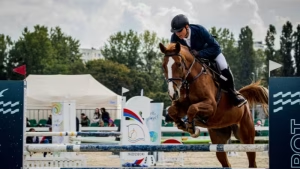
Caroline Bradley paid £1,000 for an iron grey weanling in 1977, and her own mother took one look at him and called him "a funny-looking thing, ugly, and no bigger than a 13.2hh pony". That weanling became Milton, and the story of John Whitaker and Milton is still the one British showjumping measures itself against. He was the first horse outside racing to win more than £1 million in prize money, and the first showjumper most non-horsey people in Britain could name.
This is the full account: his breeding, the two riders who had him before Whitaker, the technical fix that unlocked him, the championship record, the Olympic medal he never won, and the reason he was known for years as Everest Milton.
Who Was Milton the Horse?
Milton was a grey gelding foaled on 16 February 1977 and registered as Marius Silver Jubilee. He stood 16.2 hands at the withers and was bred by the Oxfordshire breeder John Harding-Rolls at a time when British sport horse breeding was still in its infancy. He died on 4 July 1999, aged 22.
His competition record is short to write down and hard to match:
- First showjumper to win more than £1 million in prize money
- Winner of around 30 major grands prix, including the 1986 du Maurier and the 1990 King George V Gold Cup
- Six championship medals: three gold, two silver and one bronze
- Back-to-back FEI World Cup Finals in 1990 and 1991
- Britain's highest-earning horse from 1986 to 1991
Milton's Breeding: Marius, Aston Answer and a Foxhunter Grand-Dam
Milton was a genuine mongrel by modern sport horse standards, and it worked. His sire Marius was a Dutch Warmblood stallion who had been a big winner for Caroline Bradley herself, including the Queen Elizabeth II Cup. That is precisely why she bought the foal: she knew what the sire could do. Marius was by Marco Polo, a Trakehner who became a foundation sire of the modern Dutch Warmblood sport horse.
His dam, Aston Answer, was an Irish Draught and Thoroughbred cross carrying Anglo-Arab blood through her sire, Any Questions. Both Milton's sire and his dam were grade A showjumpers. Aston Answer was only four when she produced him, went on to compete with Derek Ricketts, and was later sold to Belgium as a broodmare. His grand-dam, Pennywort, was the 1970 Foxhunter champion.
So the jumping blood came from both sides, which is worth remembering whenever someone argues that a top showjumper has to be purpose-bred from a fashionable warmblood line.
Caroline Bradley: The Rider Who Spotted Him First
Caroline Bradley was one of Britain's leading showjumpers and the person who saw what Milton would become. She produced him quietly through his novice years, and it was not a smooth apprenticeship. He failed to qualify for the Foxhunter final after spooking at cars parked around the ringside, and David Broome, who tried more than once to buy him, remembers the raw material honestly.
"He had a bit of a chequered career in those early days because he was so untidy in front," Broome told Horse & Hound. "My assistant even saw him have 16 faults at one show."
Bradley died suddenly of heart failure in the summer of 1983, aged just 37. She never saw Milton jump a championship. Her parents, Tom and Doreen Bradley, kept the horse and turned down every offer to buy him, and that decision shaped the next decade of the sport.
How John Whitaker Got the Ride on Milton
The detail most retellings skip is that John Whitaker was offered Milton twice, and the first time he could not take him.
After Caroline Bradley's death her parents approached Whitaker first. He was on his way to the Royal Highland Show and could not commit to anything for a fortnight, so the Bradleys sent the six-year-old Milton, with all of £63 in career winnings on his card, to Steve Hadley instead.
Hadley knew immediately what he had. "By September he was jumping small grands prix and it was clear he was destined for great things," he recalled. "It felt like he was on springs, he was beautifully balanced and he enjoyed it because he was good at it." At Park Farm's Lancia Championships, Hadley told his groom to look after that one, because he was the best they would ever see.
Then came the setback that changed everything. Milton's one phobia was being clipped. He lashed out, and whether he caught the blade or struck into himself, he injured a tendon badly enough to need more than a year off. He went back to the Bradleys to convalesce.
By the time he was sound again, Paul Schockemöhle was brokering Next's sponsorship of the Whitaker brothers and wanted Milton to go to John as part of the deal. Whitaker was asked at the 1985 World Cup Final and, in his own account, was distinctly underwhelmed: "I actually said, 'I'm not really that bothered,' but as a favour to Paul I said I'd try him."
One cross-pole changed his mind. "He was light as a feather off the ground and I'd never experienced anything like it. I rode up to the house, knocked on the window and said to Clare, 'Come and watch this horse jump!'"
John Whitaker and Milton: Building the Partnership
Whitaker started the eight-year-old at a few local shows in the autumn of 1985, then took him to Berlin, where they were third in the small grand prix. The escalation from there was almost comic: second in the World Cup leg at Brussels a week later, then a win in the World Cup leg at Bordeaux.
The Ground Line That Unlocked Him
Milton was not straightforward, and the fix was not the one usually reported. His quirk was in front: if a rider pushed him too deep or hurried him, he twisted over the fence and disliked the whole business. Whitaker spent months jumping clear rounds without quite understanding why some felt better than others.
The answer came from Peter Robeson in the collecting ring before a Nations Cup at Hickstead in 1986. Robeson told him the horse needed a big ground line at the practice fence to help him get up in front. "Once I figured out that was what he liked," Whitaker said, "we never looked back."
It is a small, deeply practical piece of horsemanship, and a useful reminder for anyone schooling a careful horse over verticals: the warm-up fence is a tool for telling the horse what shape to make, not just a loosener. If you are new to how these courses are put together, our guide to show jumping courses and obstacles covers the fence types Milton met week in, week out.
Milton's Major Wins: World Cups, Europeans and the King George
Once the partnership settled, Milton became the most reliable big-occasion horse in the world. The headline results:
- 1986: won the du Maurier Limited International at Spruce Meadows, then the richest showjumping class in the world
- 1987 European Championships, St Gallen: individual silver and team gold
- 1989 European Championships, Rotterdam: individual gold and team gold
- 1989 World Cup Final: runner-up, beaten by Ian Millar's Big Ben
- 1990 FEI World Cup Final, Dortmund: won
- 1990 King George V Gold Cup: won, after finishing third in 1987 and second in both 1988 and 1989
- 1990 World Equestrian Games, Stockholm: individual silver and team bronze
- 1991 FEI World Cup Final, Gothenburg: won, and made the front page of the Swedish papers
- 1993 World Cup Final: runner-up to Ludger Beerbaum and Ratina Z
The hat-trick of World Cup titles that should have followed in 1992 was lost to something utterly mundane: Milton was found to have pus in his foot.
Alongside the individual record he was the anchor of Britain's Nations Cup team, going seven consecutive double clears from the number four spot. Ronnie Massarella, Britain's chef d'équipe through that era, said simply that Milton gave him "my greatest years in the sport".
Stockholm 1990 and the Horse-Swap Final
The inaugural World Equestrian Games used the four-rider horse-swap format for the individual medals, and it produced one of the best Milton stories. Whitaker qualified alongside Eric Navet (Quito de Baussy), Hubert Bourdy (Morgat) and the American Greg Best on the other great grey of the era, Gem Twist.
"Gem Twist was a dream to ride, but he was the total opposite to Milton," Whitaker said, "so when Greg rode Milton, it didn't really work out and he had two fences down. But that woke Milton up, he wasn't for knocking anything else down after that, and for about the next two months!"
Best's own verdict on getting the ride has aged rather well: it was, he said, like finding out you had a date with the most beautiful girl in the world, and finding yourself tripping over your feet.
Why Milton Never Won an Olympic Medal
This is the gap in the record, and the reason is not the one usually given. It was not the length of the journey. When the Bradleys handed Whitaker the ride they attached three conditions, and all three were about honouring Caroline:
- Milton was not to jump the Hickstead Derby
- Milton was not to go to the Olympics, because of a dispute Caroline had previously had with the selectors
- Milton was not to compete at the Suffolk Show, where she had died
So in 1988, with Milton arguably at his peak, the pair could not travel to Seoul, and the row played out in the press. The Bradleys did not budge.
Barcelona 1992: Leading, Then Gone
Tom and Doreen Bradley relented in time for Barcelona, and a 15-year-old Milton joined Michael Whitaker, Tim Grubb and Nick Skelton on the British squad. It ended as one of the cruellest medal deciders in the sport's history.
"He was maybe slightly past his best, but still very capable," Whitaker said. "But I realised the really hard sand there was making his fetlocks sore when he jumped and he wasn't enjoying it."
Even so, they held the lead going into the final round. Then Milton stumbled badly on landing in a large combination, and Whitaker pulled him out rather than press on. "I was so disappointed because I had a fighting chance for a medal, but you can't dwell on it."
Everest Milton and Next Milton: Why He Had Two Other Names
Anyone searching old results or watching period footage will find Milton listed under names that look wrong. He is not a different horse. British showjumping in the 1980s and 1990s ran on commercial sponsorship, and the sponsor's name was prefixed to the horse's registered name in the programme and on the scoreboard.
Milton competed as Next Milton during the Next sponsorship of the Whitaker brothers, the deal Paul Schockemöhle helped broker and the one that brought Whitaker the ride in the first place. He later ran as Everest Milton under the Everest sponsorship, and it is as Everest Milton that he was formally retired at Olympia in 1994.
The practice has largely disappeared from the sport, which is why the names confuse people looking back. If you see Next Milton, Everest Milton or plain Milton in a results list from that period, it is the same grey gelding.
Milton's Character: Rugs, Raspberries and Pavarotti
Milton was a showman who genuinely fed off a crowd, and a complete menace at home. Both things were true, and his groom Penny Dalton is the best witness.
"He loved people, so if anyone didn't pay him enough attention he would blow raspberries or grab your sleeve," she said. "But he could be the devil to look after. He didn't like being rugged up. Every morning he'd be standing with his rug over his head, or shredded on the floor, waiting to be rescued."
He travelled badly, pawing the whole way, and was bored before the lorry had left Yorkshire. He kicked the stable door if the lorry went out without him. He received sack-loads of fan mail. People stole hair from his mane, to the point that brushes could not be left out at shows.
He spent 14 years as a member of the Whitaker family. John used to stagger-start his children down the field on their grey ponies and race them, which Milton loved. He was so attached to Robert's Shetland that the pony travelled under Milton's neck in the lorry, and during the warm-up for a crucial Nations Cup second round Milton spent the whole time whinnying at it.
The story that best captures his reach beyond the sport comes from Modena, at Pavarotti's show. The tenor asked to meet Milton, and by Dalton's account stood stroking him for ages, in tears.
The Levade: Milton's Party Piece
Milton's signature was rearing up off all four feet on the lap of honour, a movement close to the Lipizzaner airs above the ground. It was not schooled in from the outset.
"He did it by accident the first time," Whitaker said, "but I soon realised I could make him jump up off all fours to command. I would canter round on the lap of honour, stop in middle and up he'd go." The crowd got to its feet every time, and Milton knew exactly what he was doing.
Milton's Retirement, Death and Burial
Milton's last competitions came in 1993, when Whitaker noticed something niggling the 16-year-old. He could have given the horse six months off and carried on. He chose not to. "I wanted such a brilliant horse to retire sound and healthy."
There was no quiet exit. "Nearly every show in the world wanted me to do a retirement ceremony," Whitaker said. The most surreal was Zurich, where Tina Turner sang "Simply the Best" and, as the dry ice cleared, Milton and Whitaker were left standing in the ring beside her. His formal retirement came at Olympia in December 1994, as showjumping's first millionaire, with more than £1.25 million in career prize money.
He stayed busy afterwards, touring on a lecture demonstration circuit with Geoff Billington and appearing alongside Michael Whitaker and another great British grey, Desert Orchid. "Milton loved showing off," said Whitaker, "and it was good for him to have a purpose for another year or so."
He survived major colic surgery in 1998, after which the decision was taken to leave him in peace at home with his companion Hopscotch. The colic returned the following year and he could not fight it off. Milton died on 4 July 1999, aged 22, and is buried on the Whitaker farm in Yorkshire.
"I often give him a nod as I walk past," Whitaker said. "Many people have asked, 'Don't you miss him, don't you wish you still rode him?' And I say, 'Well at least I was lucky enough to have him.'"
Milton's Legacy in British Showjumping
Milton's importance is not only the prize money, though being the first showjumper past £1 million reset what the sport thought was possible. It is that he did it as a horse the public could recognise and care about.
Three things about him still repay attention from anyone producing a jumper today:
- Breeding is not a formula. An Irish Draught and Thoroughbred mare crossed with a Dutch Warmblood stallion, with Trakehner and Anglo-Arab further back, is nobody's textbook recipe for a World Cup winner.
- The rider adapts to the horse. Whitaker did not train the twist out of Milton. He changed the warm-up so the horse could jump the way he wanted to.
- Temperament is an asset, not a tax. The same horse who shredded his rugs and blew raspberries at his groom jumped higher the louder the crowd got.
He is the benchmark other British jumpers get measured against, and the reason a generation of riders can tell you exactly where they were when he did his lap of honour. For the wider picture of what makes a top jumper, see our guide to show jumper horses from first fence to grand prix.
Further reading: Horse & Hound's 140th anniversary feature on Milton, which carries the fullest set of first-hand accounts from Whitaker, Hadley, Broome and Milton's groom.
Frequently Asked Questions
How did Milton the horse die?
Milton died of colic on 4 July 1999 at the age of 22. He had survived major colic surgery in 1998, after which he was retired fully from public appearances, but the colic returned the following year and he could not fight it off. He is buried on John Whitaker's farm in Yorkshire.
Why did Milton never go to the 1988 Seoul Olympics?
Not because of the journey. When the Bradley family gave John Whitaker the ride they set three conditions in Caroline Bradley's memory: no Hickstead Derby, no Suffolk Show (where she died), and no Olympics, because of a dispute she had previously had with the selectors. They relented for Barcelona in 1992, where Milton led going into the final round before stumbling in the deep sand.
How high could Milton jump?
No official high-jump or puissance record is attributed to Milton. He was a grand prix and championship horse rather than a puissance specialist, jumping courses whose fences topped out at roughly 1.60m. The outright high-jump world record of 2.47m has been held by Huaso and Captain Alberto Larraguibel Morales since 1949.
Why is Milton sometimes called Everest Milton or Next Milton?
Those are sponsored competition names, not different horses. British showjumping of the era prefixed the sponsor's name to the horse's registered name, so Milton ran as Next Milton and later as Everest Milton. His registered name was Marius Silver Jubilee.
How much prize money did Milton win?
More than £1.25 million, which made him the first showjumper to pass £1 million and the first horse outside racing to do so. He was Britain's highest-earning horse from 1986 to 1991.
What breed was Milton?
Milton was not a single breed. He was by the Dutch Warmblood stallion Marius, out of Aston Answer, an Irish Draught and Thoroughbred mare carrying Anglo-Arab blood. There is Trakehner further back on his sire's side through Marco Polo.