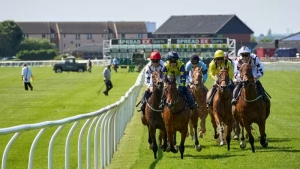
Point-to-point racing — pointing, to the people who do it — is the amateur amphitheatre of British and Irish jump racing. Run on rolling courses across farmland, organised by hunts and ridden by amateurs, it is where many of the biggest names in National Hunt racing got their first feel of a steeplechase fence. Best Mate, Tiger Roll, Sizing John and a long list of Cheltenham winners ran their first races between two flags in a country field. With over 2,400 monthly UK searches at the season’s spring peak, “what is point-to-point racing” is a question every new National Hunt fan eventually asks.
This guide explains how point-to-point works in 2026 — the courses, the classes of race, the Hunters’ Certificate that ties horses to a hunt, the season calendar, the social side, the betting, and the famous National Hunt graduates who started life in the pointing field.
Table of Contents
What Is Point-to-Point Racing?
Point-to-point racing is amateur steeplechase racing, run under the rules of the Point-to-Point Authority (PPA) in Great Britain and the Irish National Hunt Steeplechase Committee (INHSC) in Ireland. The races are held on temporary courses laid out across hunting country, almost always on a Saturday or Bank Holiday, between November and June.
Each meeting is staged by a recognised hunt (occasionally by an armed forces or club committee). The horses must be qualified with that hunt or another recognised pack, the jockeys must hold an amateur permit, and the whole thing is run on the assumption that thoroughbred blood, fox-hunting fitness and an unpaid jockey are an honourable combination.
From Steeple to Steeple: The Origins
Buttevant to Doneraile, 1752
The first recorded point-to-point race took place in 1752 between Edmund Blake and Cornelius O’Callaghan, who raced four-and-a-half miles cross-country in County Cork, navigating from the steeple of St Mary’s church in Buttevant to the steeple of St John’s in Doneraile. They picked their own line and jumped whatever lay between. The word steeplechase survives directly from this — a chase from steeple to steeple.
From Hunt Meet to Organised Sport
For more than a century the format remained informal: hunting men matching their horses across country between recognisable landmarks, in much the same way that community-run races such as Siena’s centuries-old Palio long predated any governing body. The first organised point-to-point in Britain is generally credited to the Atherstone Hunt in 1836, with rules and a set course rather than a free-for-all line. By the late 19th century pointing was established as a hunt-based sporting calendar, and by the early 20th century the modern pattern of fixtures, classes and qualifications had crystallised.
Tied to the Hunting Field
What separates point-to-point from professional National Hunt racing is the hunt qualification. To run, a horse must hold a Hunters’ Certificate signed by the master of a recognised pack, confirming the horse has been fairly hunted that season. The number of days required varies, but four to eight days out hunting in the autumn and winter is typical. This is why pointing’s calendar starts after the hunting season is well under way and why the sport is impossible to separate from the hunts that organise it.
The hunt that runs the meeting receives the gate money, and a busy fixture is often a major fundraiser for hunt costs. Even after the 2004 Hunting Act changed how foxhounds operate in England and Wales, the qualification still revolves around hounds and country — trail hunting now provides the basis for the Hunters’ Certificate.
The Courses and the Fences
Three to Four Miles of Open Country
Point-to-point courses are temporary tracks set out on farmland. Most fixtures use roughly oval circuits of about a mile-and-a-half to two miles round, with horses completing two or three circuits depending on the race. Total distances are 3 miles for a Maiden up to 3¾ miles for an Open — a long way further than the seven or eight furlongs of a typical Flat sprint. The going can range from glue-pot heavy in February to firm and dusty by May — a far wider range than most professional courses see, which is why ground conditions reshape a pointing card more than almost anything else.
The Fences
Each circuit carries 9 to 11 fences (so a typical race jumps 18–22). The fences are built from birch on a frame, faced with a takeoff board and dressed with foliage. They are slightly more forgiving than top-grade National Hunt steeplechase fences but still demand a horse that jumps cleanly and judges its takeoff at speed. Drop fences, open ditches and water are rare in pointing — the format is a true test of hunting jump rather than a built-in trap.
Race Classes and How a Card Works
A typical British meeting cards five or six races. The standard PPA classes are:
| Race | Who runs in it |
|---|---|
| Members’ / Hunt Members’ | Horses qualified with the hosting hunt; an opening race for hunt regulars |
| Maiden | Horses that have not won a race anywhere |
| Restricted | Horses that have not won a Conditions, Open or hunter chase |
| Conditions / Intermediate | For horses with limited prior winning experience; weights vary |
| Men’s Open | The premier race for male riders; carries the bigger purse |
| Ladies’ Open | The premier race for female riders |
| Mixed Open | Some fixtures combine Men’s and Ladies’ Opens |
Ireland’s race programme is similar in structure but operates under the INHSC, with maidens, winners-of-one and winners-of-two-or-three categories. Irish points are heavily oriented toward producing horses for sale into British training yards, so the Maiden and Winners-of-One races attract serious money and watching trainers.
The Horses and the Jockeys
The Horses
All point-to-pointers are thoroughbreds, and most are either ex-Flat or ex-National Hunt horses, young store horses being prepared for “rules” racing, or seasoned hunters whose careers have settled on pointing. The great majority are geldings — staying chasers rarely race on as entires — and they tend to be bigger, scopier and slower-maturing than Flat horses, with the kind of jumping pedigree that produces a Hennessy or a Cheltenham Festival horse such as Denman.
The Jockeys
Riders are amateur, holding a Category A or Category B amateur permit issued by the BHA. Many are aspiring professionals using points as a stepping-stone to a National Hunt career; others are dedicated hunting people who ride a few horses each season for their own pleasure. Riders must pass medical and fitness tests, and most younger jockeys come up through the strong “pony club” and racing schools route. Several PPA Champion Riders’ titles have launched professional careers — recent examples include Sam Twiston-Davies, Bryony Frost and Rachael Blackmore.
The Season and Where to Watch
The British point-to-point season runs from late November to early June, building from a quiet start to a busy late spring with multiple fixtures every Saturday. The Irish season runs slightly longer, from October through into June, with peak activity from January to May.
Some of the best-known UK courses include:
- Larkhill (Salisbury Plain) — the Royal Artillery’s home fixture and one of the longest-running courses
- Kingston Blount (Oxfordshire) — a popular spring meeting drawing horses from south of England yards
- Garthorpe (Leicestershire) — a major Cottesmore Hunt fixture
- Cocklebarrow (Gloucestershire) — Heythrop Hunt; a fixture beloved by punters
- Mollington (Oxfordshire) — Bicester with Whaddon Chase fixture
- Andoversford (Cotswolds) — North Cotswold Hunt; staged within striking distance of Cheltenham
Irish landmarks include Tattersalls Farm in County Meath (heavily used by sales-bred maiden runners), Loughanmore, and Kirkistown. Fixture lists are published each season on Weatherbys’ pointtopoint.co.uk for Britain and on the INHSC site for Ireland.
Finding a point-to-point near you is straightforward: the Weatherbys fixtures page lists every British meeting by date and area, and most spring weekends offer a choice within an hour’s drive across the shires, the West Country and the North. Entry is cheap — usually a flat car-park charge of around £10–£20 per vehicle rather than per head — and you are welcome to walk the course, picnic from the boot and stand at the rails just a few feet from the action. It is the most accessible and family-friendly day out in British racing, and the best possible introduction to jump racing before stepping up to a professional fixture.
Point-to-Point vs National Hunt
| Feature | Point-to-Point | National Hunt |
|---|---|---|
| Riders | Amateur (PPA / INHSC permits) | Professional (BHA / IHRB licensed) |
| Course | Temporary, on farmland | Permanent licensed racecourse |
| Fences | Birch, slightly more forgiving | Birch, full National Hunt spec |
| Distances | 3 to 3¾ miles | 2 to 4½ miles |
| Prize money | £100–£1,000 typical | £3,000 minimum, much higher at festivals |
| Atmosphere | Rural, family, picnic-led | Stadium racing, betting ring |
| Regulator | PPA (under BHA) / INHSC (under IHRB) | BHA / IHRB |
The cross-over between the two is constant. Many of the best pointing horses progress to hunter chases — National Hunt races run under rules but reserved for horses with a Hunters’ Certificate. The pinnacle is the Cheltenham Foxhunter Chase, run on the Friday of the Cheltenham Festival over the same Gold Cup course raced by chasing greats like Arkle and Thistlecrack. Win the Foxhunter and you have just beaten the best amateur-ridden horses in Britain and Ireland on the most demanding stage in the sport. You can follow our wider horse racing coverage for more on the Festival and its history.
Famous Graduates of Pointing
- Best Mate — won his maiden point-to-point at Lismore in February 2000 before going on to win three consecutive Cheltenham Gold Cups (2002–2004)
- Tiger Roll — won an Irish point-to-point as a four-year-old before his back-to-back Grand National victories in 2018 and 2019
- Sizing John — Irish maiden pointing graduate who took the 2017 Cheltenham Gold Cup
- Imperial Commander — point-to-point start before a 2010 Cheltenham Gold Cup
- Native River — an early run in points before his 2018 Cheltenham Gold Cup
- The Storyteller, Don Cossack, Champagne Fever — all major Festival winners with pointing pedigrees
The romance runs deeper than the modern sales ring. Generations of jumping heroes carried the rural, hunting-bred stamp that pointing produces, none more famously than Aldaniti, whose 1981 Grand National win with Bob Champion remains National Hunt racing’s most enduring comeback story. The “Irish point-to-point bumper” — typically a four-year-old maiden run between two flags — is now one of the most-watched feeders for British training yards, with horses regularly selling for six figures off a single point-to-point win.
Betting at a Point-to-Point
Yes, you can bet at a point-to-point. On-course bookmakers set up alongside the parade ring at most fixtures and operate cash-only, with tax-free winnings (because the levy that funds professional racing isn’t applied here). Tote-style pools are sometimes available too. Off-course betting on points is more limited than on rules racing, although Sky Sports Racing and Racing TV stream selected fixtures and the Tote runs win/place pools on the bigger meetings.
A few practical tips:
- Form is patchy. Many runners only race a handful of times a season — knowing the trainer, the rider and the horse’s hunt qualifications often beats studying the form book
- Going matters more than at a permanent course; firm or heavy ground reshapes everything
- Late-season Irish bumpers and points are where the trade — bloodstock agents, BHA-licensed trainers — turn up to bid. If a horse is being aimed at the sales ring, that intent often shows in the betting
Owning, Training and Buying
One of pointing’s enduring appeals is that ownership is genuinely accessible. Many horses are owned by farmers, hunt followers and small syndicates, and trained by their owners on home gallops rather than at licensed yards. A horse that costs £8,000–£15,000 to buy can return enough prize money and hunting enjoyment to justify itself — and, with a good Maiden win, can be sold on for considerably more.
The big Irish point-to-point sales — Goffs Punchestown, Tattersalls Cheltenham and Tattersalls Ireland Derby Sale — regularly see point-to-point graduates sell for hundreds of thousands of euros to British training yards. A win in a four-year-old maiden in February can multiply a horse’s value by ten by April.
Frequently Asked Questions
What is point-to-point racing in simple terms?
Point-to-point racing is amateur steeplechase racing run on temporary courses across farmland by recognised hunts. Horses must hold a Hunters’ Certificate, jockeys must hold an amateur permit, and races are typically 3 to 3¾ miles over birch fences. It is the grassroots version of National Hunt racing and a major feeder of horses to professional Cheltenham-class jump racing.
What’s the difference between point-to-point and National Hunt racing?
National Hunt racing is professional, run on permanent licensed racecourses under the BHA or IHRB, with paid jockeys and significant prize money. Point-to-point is amateur, run on temporary courses by hunts under the PPA or INHSC, with unpaid jockeys and smaller purses. Point-to-pointers can progress to “hunter chases” run under National Hunt rules, including the Cheltenham Foxhunter Chase.
When is the UK point-to-point season?
The British point-to-point season runs from late November to early June. Fixtures peak between February and May, with most meetings held on Saturdays and Bank Holidays. Ireland’s season runs from October to June and peaks slightly earlier than the British calendar. Fixture lists are published on Weatherbys’ pointtopoint.co.uk and the INHSC website.
Do horses need to be registered to race in point-to-point?
Yes. All point-to-pointers must be thoroughbreds registered with Weatherbys (UK) or Horse Racing Ireland (Ireland), and must hold a Hunters’ Certificate confirming they have been fairly hunted that season with a recognised pack. They must also have a current PPA passport and meet the entry conditions of each specific race.
Which famous horses started in point-to-point?
Best Mate (three Cheltenham Gold Cups), Tiger Roll (two Grand Nationals), Sizing John (2017 Gold Cup), Imperial Commander (2010 Gold Cup) and Native River (2018 Gold Cup) all began their careers in point-to-points. The Irish four-year-old maiden point is now one of the most-watched feeders for top British and Irish National Hunt yards.
Can I bet at a point-to-point?
Yes. On-course bookmakers operate at most fixtures, taking cash-only bets with tax-free winnings. Tote pools are sometimes available, and the bigger meetings are now streamed on Sky Sports Racing or Racing TV with off-course markets attached. Form study is harder than for rules racing — knowing the rider, the trainer and the going usually matters more than the form book.
Who can ride in a point-to-point race?
Only amateur riders holding a current PPA permit (UK) or INHSC permit (Ireland). Riders must pass medical, weight and fitness tests, hold appropriate insurance and have ridden in qualifying flat work or hunter trials. Permits divide riders into Category A (more experienced) and Category B (less experienced), restricting which races they can enter.