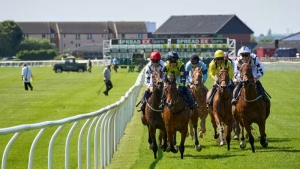
Red Rum is the most famous racehorse in Grand National history and arguably the most beloved horse in British sport. With three Grand National victories and two second-place finishes across five consecutive years (1973–1977), his record at Aintree has never been matched. From his unpromising beginnings as a flat-racing sprinter dogged by a crippling foot condition to his transformation on the Southport sands, Red Rum’s story is one of resilience, brilliance, and an extraordinary bond between horse and trainer.
Table of Contents
Early Life and Breeding
Red Rum was foaled on 3 May 1965 at Rossenarra Stud in County Kilkenny, Ireland, bred by Martyn McEnery. His sire was Quorum, a sprinter-miler, and his dam was Mared. The name is a small piece of cleverness in itself: it is formed from the last three letters of each parent’s name — Mared and Quorum — giving Red Rum.
His breeding was that of a flat sprinter, not a future steeplechaser, and there was little in his pedigree to suggest the staying power and jumping ability that would later define him. As a Thoroughbred gelding, he would never go to stud, which makes the affection he earned in his own right all the more remarkable.
Early Racing Career
Red Rum began life on the flat. In a quirk that history would savour, his very first race was a five-furlong two-year-old contest at Aintree in 1967 — on the flat course beside the famous National fences — where he dead-heated for first. He was a competent but unexceptional sprinter, passing through several yards over the following years.
Far more seriously, Red Rum developed pedal osteitis, an inflammatory bone disease of the foot that is usually career-ending. By the time he came up for sale in 1972, this chronic lameness problem hung over him, and few would have predicted what came next.
Ginger McCain and the Southport Sands
In August 1972, the Southport trainer Donald “Ginger” McCain bought Red Rum for 6,000 guineas at the Doncaster sales on behalf of the elderly owner Noel Le Mare, a self-made millionaire whose lifelong dream was to win the Grand National. McCain trained from modest premises behind his second-hand car showroom on the Lancashire coast — and his secret weapon was the beach.
McCain worked Red Rum on the sands and in the salt water of Southport. The seawater is widely credited with soothing and managing the horse’s troublesome feet, and the firm beach gallops built extraordinary fitness. Whatever the precise mechanism, the previously lame sprinter blossomed into a tough, sound staying chaser. On his very first run for McCain he won, and the partnership was on its way to Aintree immortality.
The Grand National Victories
1973 — the greatest finish of all. In his first Grand National, ridden by Brian Fletcher, Red Rum produced what is still regarded as the most dramatic finish in the race’s history. The Australian-bred Crisp, carrying 23lb more, led by a vast margin for most of the four-and-a-quarter miles. Crisp began to tire on the long run-in, and Red Rum reeled him in stride by stride to win by three-quarters of a length in a record time of 9 minutes 1.9 seconds — a record that stood for over 17 years.
1974 — top weight, and a unique double. The following year Red Rum won again under Brian Fletcher, this time carrying top weight of 12 stone — a punishing burden that underlines his class. Just three weeks later he won the Scottish Grand National at Ayr as well, becoming the only horse ever to complete the Aintree–Scottish National double in the same season.
1975 and 1976 — gallant in defeat. Red Rum finished second in both intervening years, beaten by L’Escargot in 1975 and Rag Trade in 1976, each time conceding weight on testing ground. Far from diminishing him, these placings cemented his reputation for sheer consistency over the toughest course in the world.
1977 — the historic third. At the age of 12, ridden by Tommy Stack, Red Rum won the Grand National for a third time, pulling clear to win by 25 lengths as the Aintree crowd roared him home. Commentator Peter O’Sullevan’s words — “It’s hats off and a tremendous reception, you’ve never heard one like it at Liverpool” — captured a moment of pure national emotion. No other horse has won the Grand National three times.
Red Rum: Career Record
| Foaled | 3 May 1965, County Kilkenny, Ireland |
| Died | 18 October 1995 (aged 30) |
| Sire / Dam | Quorum / Mared |
| Owner | Noel Le Mare |
| Trainer | Donald “Ginger” McCain |
| Grand National wins | 1973, 1974, 1977 (2nd in 1975 & 1976) |
| Other major win | Scottish Grand National 1974 |
| Career starts | 100+ over flat and jumps |
| Buried | The winning post, Aintree Racecourse |
The Grand National Course
To appreciate Red Rum’s achievement, you have to understand what he conquered. The Grand National is run over roughly four and a quarter miles with 30 fences across two circuits — the most demanding test in National Hunt racing. Its obstacles are legendary: Becher’s Brook, with its notorious drop on the landing side; the Chair, the tallest and broadest fence on the course; the sharp turn at the Canal Turn; and the water jump in front of the stands.
Completing the National even once marks a horse as exceptional. Red Rum jumped round five times in a row without a single fall — a record of soundness and surefootedness over those fences that may never be equalled.
Life After Racing
Red Rum was being prepared for a sixth Grand National in 1978 when he suffered a hairline fracture in training the day before the race. McCain announced his retirement, and the horse who had defied a career-ending foot condition bowed out sound and celebrated rather than broken down on the track.
Retirement only increased his fame. Red Rum became a genuine national celebrity — he led the Grand National parade for years, opened supermarkets and betting shops, switched on the Blackpool Illuminations, and made television appearances, including at the BBC Sports Personality of the Year. Few animals have been so widely recognised or so warmly loved by the British public.
Legacy and Cultural Impact
Red Rum’s influence ran far beyond his three wins. He arrived at a moment when the Grand National’s future was in genuine doubt, with Aintree under financial threat and talk of the race ending. His charisma and success reignited public affection for the National and are widely credited with helping to save it. In a real sense, Red Rum is the horse who rescued the world’s greatest steeplechase.
His trainer Ginger McCain returned to win the National again in 2004 with Amberleigh House, a fairytale postscript to the partnership that made him famous. Red Rum’s name remains shorthand for courage and staying power, invoked whenever a new contender threatens to match the unmatchable.
Visiting Red Rum’s Grave
Red Rum died on 18 October 1995, aged 30, and was buried at the winning post at Aintree Racecourse — the spot where he produced his greatest moments. The grave is marked with a headstone and remains a place of pilgrimage for racing fans, particularly around Grand National weekend each spring.
A life-size bronze statue of Red Rum stands at Aintree, and a second statue is sited in his home town of Southport, where his beach gallops turned a lame sprinter into a legend. Together they ensure that the horse who belonged to the nation is never forgotten.
Frequently Asked Questions
What happened to Red Rum the horse?
Red Rum retired sound in 1978 after a minor training injury ended his bid for a sixth Grand National. He lived a long, celebrated retirement as a national celebrity and died on 18 October 1995 aged 30. He is buried at the winning post at Aintree.
Was Red Rum the best racehorse ever?
Red Rum is the greatest Grand National horse of all time, the only horse to win the race three times. Whether he was the best racehorse overall is debated — pure-class chasers such as Arkle are often rated higher on raw ability — but no horse has matched Red Rum’s record and soundness over the National fences.
Did Red Rum sire any foals?
No. Red Rum was a gelding, so he could not be used at stud and never sired any foals. His legacy lives on through his record and his place in racing history rather than through descendants.
Why was Red Rum so famous?
He won the Grand National a record three times (1973, 1974, 1977), finished second twice more, and completed the course five years running without a fall. His charisma helped save the National at a time when the race was under threat, and he became a beloved public figure in retirement.
Who owned and trained Red Rum?
Red Rum was owned by Noel Le Mare and trained by Donald “Ginger” McCain in Southport, Lancashire. McCain famously trained him on the local beach and in the sea, which helped manage the chronic foot condition that had threatened to end his career.