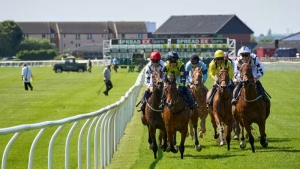
Golden Miller is the only horse in history to win the Cheltenham Gold Cup five years in a row (1932–1936) and the Grand National in the same season as a Gold Cup victory (1934). Foaled in Ireland in 1927 and bought as a young horse by the indomitable Dorothy Paget, “The Miller” rewrote what was thought possible in National Hunt racing and remains, ninety years on, the benchmark by which every staying chaser is judged. His statue stands at Cheltenham racecourse — the only place that could fairly hold it.
Table of Contents
Golden Miller: Quick Facts
- Foaled: 1927, in Ireland
- Sex/colour: Bay gelding
- Sire: Goldcourt
- Dam: Miller’s Pride
- Owner: Hon. Dorothy Paget (from 1931)
- Trainers: Basil Briscoe, later Owen Anthony
- Career: 55 starts, 28 wins
- Cheltenham Gold Cups: 5 (1932, 1933, 1934, 1935, 1936)
- Grand National: 1 (1934)
- Died: 1957, aged 30
- Memorial: Bronze statue, Cheltenham racecourse paddock
Breeding and Early Life
Golden Miller was bred by Laurence Geraghty at Pelletstown in County Meath, Ireland — the same county that has produced more Cheltenham Festival winners than any other before or since. His sire, Goldcourt, was a moderate stayer of no particular distinction; his dam, Miller’s Pride, was a sound but unremarkable broodmare. By the bloodstock metrics of the day there was nothing in the pedigree to suggest a superstar, which is part of what made his eventual greatness so confounding to the form book.
As a youngster he was reportedly slow to mature and physically unimpressive — narrow, lean, and not the powerful chasing type then in fashion. He passed through several hands cheaply: bought by dealer Captain Farmer for £100, sold on to trainer Basil Briscoe for £500, and broken at Briscoe’s Exning yard in Newmarket. Briscoe later admitted he had bought the horse on instinct rather than conformation — “he had a kind eye and a good walk” was the sum of his initial assessment.
Dorothy Paget and Basil Briscoe
The story of Golden Miller is inseparable from the story of his owner. Dorothy Paget — heir to a substantial Whitney fortune, eccentric to the point of legend, and one of the most prolific owners in racing history — bought the horse from Briscoe in 1931 for a reported £6,000, an enormous sum at the time. She was 25 years old. The Miller and his stablemate Insurance, also bought in the same deal, would go on to win her seven Cheltenham Festival races between them within eighteen months.
Paget was famously nocturnal, unwilling to bet during racing hours, fond of strong tea and stronger opinions. She rarely attended races but expected to win every one she did. Her relationship with Briscoe deteriorated over years of difficult communication and increasingly impossible demands; Owen Anthony took over the training of Golden Miller from 1934 onwards, eventually overseeing the horse’s last two Gold Cups.
For all her difficulty as an owner, Paget bought brilliant horses and let competent men train them. Golden Miller is the most enduring monument to that judgement.
The Five Cheltenham Gold Cups (1932–1936)
The Cheltenham Gold Cup, run over three miles two and a half furlongs and twenty-two fences, is the championship test of the staying chaser. Until Golden Miller, no horse had won it more than twice. He won it five years in succession.
1932 — First Gold Cup, age 5
Ridden by Ted Leader. Won by four lengths from Inverse, having looked the most natural jumper in the field. The win established him as a Festival horse but did not yet announce a champion — the Gold Cup was a smaller affair in 1932, a long way from today’s prize and prestige.
1933 — Second Gold Cup
Ridden by Billy Stott. Won by 10 lengths from Thomond II in a performance widely regarded as among the easiest in the race’s history. By the second Gold Cup the racing public had begun to take The Miller seriously.
1934 — Third Gold Cup, then the National
Stott again. Won the Gold Cup on the Tuesday by six lengths from Avenger. Three weeks later, Golden Miller went to Aintree. The rest is in the next section.
1935 — Fourth Gold Cup
Stott again, in his last full season as the horse’s regular partner. A duel with Thomond II, who had improved enormously, produced one of the great Cheltenham races. The Miller won by three quarters of a length in a finish so close that the judge took longer than usual to call it.
1936 — Fifth Gold Cup, age 9
Ridden by Evan Williams. Won by twelve lengths in heavy ground. No horse has come closer than four to that record — Best Mate matched three from 2002 to 2004; Al Boum Photo and Galopin Des Champs have both stalled at two.
For an audience that grew up watching modern champions, the scale of the achievement is hard to overstate. The Cheltenham Festival of the 1930s was a smaller event than today’s four-day spectacle, but the Gold Cup was already the championship race, and the competition included the best chasers of an era that produced multiple top-class horses. Five consecutive wins in any major championship across any equine generation is a feat the modern game has not approached.
The 1934 Grand National — A Record That Still Stands
On 23 March 1934, three weeks after his third Gold Cup, Golden Miller lined up at Aintree for his first Grand National. He carried 12 st 2 lb — the second-highest weight in the field — over four miles three and a half furlongs and thirty fences including Becher’s Brook, the Canal Turn, and the Chair. Stott rode him.
The race itself became part of the legend. The Miller jumped immaculately throughout, took up the running approaching the second-last fence, and pulled clear to win by five lengths from Delaneige in a course-record time of 9 minutes 20.4 seconds — a record that stood for 39 years. He remains the only horse ever to win the Cheltenham Gold Cup and the Grand National in the same season.
The 1934 Aintree win is the moment Golden Miller passed from racing celebrity to national figure. The following morning’s newspapers carried him on the front page; Pathé newsreel footage of the race played in cinemas across Britain for weeks. He was, briefly, the most famous animal in the country.
Subsequent Aintree attempts
The Miller ran in three further Grand Nationals (1935, 1936, 1937) but never finished one. He fell or unseated each time — leading some commentators of the day to suggest that the increasingly heavy weights asked of him at Aintree, combined with the relentless schedule of a five-time Gold Cup horse, finally caught up with him at the bigger fences. The truth is probably simpler: the Grand National is a race in which the very best can fall, and luck plays as large a part as form.
The Riders and Handlers
- Ted Leader rode him to his first Gold Cup in 1932.
- Billy Stott partnered him through 1933, 1934, and 1935 — the regular pilot through the peak years and the rider on board for the historic 1934 National.
- Evan Williams took the ride for the fifth Gold Cup in 1936 after Stott’s retirement and stayed with the horse for most of his late career.
- Gerry Wilson rode him in some of his less-celebrated appearances, including disastrous Aintree returns.
On the training side, Basil Briscoe handled him from purchase to early 1934. Owen Anthony took over thereafter and trained the last two Gold Cup wins — a credit not always given properly in the popular accounts, which tend to fold the whole story into Briscoe.
Temperament and Physique
Stable lads who looked after Golden Miller in his prime described a horse of immense quality but unremarkable size — about 16 hands, lean, with a deep girth, sloping shoulder, and the classic chaser’s powerful hindquarters. He was a kind horse to handle, though notoriously difficult to fitten — taking enormous quantities of work to reach race fitness and then keeping it for months.
What set him apart, by every contemporary account, was his jumping. He measured fences perfectly, took off at the right point almost without exception, and lost the minimum of ground in the air. In an era when fallen runners were common at Cheltenham, his Festival completion record speaks for itself.
His coat colour was a clear bay — dark body with the standard bay points on legs, mane, and tail. His statue at Cheltenham captures the type accurately if a little flatteringly.
Decline, Retirement and Final Years
Golden Miller’s racing career wound down through the late 1930s. After his fifth Gold Cup in 1936 he was beaten in the 1937 renewal by Royal Mail and never recovered the championship form. He continued to run sporadically in lesser company until 1939, by which point the Second World War was ending top-level National Hunt racing for the duration.
He retired to Dorothy Paget’s stud at Elsenham in Essex, where he lived out his days in quiet companionship with several broodmares (he was a gelding, so not breeding — simply turned out as a celebrated retiree). Paget, who outlived him by three years, visited regularly and ensured he wanted for nothing.
Golden Miller died in 1957, aged 30 — an exceptional lifespan for any horse, never mind one who had run 55 races over fences. He is buried at Elsenham, with a simple headstone bearing his name and the dates 1927–1957.
Legacy and Place in Racing History
The Miller’s records have survived ninety years of attempts to break them:
- 5 consecutive Cheltenham Gold Cups — never matched. Best Mate’s three (2002–2004) is the modern best.
- Gold Cup and Grand National in the same season — never matched.
- The Cheltenham statue, sculpted by Doris Lindner and unveiled in 1989, stands at the entrance to the parade ring. New runners walk past it on their way to the championship races.
- The Golden Miller Chase, a Grade 2 race over two miles at Cheltenham’s December meeting, carries his name.
His influence runs deeper than the trophy cabinet. Golden Miller was the first National Hunt horse to become a household name in Britain. He gave Cheltenham the prestige it has carried ever since. He persuaded a generation of owners and trainers that the Gold Cup was a race worth chasing — and in doing so created the championship culture that produced Arkle, Mill House, Desert Orchid, Best Mate, Kauto Star, and the modern Festival.
Golden Miller vs the Modern Greats
The pointless but irresistible question: how would The Miller have fared against the great chasers since? The honest answer is that direct comparison across eras is impossible — horses, fences, training methods, and ground conditions have all changed. But there are useful reference points.
| Horse | Years active | Gold Cups | Other major |
|---|---|---|---|
| Golden Miller | 1931–1939 | 5 (1932–36) | Grand National 1934 |
| Arkle | 1962–1966 | 3 (1964–66) | Hennessy x2, Irish Grand National |
| Desert Orchid | 1983–1991 | 1 (1989) | King George VI Chase x4 |
| Best Mate | 1999–2005 | 3 (2002–04) | Peterborough Chase |
| Kauto Star | 2004–2012 | 2 (2007, 2009) | King George VI Chase x5 |
Most racing historians who have wrestled with the question put Arkle and Golden Miller at the top of the list, with the order swapping depending on which generation the historian belongs to. Both achieved at the highest level under top weight; both had moments of dominance the sport has not seen since. The Miller has the longer Gold Cup record; Arkle has the higher official ratings (212 against modern equivalents around 175 for The Miller). Pick whichever argument suits your prejudices.
Final Thoughts
Ninety years after his first Gold Cup, Golden Miller remains the standard. Five consecutive championships is a feat that increasingly looks beyond the modern game — the depth of competition, the demands of preparation, and the punishing Cheltenham schedule together make even three Gold Cup wins a once-in-a-generation achievement. The Miller’s record is the kind that gets quietly sealed by history.
For more on the great names of jump racing, see our profiles of Red Rum, Desert Orchid, and Kauto Star.
Frequently Asked Questions
How many Cheltenham Gold Cups did Golden Miller win?
Five — in 1932, 1933, 1934, 1935 and 1936. No other horse has won more than three. Best Mate is the closest to the record in the modern era with three consecutive wins from 2002 to 2004.
Did Golden Miller win the Grand National?
Yes — in 1934, just three weeks after his third Gold Cup. He set a course record of 9 minutes 20.4 seconds that stood for 39 years. He remains the only horse ever to win both the Gold Cup and Grand National in the same season.
Who owned Golden Miller?
Hon. Dorothy Paget — heir to a Whitney fortune and one of the most colourful owners in racing history. She bought him from trainer Basil Briscoe in 1931 for a reported £6,000.
Where is Golden Miller buried?
He died in 1957 at Dorothy Paget’s Elsenham Stud in Essex, aged 30, and is buried there. His bronze statue stands at the entrance to the Cheltenham racecourse parade ring.
Was Golden Miller better than Arkle?
Most racing historians rank them as the two greatest staying chasers in history. Golden Miller has the longer Gold Cup record (five to Arkle’s three); Arkle has the higher official ratings. The order depends largely on which era the historian comes from — both belong at the very top.