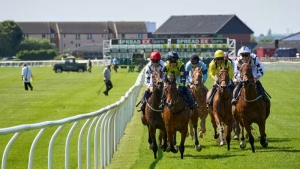
Horse racing betting can seem bewildering when you first walk into a bookmakers or open a betting app. The jargon alone — each-way, ante-post, SP, tricast, accumulator — is enough to put off most beginners. But the basics are genuinely straightforward once someone explains them without assuming you already know. This guide covers every type of horse racing bet used in the UK, how odds work, how to read a racecard, and the practical steps to placing your first bet — whether at the track or online.
Table of Contents
How Horse Racing Odds Work
Odds represent the bookmaker’s assessment of how likely a horse is to win. In the UK, odds are traditionally displayed as fractions (e.g., 5/1, 7/2, 11/4), though decimal odds (e.g., 6.00, 4.50) are increasingly common on betting websites. For a deeper dive into pricing and value, see our dedicated guide to understanding horse racing odds.
Fractional Odds
Fractional odds tell you how much profit you make relative to your stake. The number on the left is the potential profit; the number on the right is the stake required.
- 5/1 (five to one): For every £1 you stake, you win £5 profit. A £10 bet returns £60 (£50 profit + £10 stake).
- 2/1 (two to one): A £10 bet returns £30 (£20 profit + £10 stake).
- Evens (1/1): Your profit equals your stake. A £10 bet returns £20.
- 1/2 (one to two, “odds on”): You risk more than you stand to win. A £10 bet returns £15 (£5 profit + £10 stake). Odds-on horses are the ones the bookmaker thinks are most likely to win.
The shorter the odds (e.g., 1/3, 4/9), the more likely the bookmaker considers the horse to win — but the less you win relative to your stake. The longer the odds (e.g., 20/1, 33/1), the bigger the potential payout but the less likely the win.
SP (Starting Price)
The Starting Price is the official odds at the moment the race begins. If you take SP rather than a fixed price, your bet is settled at whatever the odds are when the stalls open. This can work for or against you — if the horse drifts in the market (gets longer odds), you get a better price; if it shortens, you get less.
Taking a fixed price early (with a bookmaker) locks in the odds at the time you place your bet, regardless of market movement. Most experienced punters take the price when they see value and let it go if they do not.
Types of Horse Racing Bets
Win
The simplest bet. You pick a horse and it must finish first. If it wins, you are paid out at the odds; if it finishes second or lower, you lose your stake.
Place
You bet on a horse to finish in the places — usually first, second, or third, depending on the number of runners. Place terms vary:
- 2–4 runners: Win only (no place betting)
- 5–7 runners: 1st and 2nd
- 8–15 runners: 1st, 2nd, and 3rd
- 16+ runners (handicaps): 1st, 2nd, 3rd, and 4th
Place odds are typically a fraction of the win odds — commonly 1/4 or 1/5 of the win price, depending on the race type and number of runners.
Each-Way Betting Explained
An each-way bet is two bets in one: a win bet and a place bet on the same horse. It costs double your unit stake — so a £5 each-way bet costs £10 (£5 to win, £5 to place).
If the horse wins, both parts pay out — you collect the win odds on your win stake and the place odds on your place stake. If the horse finishes in the places but does not win, you lose the win part but collect on the place part. If it finishes outside the places, you lose both stakes.
Example: You back a horse at 10/1 each-way for £5 (total stake £10). Place terms are 1/4 odds for the first three places.
- If the horse wins: Win part pays £50 profit (10/1 × £5). Place part pays £12.50 profit (10/4 × £5 = 2.5/1 × £5). Total return: £72.50 (£62.50 profit + £10 stake).
- If the horse finishes 2nd or 3rd: Win part loses (−£5). Place part pays £12.50 profit. Total return: £17.50 (£7.50 profit overall).
- If the horse finishes 4th or worse: Both parts lose. You lose £10.
Each-way betting is particularly popular in big-field handicaps and festival races where any of a dozen horses could place. It gives you a safety net without needing the horse to win outright.
Exotic and Multiple Bets
Forecast (Exacta)
Pick two horses to finish first and second in the correct order. A reverse forecast covers both possible orders (costs double). Computer straight forecasts (CSF) are calculated by the Tote pool and often produce bigger payouts than fixed-odds forecasts.
Tricast
Pick three horses to finish first, second, and third in the correct order. Available in handicap races with 8 or more runners. The payouts can be enormous — a Tricast in a competitive 20-runner handicap at Cheltenham can pay hundreds or even thousands of pounds for a £1 stake.
Accumulator (Acca)
An accumulator combines selections from multiple races into a single bet. All selections must win for the bet to pay out, but the winnings from each race roll over into the next, creating potentially large returns from a small stake.
- Double: Two selections
- Treble: Three selections
- Four-fold and above: Four or more selections
Example: A £5 treble on three horses at 3/1, 2/1, and 4/1 returns £300 if all three win. Miss one and you lose your £5. Accumulators are high-risk, high-reward bets — exciting but statistically difficult to land consistently.
Lucky 15, Lucky 31, Lucky 63
These are popular multiples that cover every possible combination of your selections:
- Lucky 15: 4 selections → 15 bets (4 singles, 6 doubles, 4 trebles, 1 four-fold)
- Lucky 31: 5 selections → 31 bets
- Lucky 63: 6 selections → 63 bets
Because they include singles, you get a return even if only one horse wins. Many bookmakers offer consolation bonuses (e.g., double the odds if only one of your Lucky 15 selections wins) and all-winners bonuses, making these bets popular for festival days at Cheltenham, Aintree, and Royal Ascot.
How to Read a Racecard
A racecard is your guide to every runner in a race. Understanding it is essential for making informed betting decisions. Here is what the key columns mean:
- Draw (flat racing only): The stall number the horse starts from. On some courses, a low or high draw gives an advantage depending on the track configuration and ground conditions.
- Form: A string of numbers showing the horse’s recent finishing positions. “1” means a win, “2” means second, “0” means finished outside the first nine, “/” separates seasons, and “F” means fell, “U” means unseated rider, “P” means pulled up.
- “WS” (wind surgery): Shown against a horse having its first run since a wind operation. It is a mandatory BHA declaration and one of the most requested pieces of form data — see our guide to wind surgery in horses for what the procedures actually do.
- Weight: The weight the horse carries, in stones and pounds. In handicaps, better horses carry more weight to level the field.
- Jockey and trainer: The names of the rider and the trainer. Both matter — some jockeys ride particular courses superbly, and trainer form (the percentage of winners in recent weeks) is a useful indicator.
- Age: The horse’s age. Flat racing features horses from 2 years old upwards; National Hunt racing (jump racing) generally starts at 4 years old.
- Going: The condition of the ground — from “firm” (hard, fast surface) through “good” and “good to soft” to “soft” and “heavy” (waterlogged). Some horses handle soft ground well; others need fast conditions. This is one of the most important factors in picking a winner.
- Distance: Race distance in miles and furlongs (one furlong = 220 yards / 201 metres). Races range from 5 furlongs (sprints) to 4 miles and beyond (the Grand National is about 4 miles 2½ furlongs).
How to Place a Bet
At the Racecourse
There are two main options at a UK racecourse:
- On-course bookmakers (the betting ring): Walk along the line of bookmakers, compare their odds on the boards, and place your bet with whichever offers the best price. State the amount, the horse’s name, and the type of bet (e.g., “£10 each-way on number 5”). You receive a paper ticket — keep it safe, as this is your proof of bet.
- The Tote (Totepool): A pool betting system where all stakes are combined and dividends are calculated after the race. Tote windows and machines are located around the course. The Tote offers its own bet types including the Tote Placepot (pick a placed horse in each of the first six races) and the Tote Jackpot.
Online and in Betting Shops
Online betting accounts are free to open with any licensed UK bookmaker (Bet365, William Hill, Paddy Power, Betfair, etc.). You can take fixed-price odds or SP, set up accumulators with a few taps, and cash out early if your bet is in profit. Betting shops work similarly — fill in a slip with the horse’s name or number, the race, and your stake.
Betting in South Africa
South African racing uses the same core bet types as the UK — win, place, each-way, and exotics such as the Pick 6 and the Jackpot — but the operators and terminology differ. The totalisator (Tote) is the traditional pool system, while fixed-odds betting is offered by licensed bookmakers regulated by the National Horseracing Authority and the provincial gambling boards. Local punters typically read form from Computaform, the South African equivalent of the Racing Post. Wherever you bet, the principles are identical: understand the odds, study the form, and never stake more than you can afford to lose.
Understanding the Tote
The Tote operates a pool betting system, which works differently from fixed-odds bookmakers. All stakes on a particular bet type are pooled together, and the dividend (payout) is determined by dividing the pool among the winners after a deduction for running costs.
Tote dividends are declared after each race and are often competitive with or better than SP, particularly when longshots win and the pool has not been heavily backed on that horse. The Tote also offers unique bets:
- Tote Exacta: Pick the first two in the correct order
- Tote Trifecta: Pick the first three in the correct order
- Tote Placepot: Pick a placed horse in each of the first six races — one of the most popular pool bets in British racing
- Tote Quadpot: Pick a placed horse in races 3, 4, 5, and 6
- Tote Jackpot: Pick the winner of each of the first six races
Ante-Post Betting
Ante-post bets are placed well in advance of a race — sometimes weeks or months before the event. The Cheltenham Gold Cup, the Grand National, and the Epsom Derby all have active ante-post markets months in advance.
The advantage of ante-post betting is better odds — because the bookmaker is taking a longer-term risk, the prices are often significantly more generous than they will be on race day. The risk is that if your horse does not run (injury, change of plan), you lose your stake. There is no “non-runner, stake refunded” protection with ante-post bets unless the bookmaker specifically states otherwise.
Tips for Beginners
- Set a budget and stick to it. Decide before you start how much you are prepared to lose. Treat it as entertainment money, not an investment.
- Start with simple bets. Win and each-way bets on individual races are the best way to learn. Save the Lucky 15s and accumulators until you understand the basics.
- Study the form. Even a quick glance at recent finishing positions, the going preference, and trainer form gives you an edge over picking a horse by name or colours.
- Check the going. Ground conditions affect different horses dramatically. A horse that won on heavy ground at Haydock may struggle on firm ground at Newmarket. Always check the official going report on the day.
- Watch trainer and jockey statistics. Some trainers have excellent strike rates at particular courses. Some jockeys ride certain tracks far better than others. Free form resources like the Racing Post and At The Races provide these statistics.
- Shop around for odds. Different bookmakers offer different prices on the same horse. Using an odds comparison site (e.g., Oddschecker) ensures you get the best available price.
- Consider each-way in big fields. In handicaps with 16 or more runners, an each-way bet on a horse at 10/1 or longer gives you excellent value — even a place return covers your outlay.
Responsible Gambling
Horse racing betting should be enjoyable, never stressful. If you find yourself chasing losses, betting more than you can afford, or feeling anxious about your betting, support is available:
- GamCare: Free support and counselling — 0808 8020 133 or gamcare.org.uk
- BeGambleAware: Information and support — begambleaware.org
- Self-exclusion: All UK-licensed bookmakers offer self-exclusion tools to help you take a break from betting
Gambling is only fun when you can afford to lose. Set limits, stick to them, and never bet to recover losses.
Frequently Asked Questions
What is the easiest horse racing bet for a beginner?
A simple win bet or each-way bet on a single race. Pick one horse, decide your stake, and either take the current price or leave it at SP. Each-way is particularly beginner-friendly because you still win something if the horse places second or third, which takes the pressure off needing it to win outright.
What does each-way mean in horse racing?
Each-way is two bets in one: a win bet and a place bet on the same horse, at double your unit stake. If the horse wins, both parts pay. If it finishes in the places (typically top 2, 3, or 4 depending on the number of runners), you lose the win part but collect on the place part at a fraction of the win odds — usually 1/4 or 1/5.
What is the difference between SP and fixed odds?
SP (Starting Price) is the official odds at the moment the race begins. Fixed odds are the price you lock in at the time you place your bet. If you take 8/1 on Monday for a Saturday race and the horse drifts to 12/1 by race time, you still get paid at 8/1. Conversely, if it shortens to 4/1, you are protected at your higher fixed price. Taking SP means you accept whatever the market produces at the off.
How much should I bet on a horse race?
Only ever what you can afford to lose — and no more. A good approach for beginners is to set a budget for the day (e.g., £20) and divide it across your bets. This might mean five £2 each-way bets (costing £4 each) or four £5 win bets. There is no correct amount — the key is that losing it all would not cause you financial difficulty.
Can you make money betting on horse racing?
A small number of professional punters do make a living from horse racing, but they are rare, highly disciplined, and treat it as a full-time job involving statistical analysis and value-based staking. For the overwhelming majority of people, horse racing betting is entertainment with the possibility of an occasional win — not a reliable income source. Bookmakers are profitable businesses for a reason.