Twice every summer the medieval city of Siena stops behaving like an ordinary Tuscan town. The Palio di Siena is a bareback horse race run three times round the packed earth of Piazza del Campo, and for the ten city wards who contest it, it is not a spectacle staged for visitors. It is the axis the whole year turns on. Most guides to the Siena horse race stop at the pageantry. This one is written for horse people, so it also covers the things that actually decide the outcome: how the horses are bred, vetted and drawn, what the track geometry does to them at the two corners, and what the welfare record really says once you go past the headlines.
The short version: ten horses, no saddles, three laps, about seventy-five seconds, and a rulebook of 105 articles that almost nobody outside Siena has read. Below is what it contains.
Table of Contents
What Is the Palio di Siena?
The Palio is a race between ten of Siena's seventeen contrade, the city wards, each represented by a horse drawn by lot and a hired jockey who rides bareback. It is run round the outer ring of Piazza del Campo, the shell-shaped square at the centre of the city, which is covered with a layer of earth for the occasion. The whole thing is over in well under two minutes.
What makes it unlike any other horse race is that the horse, not the partnership, is the competitor. Article 70 of the official Regolamento del Palio, the text approved by Siena City Council in deliberation 99 of 17 June 2019 and in force since 1 December 2019, awards victory to the contrada whose horse, after a valid start and three laps, reaches the finishing flag first anche scavezzato, meaning even riderless, and it says so explicitly even if the jockey fell during the race. A loose horse crossing the line first wins outright. The Sienese call it a cavallo scosso.
What the Word Palio Means
Palio comes from the Latin pallium, a cloth. The prize is a hand-painted silk banner, the drappellone, known around the city as il cencio, the rag. Article 93 of the regulation is explicit that this is the prize the city assigns to the winning contrada, and that the banner then becomes the ward's property, though the silver plate topping it must go back to the Comune within the year. It is not a trophy in the sporting sense. It is the object a contrada builds a museum around, and the only thing anybody is actually racing for.
Why the Race Itself Lasts Barely Seventy-Five Seconds
The Sienese Palio archive, which has kept times since the Second World War, puts a fast Palio at 1 minute 15 to 1 minute 16 and a slow one at over 1 minute 20. The track record it publishes stands at 1 minute 14, set on 16 August 1987 by the horse Benito under the jockey Cianchino, winning for Pantera. So the racing is quick even by the standards of a sprint.
Almost none of the drama sits in that minute and a quarter. It sits in the four days before it: the vet inspections, the draw that hands each ward its horse, six trial runs, the deals struck between captains, and the street dinners the night before. If you arrive on race day you will see the last ninety seconds of a story you have missed.
Palio di Siena Dates: 2026 Results and 2027
The two ordinary races are fixed by the regulation to 2 July and 16 August every year. The July race is the Palio di Provenzano, for the Madonna di Provenzano, a Marian devotion peculiar to Siena. The August race is the Palio dell'Assunta, run the day after the Feast of the Assumption. Outside those two dates the city may run an extraordinary Palio for something genuinely exceptional, and it does so rarely. The most recent was on 20 October 2018, for the centenary of the end of the First World War. Before that there was one on 9 September 2000 for the millennium, and one in 1969 for the Apollo 11 landing.
Who Won the Palio di Siena in 2026
Both 2026 races ran a day or two late, which is worth knowing if you are planning a trip around the published dates. According to the Comune di Siena's own page for the July race, the Palio di Provenzano was run on 3 July 2026 and won by Aquila, the Eagle, its first victory in thirty-four years. The August page records that the Palio dell'Assunta was run on 18 August 2026 and won by Nicchio, the Seashell, ending a gap since 1998. Renato Bircolotti was the mossiere, the starter, for both.
That pair of results moved the title of nonna, grandmother, which belongs to whichever contrada has gone longest without a win. Aquila handed it to Nicchio in July; Nicchio handed it on again in August. It now sits with Chiocciola, the Snail, which has not won since 16 August 1999.
Palio di Siena 2027 Dates
Barring a postponement of the kind 2026 produced, the 2027 races fall on Friday 2 July 2027 and Monday 16 August 2027. Two points for anyone booking:
- The dates are fixed, but the start time is not announced far ahead, and the race can be pushed back a day or more for weather or track condition. Treat the published date as the first possible day, not the only one.
- The four-day festival matters more than the date itself. For a July Palio the build-up runs from roughly 29 June; for August, from about 13 August.
- The Comune publishes each year's timetable, officials and results on its recent Palii archive, which is the only source worth trusting on dates and times.
It is also worth noting what a gap in that archive means: the Comune records that no Palio was run in 2020 or 2021 because of the Covid-19 pandemic. The race had not previously been cancelled since the Second World War.
The Four Days Before the Race
Under Article 34 of the regulation, the presentation, selection and drawing of the horses all happen on the morning of the third day before the Palio. From that afternoon the city runs six trial races, the prove, morning and evening, up to the morning of race day itself. Article 52 makes attendance compulsory: contrade must work their horses collectively in the Campo at the hours the city sets, and only in exceptional circumstances may a ward be allowed to school its horse alone.
The night before the race, each contrada holds an open-air dinner along its own streets, with the jockey seated at the top table. On race day there is a Mass for the jockeys, then the blessing of the horse inside the contrada's church, then the Corteo Storico, a two-hour costumed procession, before the field goes to the ropes.
The Horses of the Palio: Breeding, Vetting and the Tratta
This is the part almost every guide to the Palio di Siena skips, and it is the part a horse person actually wants. The horses are not owned by the contrade, not chosen by them, and not bought on the open market on the morning of the race. There is a register, a veterinary commission, a training protocol and a lottery, and all of it is set out in Chapter 4 of the regulation.
No Purebreds: The Palio Runs Half-Breds
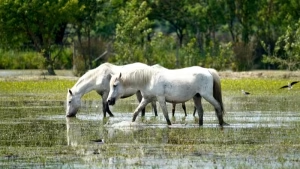
The Palio horse is a mezzosangue, a half-bred, and the type is bred for the job rather than registered to a studbook. In practice that has long meant Anglo-Arab blood, and the Sardinian Anglo-Arab in particular, crossed with whatever produces the right frame. In British terms the Palio runner sits close to what we would call a grade horse: sound, athletic, of mixed and often undocumented breeding, and judged entirely on what it can do.
There is a reason a purebred racehorse is the wrong animal here. A Thoroughbred is bred to gallop in a straight line on a wide, graded surface. The Campo asks for a 95-degree turn on a cambered, downhill, hard-packed corner at racing pace, with nine other horses alongside and no saddle. What wins is balance, a low centre of gravity and the sort of agility a Maremmano or a half-bred Anglo-Arabian carries more naturally than a flat-racing type. Arabian blood contributes the hardness of foot and the cardiovascular capacity; the other half contributes the scope.
How a Horse Gets Into the Palio
Article 37 of the regulation sets out the pipeline, and it is stricter than most spectators assume:
- Pre-registration. Owners enter one or more horses under an ordinance issued by the city for each individual Palio.
- First cut. The city, with its vets and with the ten captains in a consultative role only, excludes horses from going forward, and must give reasons for each exclusion.
- Veterinary inspection. A Commissione Veterinaria appointed by the city council, made up of the municipal vet and a second vet, examines the remaining horses. The inspection follows the city's annual Protocollo per l'addestramento dei cavalli da Palio.
- Regulated trials. Horses passed as fit must run in the prove regolamentate. A horse not presented at these cannot go to the draw at all, although the commission may send an obviously sound horse straight through.
- The admitted list. At the end of the trials the veterinary commission gives the city and the ten captains the list of horses admitted, with its reasoning on each.
- The tratta. Ten horses of roughly equal ability are selected, and only then does a lottery decide which ward gets which.
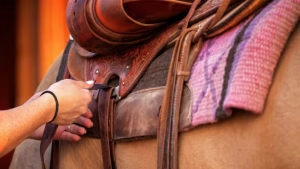
Two details in that article are easy to miss and tell you a lot. An owner whose horse is passed fit is obliged to present it at the draw; absence without a vet-verified reason costs the horse its place at the next Palio, and repeated absence across three Palii earns a three-year exclusion. And the horses are presented in bit and bridle only, with no saddle and no stirrups. There is no point in the process at which a Palio horse goes under saddle.
Why the Lottery Exists
The draw is the whole integrity mechanism. If wards could buy their runner, the wealthiest contrade would win permanently and the race would have died centuries ago. Because the horse arrives by lot three days out, a contrada's entire strategy is compressed into what it does after the draw: which jockey it engages, which alliances it makes, and how it looks after the animal it has been handed.
That last part is taken seriously enough to be a job. Each drawn horse is put in the care of a barberesco, the contrada's own groom, who houses it in the ward's stable and guards it around the clock until the race. The role is the Sienese equivalent of a stable lad with a security brief attached, because interference with a rival's horse is a live enough risk that the watch is continuous.
Barbero, Soprallasso and the Two Horses in the Procession
Siena has its own vocabulary for its horses, and Article 73 fixes it. The barbero is the race horse drawn by the contrada. The soprallasso is the parade horse. Each competing ward must send both to the Corteo Storico: the jockey rides the soprallasso, led by a groom, while the barbero walks alongside in hand, led by the barberesco. Wards that are not running send a procession party without either horse.
It is a sensible piece of horsemanship dressed as ceremony. The animal that has to race in an hour is not asked to carry a rider through two hours of drums, flags and a hundred thousand people first. Article 76 even allows the city, on the advice of the Deputati della Festa, to take a horse straight to the Corte del Podestà if it is too unsettled to be led through the crowd.
How the Siena Horse Race Works
Which Ten Contrade Run
Seventeen wards exist; ten race. The seven that did not run in the same month the previous year are in by right. The other three are drawn by lot, publicly, from the windows of the town hall, to a fanfare of trumpets. The cap of ten dates from the eighteenth-century reforms that also fixed the contrada boundaries, and it was imposed after a run of accidents in larger fields. It is the oldest surviving safety rule in the race.
La Mossa: The Longest Start in Racing
There is no starting stall and no gate. The start, la mossa, uses two ropes, the canapi. Nine horses enter the space between them in an order drawn by lot and announced only moments beforehand. The tenth, the rincorsa, stays outside. The race begins the instant the rincorsa crosses in, at which point the mossiere releases the front rope.
Because the rincorsa chooses its moment, and because the wards have usually agreed in advance what that moment should be worth, the start can take a very long time. Horses stand, circle, are recalled and line up again, sometimes for the better part of an hour. If you have only ever seen the ninety seconds on television, the mossa is the part you have missed, and from a horsemanship point of view it is the hardest thing the animals are asked to do all day: hold a state of readiness, in a walled crowd, for an unknown length of time.
Riding Bareback, and What the Jockeys May Do
The jockeys, fantini, are hired professionals, engaged by a contrada for a single race rather than attached to it. They ride bareback with a bridle and bit, which on a cambered downhill turn at racing speed is a genuinely exceptional piece of riding, and Chapter 5 of the regulation devotes twenty articles to what they may and may not do.
Very little is forbidden once the ropes drop. A jockey may pull or shove a rival, and may use the whip on horses other than his own. The Palio whip is not a conventional riding crop but a nerbo, a length of stretched and dried ox hide. This is the single most contested feature of the race for anyone coming to it from a modern racing background, where whip use is capped, measured and stewarded. In the Campo it is a tactical instrument, and that difference is at the centre of the welfare argument set out further down this page.
Winning, and the Contrada That Really Loses
The finish is called by three Giudici della Vincita from the judges' stand, and their verdict is final and cannot be appealed. A drum roll and a mortar shot mark the arrival. Under Article 88 the drappellone is handed straight to the winning captain, and the ward's flag goes up at a first-floor window of the town hall, where it stays for the rest of that day and all of the next.
The loser is not the horse that finishes last. It is the one that finishes second, and the feeling is much worse if the ward that beat it is its historic rival. This is why a Palio is never simply a race to win: for several of the ten, stopping a particular rival is a perfectly acceptable afternoon's work.
The Track: Why Horses Fall at San Martino
Piazza del Campo is not a racecourse. It is a paved public square with a pronounced slope, and the track is built on top of it for a few days a year. The Sienese Palio archive publishes the survey, and it explains the falls better than any amount of footage.
The Surface
- The stone perimeter, normally pietra serena paving, is covered with a mix of tufo and sand.
- Depth varies round the circuit but averages roughly 15 cm.
- It is compacted with steam rollers and watered periodically so it stays elastic rather than drying out.
- Even so, the archive describes it as a hard surface by the standards of a normal racecourse.
- The circuit measures 339 metres in a straight-line survey, and the archive gives the three-lap distance as a theoretical 1,070 metres.
The Two Corners
The square is divided into four sections, and two of them decide the race:
- San Martino is a 95-degree corner. Its first part falls away slightly and is banked across its width, with about 90 cm of difference in level between the inside and outside edges. Its second part drops at roughly 8 per cent, with at least a metre of cross-fall.
- Casato is a 92-degree corner approached on a climb that reaches about 10.5 per cent over the last 15 metres, then continues slightly uphill before levelling out.
The archive's reconstruction of falls over twenty years of Palii puts 57 per cent of accidents at San Martino and 37 per cent at Casato. The pattern within that is the telling bit. At Casato, 70 per cent of incidents happen on the first lap, which points squarely at crowding: ten horses still bunched, going up a gradient into a tight left. At San Martino, falls are spread across the first lap (45 per cent) and the second (55 per cent), so crowding alone does not explain it. The camber and the descent do. A horse meeting that corner with its outside shoulder a metre above its inside one, on hard-packed tufo, at close to full speed, is being asked something a racecourse would never ask.
That geometry is why the padding at San Martino was the first thing Siena rebuilt when it started reforming the race, and why the injuries that do occur there tend to be the severe kind. A fall taken at speed into a banked corner is the mechanism behind rotational fall injuries, the same pattern British riders know from cross-country, where the horse's momentum carries it over its own shoulder rather than allowing it to slide.
The Seventeen Contrade of Siena
A contrada is not a supporters' club. It is a functioning institution with its own territory, government, church, museum, patron saint, colours and annual calendar, and people are born into it and stay in it. The boundaries and the number were fixed in the eighteenth century by Violante Beatrice of Bavaria, then governor of the city, in a proclamation the Sienese Palio archive dates to 7 January 1730, which merged the surviving wards down to seventeen.
The seventeen are Aquila (Eagle), Bruco (Caterpillar), Chiocciola (Snail), Civetta (Little Owl), Drago (Dragon), Giraffa (Giraffe), Istrice (Porcupine), Leocorno (Unicorn), Lupa (She-Wolf), Nicchio (Seashell), Oca (Goose), Onda (Wave), Pantera (Panther), Selva (Forest), Tartuca (Tortoise), Torre (Tower) and Valdimontone (Ram).
Records, the Nonna and the Cappotto
Oca, the Goose, leads the all-time table with 67 wins on its own records, which begin in 1644, ahead of Chiocciola on 51 and Tartuca on 48 and a half. The half is not a typo: a shared or disputed result is carried as such.
Two Sienese terms are worth knowing if you follow the results:
- Nonna, grandmother, is the ward that has gone longest without a win. After the two 2026 races it is Chiocciola, unbeaten since August 1999. It is a title nobody wants and everybody tracks.
- Fare cappotto is winning both races in the same year. Since 1900 only three wards have managed it with the same jockey, most recently Lupa in 2016 with Jonatan Bartoletti on Preziosa Penelope.
The Drappellone
A different artist paints the banner for every race, and it is unveiled to the city about a week beforehand. The brief is rigid on content and free on style: it must carry the sacred imagery of the Madonna the race honours, the arms of the city, the shields of Siena's three historic Terzi and the colours of the ten competing wards. Beyond that the artist does as they please, which is why no two look remotely alike. The 2026 banners were painted by Ismaele Nones for July and Teodora Axente for August.
Horse Welfare at the Palio: The Record and the Reforms
No honest guide to the Palio di Siena can skip this, and most of them do. British equestrian readers will mostly have met the race through welfare coverage: Horse & Hound has reported on it repeatedly, including calls for a ban after a horse died in a 2015 trial and a renewed campaign in 2018. What follows is what the numbers and the rulebook actually show, from both directions.
What the Figures Say
The two sides count differently, and it is worth seeing both counts rather than one:
- The Lega Anti Vivisezione, in its Palio dossier, counts 48 horse deaths between 1970 and 2007, which averages out at roughly one a year.
- Supporters of the race, counting the same period but expressing it per start and including every trial as well as the races themselves, give a fatal accident rate of 2.05 per cent per ride.
- Both numbers can be true at once. They are different denominators, not different facts, and quoting only one is how this argument usually gets misrepresented.
The best-evidenced figure of all concerns the riders rather than the horses, and it comes from a peer-reviewed study rather than a campaign document. Fortina and colleagues, writing in Injury in 2019 (50 Suppl 4: S56-S59, PMID 30910241; doi:10.1016/j.injury.2019.03.015), reviewed injuries to 224 jockeys over 72 years of the Palio. They found that at least one jockey fell in 96.1 per cent of races, that in 28.6 per cent of races half the field or more came off, and that 43.4 per cent of falls sent the rider to the emergency department. Comparing the Palio with traditional races elsewhere, they recorded an injury incidence of 109.9 per 100 falls against 27 to 59 in comparable events, and concluded that Palio jockeys face a greater risk of falling than in any other race in the world.
That is a hard statistic to argue with in either direction. It is a fair description of how demanding the track is, and it is also, from a welfare standpoint, a fair description of how often things go wrong at 40-odd miles an hour on a corner with a metre of cross-fall.
What Siena Has Changed Since 1999
The city sets out its own programme on its Tutela del cavallo page, and the reforms are more substantial than critics usually allow. According to the Comune, the decisive year was 1999:
- May 1999: blood chemistry testing introduced with outside partners, to enforce the regulation's long-standing ban on stimulants, depressants and local anaesthetics.
- June 1999: the protection at the San Martino corner redesigned, with a high-absorption barrier replacing the old parapet. These are the materassoni you can see as padded walls in any modern footage.
- Later in 1999: the Protocollo per l'erogazione di incentivi per il mantenimento dei cavalli da Palio approved, and the Albo dei cavalli established on a trial basis, a register of horses continuously and specifically trained to run in the Campo. The Comune calls it the most significant single intervention it has made, and it is renewed annually.
- 2004: a register of breeders producing horses for the Palio added.
- 2012: breath testing of jockeys for alcohol made law.
- Annual protocol: the training protocol is reissued every year, with a current Protocollo Equino published for 2025 and again for 2026, so the rules the vets work to are not fixed in 1999 and are worth checking for the year you are interested in.
The register is the part worth understanding, because it changes what kind of animal turns up. Its stated aims are accreditation of owners against set requirements, selection of horses matching the biometric parameters judged optimal for the job, training in graded races and schooling runs to prepare horses for the Campo specifically, financial incentives steering owners towards breeding that type, and continuous monitoring by the vets on the city's technical commission. Siena also built a purpose-made training track at Mociano with the shape and slope of Piazza del Campo, plus alternative tracks at Monticiano and Monteroni d'Arbia, where horses work from March to June.
Where That Leaves the Argument
Welfare organisations continue to seek abolition, and their case does not depend on Siena having done nothing. It is that a hard-packed, steeply cambered public square with unrestricted whip use is an inherently unsuitable place to race horses, and that reform cannot fix the geometry. In 2011 those concerns were enough for Italy's own tourism minister to block the Palio's nomination to the UNESCO list of Intangible Cultural Heritage.
The reform arc will look familiar to anyone who has followed British racing. Aintree has spent three decades reshaping the Grand National, filling in the landing at Becher's Brook, softening fence cores and cutting the field, without ever satisfying the people who want the race gone. Siena is running the same argument with an eight-hundred-year-old square instead of a racecourse, and rather less room to manoeuvre.
Our own view, stated plainly as ours: the horse selection and veterinary regime is genuinely more rigorous than most visitors assume and better than the race's reputation suggests, and the track geometry at San Martino remains the unresolved problem that no protocol has yet answered.
How to Watch the Palio di Siena
Standing in the Campo
The centre of the square is free, and it is where the atmosphere is. It is also a commitment. The police seal the entrances once the crowd is in, and after that nobody goes in or out until the race has finished, which in practice can mean several hours standing in a dense crowd with no shade and no way to leave. If you are taking children, note that they are no longer permitted to stand in the middle of the piazza and must watch from a stand or a window.
Practical advice for the centre, from people who have done it:
- Get in well before the gates close, not at the advertised start time. The mossa can run long, so the wait inside is longer than the schedule implies.
- Take water and sun cover. July and August in Tuscany at seven in the evening is still hot.
- Stand towards the inside rail near the Palazzo Pubblico if you want to see the finish and the flag going up afterwards. Stand towards San Martino if you want to see where the race is decided.
- Accept that you will see very little of the actual racing from ground level in the middle. Most people in the centre experience the Palio as sound.
Grandstands, Balconies and Tickets
Paid seating exists in two forms: the wooden grandstands built round the edge of the piazza, and the balcony and window places in the private buildings overlooking the square. Both are sold privately rather than by the city, both sell out a long way ahead, and prices vary enormously by position, so treat any figure you see quoted on a third-party site with caution and confirm it with the seller before booking. The Comune's own Palio site is the place to check dates, times and official information before you commit to anything.
One thing worth setting expectations on: tourists do not take part. The jockeys are engaged professionals and the horses come off a municipal register. There is no participatory element for visitors beyond watching, which is the opposite of the Scottish Common Ridings, where hundreds of ordinary riders turn out behind the principal and an experienced visiting rider can sometimes join a ride.
Go for the Whole Festival, Not the Race
If you are travelling for the Palio di Siena as a horse person rather than a sightseer, the four days beforehand are worth more than race day. The tratta, when the ten horses are drawn and the square erupts or deflates ward by ward, is the most revealing hour of the week. The prove let you watch the same ten horses six times over three days, which is the only way to form your own opinion of them. And the street dinners on the eve of the race are where the thing stops looking like an event and starts looking like a town.
It is also a useful corrective to the idea that the Palio is racing in the ordinary sense. It is not run by a racing authority, the prize is a painted cloth, and there is no form book a bookmaker would recognise. The closest British equivalent in spirit is not Ascot but the grassroots end of the sport, where point-to-point racing is organised by hunts and run on local custom rather than by a governing body. Siena has simply been doing its version for four hundred years longer.
The Palio di Siena is not really comparable to anything else in the horse world. It is a religious festival, a civic election, a medieval pageant and a horse race stacked on top of one another, and the racing is the shortest part of it. Understanding how the horses get there, and what the square does to them when they arrive, is what turns ninety seconds of noise into something you can actually read.
Frequently Asked Questions
How many contrade take part in each race?
Siena has seventeen contrade in total, but only ten race at a time, since that is roughly the safe capacity of the piazza track. Seven are guaranteed a place because they did not run in the same month the previous year, while the remaining three are chosen by draw.
How are the horses chosen for each contrada?
Horses are assigned to contrade by public lottery, not selected by the districts themselves. This rule exists to stop wealthier contrade from securing the fastest horses every year. Riders are chosen separately by each contrada's captain, based on how well suited they seem to the horse drawn.
Can a horse win the Palio without its jockey?
Yes. A horse that finishes first without its rider still wins the race, a result known as cavallo scosso. Since the Palio is awarded to the contrada represented by the horse rather than to the jockey personally, a riderless win still counts in full.
How long does the actual race last?
The race itself lasts around 90 seconds, covering three laps of Piazza del Campo. The build-up, however, spans four days of trials, processions and neighbourhood celebrations.
How often does the Palio di Siena take place?
The Palio is run twice a year, on 2 July and 16 August. On rare occasions, Siena holds an extraordinary third Palio to mark a major anniversary, though these are uncommon. The most recent was in 2018.