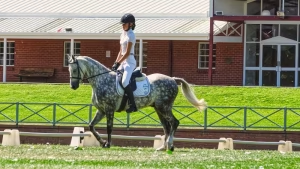
Ask most people to picture a racehorse and they will describe a Thoroughbred: lean, long-legged and built to run. The breed dominates racetracks from Kenilworth to Kentucky, yet it is far more versatile than its reputation suggests. Many of the horses competing in eventing arenas and hunting fields started life on the track.
Table of Contents
What Is a Thoroughbred Horse?
A Thoroughbred is a specific breed of horse developed in England during the 17th and 18th centuries for racing. Native English mares were crossed with imported stallions of Arabian, Barb and Turkoman breeding, producing a horse that could carry high speed over distance.
Thoroughbreds are classed as hot-blooded horses, a group bred for agility and speed and known for being spirited and bold. Their pedigrees are recorded in closed studbooks, meaning both parents must already be registered for a foal to qualify.
Thoroughbred Is Not the Same as Purebred
The word "thoroughbred" is often used loosely to describe any purebred animal, but this is incorrect. A purebred horse is simply one descended from a single breed line, whether that is an Arabian, a Friesian or a Boerperd. Thoroughbred refers only to horses registered in the General Stud Book or an equivalent national register. The confusion likely arose because the General Stud Book was one of the first breed registries ever created.
A horse with just one Thoroughbred parent is called a half-bred in Britain and a Grade Thoroughbred in the United States.
Where the Thoroughbred Came From
The Three Foundation Stallions
Every modern Thoroughbred traces back to three stallions imported into England from the Middle East: the Byerley Turk in the 1680s, the Darley Arabian in 1704 and the Godolphin Arabian in 1729. Around 160 stallions contributed to the breed in total, but these three founded the male lines that survive today.
Each of these stallions had one descendant who carried the line forward. The Darley Arabian's line runs through Eclipse, an undefeated racehorse of his day. The Byerley Turk's survives through Herod, and the Godolphin Arabian's through Matchem. Genetic studies show that roughly 95% of male Thoroughbreds trace their direct male line back to the Darley Arabian through Eclipse.
The Foundation Mares
The mares mattered just as much. Under James I and Charles I, 43 mares known as the Royal Mares were imported into England, joined by native stock including the Irish Hobby. Research on mitochondrial DNA suggests fewer genetically distinct mare lines existed than early researchers believed. Ten founder mares account for around 72% of all maternal lineages in the breed.
James Weatherby published the first volume of the General Stud Book in 1791, recording the pedigrees of 387 mares. It is still published in England today. The American Stud Book followed in 1873 and has been overseen by the Jockey Club since 1896.
How the Breed Spread
Bulle Rock, a son of the Darley Arabian, arrived in Virginia in 1730 as the first Thoroughbred in the American colonies. More than 300 followed by 1800. The breed reached Australia in the early 1800s, France in 1817, Argentina in 1853 and Japan in 1895.
Oriental horses were brought into South Africa from the late 17th century to improve local stock, and Thoroughbreds arrived in growing numbers as racing became established here in the late 18th and early 19th centuries.
One quirk of the breed is its official birthday. Thoroughbreds born in the Northern Hemisphere are considered a year older on 1 January, while those born in the Southern Hemisphere, South Africa included, turn a year older on 1 August. This keeps age-restricted races fair.
What Does a Thoroughbred Look Like?
Height and Build
Most Thoroughbreds stand between 15.2 and 17 hands, averaging around 16 hands, and weigh between 450 and 550 kg. A 16-hand Thoroughbred weighs noticeably less than a 16-hand Boerperd or Quarter Horse because the breed is built lean.
A well-made Thoroughbred has a refined head with widely spaced eyes, a long light neck, high withers, a short back, a deep chest and long legs with clean, pronounced tendons. Sprinters tend to carry more muscle, while stayers are usually smaller and slimmer.
Height has crept up over the centuries. The average Thoroughbred stood about 13.3 hands in 1700 and 15.3 hands by 1876.
Coat Colours
The Jockey Club recognises bay, dark bay or brown, black, chestnut, grey, roan, palomino and white. Bay and chestnut are by far the most common. White markings on the face and legs are acceptable, but multi-coloured patterns such as pinto or appaloosa are not recognised by mainstream registries.
Why Thoroughbreds Are So Fast
Thoroughbreds reach peak speeds of around 64 km/h and hold high speeds over 800 to 5,000 metres. The record belongs to a mare named Winning Brew, who clocked 70.76 km/h over two furlongs.
Heart and Lungs
The breed's aerobic capacity is roughly 2.6 times that of cattle of similar size. Thoroughbred hearts weigh 0.9 to 1.1% of bodyweight and can pump up to 400 litres of blood a minute during hard work. Secretariat's heart was estimated at 10 kg, up to double that of an ordinary stallion.
The lungs are equally impressive, moving about 12 litres per breath and up to 1,600 litres of air per minute at maximum effort. The spleen also contracts at the onset of exercise, releasing stored red blood cells and lifting the blood's oxygen-carrying capacity by as much as 50%.
Muscle and Stride
Thoroughbred muscle stores far more glycogen than human muscle and holds roughly twice the mitochondria of cattle. Elastic energy stored in the tendons halves the muscular work of galloping, which is why a horse can cover ground so efficiently.
Interestingly, winning times in major races have not improved much since about 1970, and researchers still disagree on whether the closed studbook has exhausted the breed's genetic potential.
Thoroughbred Temperament
Thoroughbreds are intelligent, sensitive and high-energy. They are quick learners with a strong work ethic, but their boldness makes them a poor match for nervous or inexperienced riders. Retired racehorses can be easily spooked and often need patient retraining before they settle into a new job.
What Are Thoroughbreds Used For?
Racing
Racing remains the breed's primary purpose, but most Thoroughbreds spend only a few years on the track. Fewer than half of all racehorses ever win a race, and under 1% win a stakes race such as the Durban July or the Epsom Derby.
Second Careers
Off-track Thoroughbreds, commonly called OTTBs, go on to succeed in eventing, show jumping, dressage, polo, fox hunting and general riding. Blackfoot Mystery, ridden by Boyd Martin at the 2016 Rio Olympics, is one well-known example. Larger horses tend to suit jumping and dressage, while smaller ones make excellent polo ponies.
Improving Other Breeds
Thoroughbred blood shaped the American Quarter Horse, the Standardbred and the Anglo-Arabian. Crossing Thoroughbreds with heavier draught breeds produced the warmbloods that dominate modern dressage and show jumping, including the Hanoverian and the Dutch Warmblood. Crossing with the Irish Draught gives the Irish Sport Horse.
Common Health Problems
The closed studbook and intense selection for speed have left the breed with some predictable weaknesses. Gastric ulcers are extremely common in racehorses. Exercise-induced pulmonary haemorrhage, or bleeding from the lungs, affects a large share of horses in hard work.
Roughly one in ten Thoroughbreds has orthopaedic problems, and young horses in training can accumulate microdamage in the bone if their programmes do not allow enough recovery time. Around 10% have low fertility, and a small percentage have abnormally small hearts. Thin-soled, weak hooves are a recurring complaint, largely because the breed carries a small hoof relative to its body mass.
The average lifespan is 25 to 35 years, so a horse retired from racing at four may have three decades of life ahead.
Feeding and Caring for a Thoroughbred
Thoroughbreds are generally hard keepers, meaning they struggle to hold condition. Racing yards often feed high-grain rations to meet energy demands, but heavy grain feeding raises the risk of colic, ulcers and hindgut acidosis.
Good-quality forage should form the base of the diet, supported by fat sources such as flax oil and fibre-based feeds such as soaked beet pulp. Alfalfa can supply extra protein and helps buffer stomach acid, though it should make up no more than 20 to 30% of forage intake. Constant access to clean water and loose salt is essential.
These horses do best with regular turnout and exercise. Without an outlet for their energy, behavioural problems are common. Persistent bad behaviour can also signal an underlying digestive issue, so it is worth involving your vet.
Is a Thoroughbred Right for You?
A Thoroughbred rewards an experienced, patient owner with athleticism, courage and a genuine willingness to work. They are not beginner horses, and they carry higher health and feeding costs than hardier breeds. For a rider with the skill and the time, though, few horses are more capable across so many disciplines.
Frequently Asked Questions
Why can't Thoroughbreds be bred using artificial insemination?
The Jockey Club only registers foals conceived by live cover, meaning the mare and stallion must mate naturally under supervision. Artificial insemination and embryo transfer are both barred, even though most other registries allow them. Part of the reasoning is record-keeping accuracy, but the commercial motive matters more. Live cover limits how many mares a stallion can serve in a season, which prevents oversupply and protects the value of top bloodlines. Australian stallion Encosta De Lago covered 227 mares in 2008, a high figure by live cover standards but a fraction of what artificial insemination would allow.
How tall is a Thoroughbred horse?
Most Thoroughbreds stand between 15.2 and 17 hands, with the average sitting at about 16 hands, or 163 cm. Height alone does not predict racing ability. Zenyatta stood 17.2 hands, Secretariat and Man o' War both measured 16.2, and Hyperion was just 15.1, yet all were champions. Very large horses mature more slowly and carry more strain on their legs, while very small ones can be disadvantaged by a shorter stride.
Are Thoroughbred horses good for beginners?
Generally not. Thoroughbreds are sensitive, quick-thinking and high-energy, which suits a confident rider but can overwhelm a novice. Horses coming straight off the track are especially unsuitable, since they are used to a completely different routine and may still be reactive. A beginner who has fallen in love with the breed is better off looking for an older Thoroughbred that has already been retrained and settled into a second career for several years.
What is the difference between a Thoroughbred and an Arabian?
Arabians are an ancient desert breed known for endurance, standing around 14 to 15 hands with a distinctive dished face and high tail carriage. Thoroughbreds were developed in England only about 300 years ago, partly from Arabian bloodlines, and were bred specifically for speed over racing distances. Thoroughbreds are taller and faster over short and middle distances, while Arabians excel at endurance riding over 160 km or more. Crossing the two produces the Anglo-Arabian.
How long do Thoroughbred horses live?
A Thoroughbred typically lives 25 to 35 years. Since most leave the track between three and six years old, a retired racehorse usually has two to three decades of life ahead. This is worth thinking through before taking one on, as an off-track Thoroughbred is a long commitment rather than a short-term project.