Boxing Day, 2016. Kempton Park. The roar from the packed grandstands as a tall, dark-bay novice powered up the home straight on only his fourth start over fences remains one of the defining moments of the modern National Hunt calendar. Thistlecrack, the reigning World Hurdle champion, had just beaten the dual Betfair Chase winner Cue Card by three and a quarter lengths in the King George VI Chase, and for a few intoxicating winter weeks the British racing public dared to believe it was watching the next true superstar of jump racing.
What followed is a story of dazzling brilliance, cruel timing and a long, well-earned retirement. This is the complete and accurate career of the Thistlecrack horse: one of the most popular animals ever to carry the silks of Colin Tizzard's Dorset yard, a Kayf Tara gelding foaled in 2008 who now spends his days as a Retraining of Racehorses ambassador in the south-west of England.
Thistlecrack at a Glance
- Foaled: 29 March 2008
- Sex and colour: Bay gelding
- Sire: Kayf Tara
- Dam: Ardstown (by Ardross)
- Breeders: R. F. and S. D. Knipe
- Owners: John and Heather Snook
- Trainer: Colin Tizzard, Venn Farm, Milborne Port, Dorset
- Regular jockey: Tom Scudamore
- Career record: 25 starts, 13 wins, 4 seconds, 2 thirds
- Career earnings: £743,651
- Signature win: 2016 King George VI Chase (Grade 1)
- Retired: March 2021, aged 13
By the bare figures, Thistlecrack was a top-class National Hunt performer. By the manner of his racing, all fluent jumping and a low, raking, almost flat-race stride on the run-in, he was something rarer still. He was the kind of horse who made the front of the racing pages, and the kind racegoers still bring up whenever the conversation turns to the great staying hurdlers and the "what might have been" chasers.
Origins and Breeding: The Kayf Tara Influence
Thistlecrack is a British Thoroughbred, bred for jump racing by R. F. and S. D. Knipe. To understand him, you have to start with his sire. Thoroughbred breeding for National Hunt racing is a patient, staying-orientated business, and few stallions have shaped it in the twenty-first century like Kayf Tara.
A dual Ascot Gold Cup winner on the Flat and a top-class stayer in his own right, Kayf Tara stood at Overbury Stud and became one of the most prolific and reliable jumps sires of his era. His stock share a recognisable stamp: tall, scopey, slow to mature, and blessed with natural jumping technique. That description fits Thistlecrack almost to the letter. Out of the mare Ardstown, herself by the outstanding stayer Ardross, Thistlecrack was bred top and bottom to stay all day and to keep improving with age. As a gelding, his entire future lay on the racecourse rather than at stud, and his connections were in no hurry to rush him there.
A Late Starter: Rise Through the Hurdling Ranks
Thistlecrack was unraced until the autumn of 2014, by which time he was already five. Colin Tizzard's policy, shared by many British jumps trainers with big, backward stayers, is to give a horse all the time it needs to strengthen before asking serious questions. The patience was rewarded almost immediately: Thistlecrack won a National Hunt Flat race on his debut and looked a natural from the outset.
He progressed to hurdles and improved with almost every start. By the 2015/16 season he had matured into a relentless staying hurdler, reeling off a sequence that included the Long Distance Hurdle at Newbury, the Grade 1 Long Walk Hurdle at Ascot and the Cleeve Hurdle at Cheltenham. The signs of something exceptional were already there: an effortless travelling motion, a willingness to make ground from off the pace, and an attitude that suggested hard work barely troubled him.
The 2016 World Hurdle: Coronation at Cheltenham
By March 2016 the World Hurdle at the Cheltenham Festival, at the time the premier prize for staying hurdlers in Europe, was the obvious target. The bookmakers made Thistlecrack a hot favourite, and he did not let his supporters down.
Ridden by Tom Scudamore, Thistlecrack jumped accurately, travelled beautifully throughout and produced a devastating turn of foot to win by seven lengths. It was the kind of performance that ends an argument before it starts, and it prompted the racing press to begin wondering aloud whether his future lay over fences. He rounded off that campaign by adding the Liverpool Hurdle at Aintree, again by seven lengths, confirming himself as the outstanding staying hurdler in training.
Sent Chasing: An Astonishing Novice Campaign
The decision to send Thistlecrack chasing in 2016/17 took nerve. Here was a proven Grade 1 hurdler, already eight years old, being asked to learn a brand-new discipline at the highest level. What happened next is one of the most extraordinary novice chasing campaigns of the modern era: four starts over fences, four wins, each more emphatic than the last.
| Date | Race | Course | Result |
|---|---|---|---|
| 25 Oct 2016 | Novices' Chase | Chepstow | Won by 4 lengths |
| 12 Nov 2016 | Novices' Chase | Cheltenham | Won by 3 3/4 lengths |
| 26 Nov 2016 | Worcester Novices' Chase (G2) | Newbury | Won by 8 lengths |
| 26 Dec 2016 | King George VI Chase (G1) | Kempton | Won by 3 1/4 lengths |
Each run answered a different question. Chepstow proved he could jump a fence in a race. Cheltenham proved he could do it at the Festival track. The eight-length demolition at Newbury proved the class was intact. Then came the main event.
The 2016 King George VI Chase
By 2016 the King George VI Chase had become the de facto mid-season championship for top staying chasers. Cue Card, twice a Betfair Chase winner and a previous King George winner himself, was the established form horse. Thistlecrack, having his fourth run over fences, was the people's favourite.
Tom Scudamore tracked Cue Card down the back straight, jumped the last upsides and unleashed a sustained, quickening run up the Kempton home straight that settled the race in a matter of strides. The winning margin was three and a quarter lengths, and the closing stages felt more like the finish of a Flat middle-distance race than a three-mile steeplechase. By the following morning Thistlecrack had been installed as ante-post favourite for the Cheltenham Gold Cup. He was a novice chaser with four starts to his name, and the British racing press had already begun comparing him to Best Mate.
Injury and the Gold Cup That Never Was
It was not to be. In February 2017, only weeks before the Gold Cup, Thistlecrack was found to have suffered a tendon injury. Tizzard withdrew him from Cheltenham and confirmed he would miss the rest of the season. As The Guardian reported at the time, the yard remained hopeful of a full recovery, but the setback ended any prospect of the Gold Cup coronation that had looked so likely at Christmas.
Tendon injuries are a recurring theme of National Hunt racing. A tear to the superficial digital flexor tendon can take nine to twelve months to repair, and even after a clean recovery the risk of recurrence lingers for the rest of a horse's career. Many talented horses come back from tendon trouble to win again. What Thistlecrack could not do was recapture the irresistible momentum of that first winter over fences. The truth, plainly told, is that he never won a race again.
The Long Road Back: 2017 to 2019
Thistlecrack returned to the track in December 2017, more than nine months after his injury, running fifth in the Long Distance Hurdle at Newbury before lining up in the King George VI Chase once more. This time he found the improving Might Bite too good and finished fourth. Worse followed: a stress fracture was detected afterwards, ruling him out of the 2018 Cheltenham Gold Cup and costing him another chunk of a season.
He came back yet again in 2018, running third in the Betfair-sponsored chase at Haydock on his reappearance. Then, on Boxing Day 2018, he ran the race of his comeback in the King George VI Chase, staying on strongly to finish second, beaten just a length and a half. It was a gallant effort against younger legs, and it confirmed that the old ability had not entirely deserted him, even if the winning habit had.
His final campaign brought two more honourable defeats. He was pulled up in the 2019 Cheltenham Gold Cup, the race that had once seemed destined to be his, and signed off with a game second in the Long Distance Hurdle at Newbury in November 2019. A foot injury then prevented a planned return to the King George, and after a further period on the sidelines his retirement was formally announced in March 2021, when he was 13.
Why Thistlecrack Captured the Public's Heart
National Hunt fans love their horses for very specific reasons, and the Thistlecrack horse ticked nearly every box.
- The connections. Colin Tizzard ran a working Dorset dairy farm and trained his horses on the same land. John and Heather Snook were lifelong racing enthusiasts, not a faceless syndicate. Thistlecrack belonged to real, recognisable racing people.
- The way he travelled. That smooth, cruising motion and the explosive run up the straight gave crowds at Cheltenham and Kempton something to roar home. There is no sound in racing quite like it.
- The jumping. Most novice chasers endure a learning phase. Thistlecrack arrived a fluent jumper almost from the first fence, a hallmark of the Kayf Tara line.
- The pedigree. Bred on stamina both top and bottom, he carried blood the British jumps public knows and trusts.
- The vulnerability. The tendon, the Gold Cup that slipped away, the long road back: these are the chapters that fix a horse in the memory more firmly than any single victory ever could.
Tom Scudamore, who partnered him for all his greatest days, has often described Thistlecrack as the best horse he ever rode. For the Tizzard yard, then a modest family operation, he was quite simply the horse who changed everything.
Life After Racing: A Retraining of Racehorses Ambassador
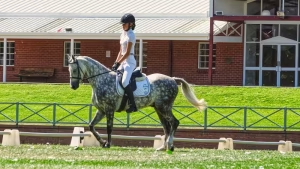
Since leaving the track, Thistlecrack has been retrained as a riding horse, ridden in his second career by Alice Gaillard. He has appeared at Retraining of Racehorses parades at the Cheltenham Festival and at several major shows, turning his hoof to cross-country schooling, show jumping and low-level showing. A Horse & Hound feature caught up with him in retirement, describing a settled, contented life of light schooling and gentle competition.
Retraining of Racehorses, the official charity for the welfare of former British racehorses, has become one of the quiet success stories of the sport. Thistlecrack is among a number of household names now serving as ambassadors for the cause, living proof that a Grade 1 galloper can transition happily into a second career when the time and the right hands are put in.
Thistlecrack's Place in National Hunt History
Where does Thistlecrack sit on the shelf of great modern jumpers? He never won a Gold Cup and he never won a Grand National, and the Gold Cup the Tizzard yard did win arrived two years later through Native River's 2018 victory at Cheltenham. His record of 25 starts and 13 wins is excellent without being statistically freakish. And yet ask British racegoers about the standout horses of the 2010s and his name is almost always in the conversation.
The reason is that 2016 King George. Few National Hunt performances of recent memory captured the public mood so completely. To go from a first-season novice in October to a King George winner in December, beating a proven top-class chaser with three and a quarter lengths in hand on only your fourth start over fences, is a feat we may not see repeated for a very long time. The Gold Cup that might have followed, snatched away by a tendon a few weeks out, adds the wistful quality that so often elevates a very good horse into a beloved one. His King George remains a chapter; his Gold Cup is one of racing's great "what ifs"; and his place in the affections of the British jumping public is permanent.
Thistlecrack FAQ
Who trained Thistlecrack?
Thistlecrack was trained throughout his career by Colin Tizzard at Venn Farm in Milborne Port, Dorset. Tizzard's son Joe took over the licence at the yard in 2022, but Thistlecrack was a Tizzard horse from his first start to his last.
What was Thistlecrack's biggest win?
His defining victory was the 2016 King George VI Chase at Kempton on Boxing Day, when he beat Cue Card by three and a quarter lengths on only his fourth start over fences. His 2016 World Hurdle at the Cheltenham Festival, won by seven lengths, ran it close.
Did Thistlecrack win two King Georges?
No. Thistlecrack won the King George VI Chase once, in 2016. He ran in it again in 2017, finishing fourth, and in 2018, when he finished a gallant second. Injury prevented him from contesting it in later years.
What injury did Thistlecrack have?
His career-defining setback was a tendon injury sustained in February 2017, which ruled him out of that year's Cheltenham Gold Cup. He later suffered a stress fracture, detected after the 2017 King George, and a foot injury in 2019. He never won a race after returning from the original tendon problem.
Is Thistlecrack still racing, and is he still alive?
Thistlecrack is retired from racing. His last competitive run came in late 2019 and his retirement was formally announced in March 2021, aged 13. He remains alive and well, living an active retirement as a Retraining of Racehorses ambassador in the south-west of England.
The Takeaway
For one extraordinary winter, Thistlecrack was the most exciting horse in British jump racing, and his 2016 King George remains one of the great Christmas performances ever seen on a British racecourse. The Gold Cup near-miss gives the story its bittersweet edge, and to see him now, sound and content in his second career, is one of the happier tales the sport has to tell.
For more on the great British jumping and Flat horses of recent decades, explore our profiles of Kauto Star, Altior, Golden Miller, Desert Orchid, Mill Reef and Red Rum.