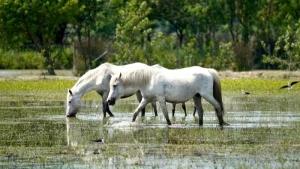
The Kladruber horse (Czech: Starokladrubský kůň) is the oldest indigenous Czech horse breed and one of the rarest horse breeds in the world — a baroque carriage horse developed over more than 440 years specifically to draw the ceremonial coaches of the Habsburg emperors. Bred at the National Stud at Kladruby nad Labem in Bohemia since 1579, the breed survives today in two distinct lines, grey and black, with around 1,200 horses worldwide and the National Stud itself recognised as a UNESCO World Heritage Site since 2019.
For UK and South African horse owners, the Kladruber horse is more often admired than ridden — purebreds rarely leave central Europe — but the breed’s history, conformation, gait, and temperament reward closer attention. This guide covers the breed’s origins, the grey and black lines, physical characteristics, temperament, modern uses, care, and where to see them today.
Table of Contents
Origins of the Kladruber Horse
The Kladruber horse’s history begins in the late 16th century. In 1579, Emperor Rudolf II elevated the existing stud at Kladruby nad Labem in Bohemia (in the present-day Czech Republic) to imperial status. The purpose was specific and prestigious: to breed ceremonial carriage horses for the Habsburg court — horses tall enough, showy enough, and steady enough to draw the emperor’s gilded coaches in state processions across Vienna, Prague, and the imperial capitals.
The foundation stock was deliberately chosen for grandeur. Spanish horses (the original Andalusian-Iberian type), Neapolitan horses (from southern Italy, particularly the Naples court), and old native Bohemian horses were combined and selectively bred. By the early 17th century, the breed had taken on the form we recognise today — a baroque carriage horse with a high crest, convex profile, broad chest, and a high, rhythmic trot designed to look impressive between the shafts of an imperial coach.
The Kladruber predates almost every other modern breed. The Lipizzan, with which it shares some early Spanish blood, dates from the 1580s. The Andalusian as a registered breed traces to the 15th century. The Thoroughbred dates from around 1700. The Kladruber’s continuous breeding programme at one stud for nearly 450 years is genuinely unique — there is nothing else like it in the equine world.
A Tale of Two Lines: Grey and Black
The Kladruber is distinctive in being bred in two separate, deliberately maintained colour lines, each historically associated with a different ceremonial role.
The Grey Kladruber
The grey line traces back to the stallion Pepoli and was traditionally used to draw the imperial coaches at the Habsburg court. White and grey horses were considered the highest-status colour for monarchs across Europe, and the Kladruber greys — born dark and lightening to white as they aged — were the ceremonial top tier. They drew the coronation coaches of Holy Roman Emperors and later the carriages of state for the Austro-Hungarian Empire.
The grey line survived the 20th century intact and remains the larger of the two lines today, bred at the main National Stud site at Kladruby nad Labem.
The Black Kladruber
The black line descends from the stallion Generalissimus, a Neapolitan-type horse, and was traditionally reserved for the church — used by archbishops and high clergy in ceremonial processions. Black horses were associated with religious authority across Catholic Europe.
The black line very nearly disappeared in the 20th century. By the 1930s only a handful of black mares remained. A coordinated rescue programme using Lipizzan, Frederiksborger, and Friesian outcrosses rebuilt the line, and by the 1980s the black Kladrubers were genetically secure again. They are now bred mainly at the secondary site at Slatiňany, just south of Kladruby nad Labem.
Both lines are bred true today, and the studbook keeps them separate. Cross-breeding between grey and black lines does occur but is carefully managed.
Physical Characteristics and Conformation
The conformation of the Kladruber horse is defined by its purpose: to look impressive in harness and to move in a high, rhythmic trot. The key breed specifications are set out below.
| Height | 16.2–17.2 hh (typically 168–178 cm) |
| Weight | 580–650 kg |
| Colours | Grey (born dark, lightening with age) or solid black; no other colours accepted in the studbook |
| Profile | Convex (Roman-nosed), an Iberian/Neapolitan baroque feature |
| Neck | High-set, well-arched, naturally crested |
| Body | Long and powerful, deep chest, broad croup |
| Legs | Strong-boned, clean, with broad joints |
| Hooves | Hard, well-formed, generally trouble-free |
| Lifespan | 25–30 years |
The arched neck, convex profile, and high knee action are not random aesthetic choices — they are the visible signatures of a horse selected over centuries for ceremonial coach work. At 16.2 to 17.2 hands, the Kladruber is also one of the taller baroque breeds, noticeably larger than its Lipizzan cousin.
Temperament and Personality
Kladrubers are noted for being calm, intelligent, and remarkably tolerant. Centuries of breeding for parade work — performing in front of crowds, in synchronised teams of four, six, or even eight horses, with bands playing and crowds cheering — selected ruthlessly for steadiness. A horse that spooked in front of an emperor’s procession did not contribute to the next generation.
The result is a breed described by handlers at the National Stud as willing, hardworking, and remarkably adaptable. Kladrubers learn quickly, accept new environments well, and form strong bonds with their handlers. They are not hot-blooded and do not suit riders looking for sharpness — they are baroque horses with the temperament to match. This even, well-balanced nature is also why the breed is increasingly used in equine-assisted therapy.
Gait and Movement
The Kladruber’s signature gait is the elevated, rhythmic trot for which the breed was specifically developed. This is harness movement — high knee action, suspended phase, dramatic from the side — rather than the long, ground-covering trot favoured for modern dressage. In harness, the gait is spectacular. Under saddle, it can feel less smooth than a Warmblood or Andalusian to riders accustomed to modern competition movement.
Walk and canter are also high and elevated. The breed has historically not been used for fast work — there are no Kladruber racehorses or eventers in the modern sense.
Historical Role at the Imperial Court
For nearly four centuries, Kladrubers performed ceremonial duties for the Habsburg monarchy and, after 1867, for the Austro-Hungarian Empire. They drew the coaches at imperial coronations, weddings, funerals, and state visits. Teams of eight matched grey Kladrubers — referred to as the imperial eight — were among the most photographed and painted carriage teams in Europe.
The collapse of the Austro-Hungarian Empire after the First World War threatened the breed for the first time in its history. Without an imperial court, the demand for ceremonial carriage horses collapsed almost overnight. The new Czechoslovak state took over the stud in 1918 and committed to preserving the breed, recognising it as a national heritage asset rather than a working tool.
Modern Use and FEI Driving
The Kladruber horse is best known today in international combined driving competition under the auspices of the Fédération Équestre Internationale (FEI). Czech driving teams have been competitive at the FEI World Driving Championships for decades, and Kladruber teams represent the breed’s most visible modern role.
Other modern uses include:
- Ceremonial duties — the Czech Castle Guard and presidential ceremonies still use Kladrubers
- Classical dressage — particularly for traditional baroque schools where the high-stepping action suits the discipline
- Pleasure carriage driving — increasingly popular in continental Europe
- Equine-assisted therapy — making use of the breed’s calm, steady temperament
- Tourist and exhibition work at Kladruby nad Labem and Slatiňany
- Selective ridden work — recreational riding for experienced riders
Outside the Czech Republic, Kladrubers are extremely rare. There are small populations in Germany, Austria, Slovakia, and a handful in the United States and the UK. They are not registered in significant numbers in the British studbook system or by South African breed associations.
The National Stud and UNESCO Status
The National Stud at Kladruby nad Labem was inscribed on the UNESCO World Heritage List in 2019, recognising the unique cultural and natural landscape of the stud, the breeding traditions preserved there, and the architectural ensemble of stables, manor house, riding hall, and surrounding pastures laid out from the 16th century onward.
The UNESCO citation specifically referenced the landscape as devoted to the breeding and training of a particular breed of ceremonial carriage horse. Few equestrian sites have received such recognition — the Lipizzan stud at Lipica in Slovenia and the Spanish Riding School in Vienna are among the very few comparable institutions.
The site comprises around 1,300 hectares of pasture, historic stable buildings, the baroque manor house, and the Slatiňany castle and stud where the black line is now bred. The National Stud welcomes visitors for guided tours, training sessions, and displays of the horses at work.
Preservation and Rarity Today
Despite the UNESCO recognition, the Kladruber remains a rare breed by global standards. Estimates put the worldwide population at around 1,200 horses, the great majority in the Czech Republic. The Rare Breeds Survival Trust does not list the Kladruber on its UK watchlist (the breed is not present in significant numbers in Britain), but Czech conservation programmes class the breed as a national cultural monument — a designation reserved for living heritage of national importance.
Conservation focuses on maintaining the genetic diversity of both colour lines, preserving the historic conformation type, and supporting demand through visible international success in driving competition.
Kladruber vs Lipizzan: Are They Related?
The two breeds are often confused. Both are baroque, both are typically grey, both have imperial Habsburg connections, and both have been used for ceremonial driving and classical riding. But they are distinct breeds bred for different roles.
| Feature | Kladruber | Lipizzan |
|---|---|---|
| Founded | 1579 (Bohemia) | 1580 (Slovenia/Lipica) |
| Purpose | Ceremonial carriage | Classical haute école riding |
| Height | 16.2–17.2 hh | 14.2–15.3 hh |
| Profile | Convex (Roman) | Straight to slightly convex |
| Action | Very high knee action | Collected, balanced |
The two breeds share some Iberian and Neapolitan ancestry but were bred for very different roles and produced different types. A Kladruber is the carriage horse of the Habsburgs; a Lipizzan is the riding horse of the Spanish Riding School. Both deserve their place in baroque equestrian history alongside spotted cousins such as the Knabstrupper.
Care and Management
Kladrubers are easy keepers compared with many large breeds. They are hardy, long-lived (25–30 years is normal), and not prone to specific genetic disorders. The two main management considerations are:
- Weight management — like most baroque breeds, they hold condition easily and need careful diet management on rich UK or European pastures
- Joint care — large size and high knee action put strain on joints; sensible workloads and good farriery help maintain soundness into late life
They suit consistent, fair handling and routine. They are not the right choice for nervous owners or for those wanting a hot, competitive sports horse — but for someone wanting a steady, presence-filled horse with deep history, they are remarkable animals.
Where to See Kladruber Horses
- National Stud at Kladruby nad Labem — public guided tours, the main grey-line breeding centre, around 100 km east of Prague
- Slatiňany Castle and Stud — the black-line site, a short drive from Kladruby
- FEI World Driving Championships — Czech teams routinely compete with Kladruber horses
- Czech ceremonial events — including state visits at Prague Castle
For UK readers wanting to see baroque carriage breeds without travelling to central Europe, the Royal Mews at Buckingham Palace and the King’s Troop Royal Horse Artillery offer comparable ceremonial driving displays, though using different breeds such as the Cleveland Bay, Windsor Greys, and Irish Draught crosses. Our feature on Queen Elizabeth’s horses looks at the British royal tradition in more detail.
For more on related rare and historic breeds, see our profiles on the Lipizzan, Andalusian, Friesian, and Cleveland Bay.
Frequently Asked Questions
What are Kladruber horses known for?
Kladruber horses are the oldest indigenous Czech breed and one of the rarest in the world. They were developed from 1579 onwards specifically to draw the ceremonial coaches of the Habsburg emperors and remain best known today for their imperial baroque presence, high-stepping carriage action, and competitive success in FEI international driving.
What is the difference between grey and black Kladrubers?
The grey line, descended from the stallion Pepoli, was traditionally used at the imperial court to draw the emperor’s coaches. The black line, descended from Generalissimus, was reserved for the church and clergy. Both are now bred separately at the National Stud — greys at Kladruby nad Labem, blacks at Slatiňany — and they are the only two colours accepted in the studbook.
How rare are Kladruber horses?
Very rare. The worldwide population is around 1,200 horses, the great majority in the Czech Republic. The breed is recognised as a Czech national cultural monument, and the National Stud at Kladruby nad Labem was added to the UNESCO World Heritage List in 2019 in recognition of the breeding tradition preserved there.
Are Kladruber horses suitable for riding?
Kladrubers are bred primarily for harness work, but their calm temperament and balanced movement also make them suitable for classical dressage and recreational riding. They suit experienced riders comfortable with a tall, baroque-type horse with high knee action — they are not the easiest first horse and they are not the best fit for a rider wanting a modern competition horse.
How long do Kladruber horses live?
With good care, Kladruber horses typically live 25–30 years. They are a hardy breed, not prone to specific genetic disorders, and many continue to work into their late teens or early twenties.
Can you visit the Kladruber stud?
Yes. The National Stud at Kladruby nad Labem in the Czech Republic offers public guided tours showing the stables, riding hall, baroque manor house, and the horses at work. The black-line site at Slatiňany Castle is also open to visitors. Both sites are around 90–110 km east of Prague.