Table of Contents
Retraining a horse that kicks is one of the highest-stakes pieces of behavioural work an owner ever takes on. A horse hoof can deliver more than 1,800 kg of force per strike, more than enough to break a femur, shatter a pelvis, or kill an adult. According to the British Equestrian Trade Association injury data, kicks account for around a quarter of all serious yard accidents in the UK each year. Retraining a kicking horse means understanding why the horse is kicking in the first place — and there are at least eight distinct causes — and applying the right protocol for each cause, with no shortcuts. This 2026 guide covers every common type of kicking, the underlying triggers, the behavioural and veterinary work that fixes it, and the equipment, professionals, and timeframes a responsible owner should expect.
Why Do Horses Kick? The Eight Main Causes
Kicking is not a single behaviour. It is a shorthand label for at least eight quite different things. Each one has a different underlying cause and needs a different fix. Misdiagnose the cause and the retraining will fail.
- Fear and self-defence. The classic startle response — the horse perceives a threat behind or beside it and kicks reflexively. Most accidents in the stable, particularly with farriers and vets, are this type.
- Pain. A horse with gastric ulcers, kissing spines, hock arthritis, ovarian pain in mares, or a sore back will kick when girthed up, mounted, or asked to work. New-onset kicking in an adult horse is a veterinary problem until proved otherwise.
- Herd dominance. Field-kept horses sort their pecking order partly through kicks. A horse that has spent years in a bullying pack often brings that behaviour into the yard, kicking out at people who approach its food or personal space.
- Mares in season. Hormonal cycling makes some mares sharp, especially around the hindquarters. Diagnosable by tracking the cycle — most “kicky mares” have specific bad weeks every 21 days. See our mares in season guide for behavioural management.
- Boredom and stable vice. A stabled horse with insufficient turnout, forage, or stimulation develops kicking the stable wall as a stereotype. Often paired with weaving, box walking, or crib-biting.
- Stallion behaviour. Entire male horses kick out at other males as a normal reproductive display. Often resolved by gelding if breeding is not intended, although learned behaviour can persist for months after the operation.
- Cow kicks — bringing a hind leg forward. Often a learned response when a horse has been girthed up roughly, mounted from the wrong side, or had its sheath cleaned without proper handling. Common in racing yards where shortcuts get learned early.
- Striking with the forelegs. Less common than hind kicking but equally dangerous, often seen in stallions, foals being weaned, and horses defending themselves against perceived frontal threats. Different behavioural pattern, different fix.
Step One: A Proper Veterinary Check
Before any behavioural retraining begins, a horse that has started kicking — particularly if the behaviour is new in an older horse — needs a thorough veterinary examination. Gastric ulcers are present in 50–60% of stabled UK horses according to the BEVA Gastric Ulcers Consensus, and pain from ulcers is the single most under-diagnosed cause of new-onset kicking under saddle. Other common pain causes: hock arthritis, sacroiliac strain, kissing spines, ovarian cyst, dental pain. A baseline lameness work-up plus gastroscopy is the right starting point. Spending three months on behavioural retraining for a horse that turns out to have a £25 dose of omeprazole’s worth of ulcer pain is the most common mistake owners make.
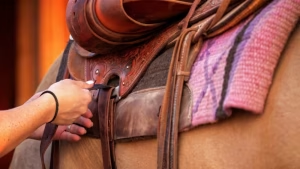
Ill-fitting tack is another common pain cause that is easy to miss. A saddle that bridges, a girth that pinches at the elbow, or a bit that pulls back into the corners of the mouth will all produce kicking behaviour under saddle. Get a Society of Master Saddlers fitter to check the tack as part of the diagnosis. See our parts of the saddle guide for the anatomy.
Behavioural Retraining Protocols
Once pain has been ruled out, the retraining work begins. The approach depends on which type of kicking you are dealing with. The two governing UK professional bodies for behaviourists are the ABTC (Animal Behaviour and Training Council) and the ASAB (Association for the Study of Animal Behaviour) — anyone working with kicking should hold credentials from one of these. The British Horse Society Approved Centres also include qualified retraining professionals.
Retraining the Fear-Kicker
Fear-based kicking responds to systematic desensitisation — exposing the horse to the trigger at intensities below the threshold that produces kicking, paired with positive reinforcement. A horse that kicks the farrier needs gradual hoof handling with food rewards or scratches, ten minutes a day, building up to a full picking out, then a rasping, then a full shoe before the actual farrier returns. Months of work, not weeks. The handler must read the horse’s body language — flicking ears, raised head, tail clamped, eye whites visible — and back off the moment any of these appear, before the kick happens. Letting the horse rehearse the kick reinforces it.
Retraining the Herd-Dominance Kicker
A horse that kicks at people approaching its food, leading rope, or stable door is performing learned dominance behaviour. The standard approach is groundwork establishing personal space — the horse must move its feet on request, yield to pressure, and back up on a soft cue before any reward is given. Pat Parelli’s “porcupine game”, Monty Roberts’ join-up, or the BHS-aligned protocols all work; what matters is consistency. Every person who handles the horse must apply identical rules. Six to eight weeks of daily groundwork is typical for clear improvement.
Retraining the Cow-Kicking Horse
A horse that brings a hind leg forward when being girthed or mounted is almost always responding to learned bad handling. Slow, methodical re-girthing — one hole at a time, walked between each tightening, with positive reinforcement at each stage — usually resolves the behaviour over four to six weeks. Mounting from a block on both sides, with food rewards for standing still, builds the right associations. Never tighten a girth in one rough movement; never mount before checking the horse is settled.
The Stable-Wall Kicker
A horse that kicks the stable wall — usually during feed time, or in the few minutes before turn-out — is responding to anticipation arousal. The fix is environmental: more turnout, more forage available continuously, slow-feeders to extend eating time, smaller meals more frequently, a stable mirror, and proximity to a companion. Pure behavioural training rarely fixes a stable kicker without environmental change.
Equipment for Working with Kicking Horses
A handful of pieces of equipment make the work safer for both handler and horse:
- Hard hat (BS EN 1384 or PAS 015). Non-negotiable around any kicking horse, even at the yard, even just leading.
- Body protector (BETA Level 3). Worth wearing for serious retraining sessions, not just under saddle.
- Steel toecap boots. A struck foot recovers far faster with one of these on.
- Long lead rope (3–4 metres). Lets you stay further from the danger zone while still keeping the horse in hand.
- Lunge whip as an extension of the arm. Not for hitting — for tapping or pointing at the shoulder to reinforce a backing-up cue from a safe distance.
- Sand-floored round pen. Falls are softer, the horse cannot escape the work, and you can see body language clearly.
Specifically NOT recommended in the UK:
- Kicking chains. Worn round the pastern to discourage kicking with self-administered discomfort. The British Horse Society opposes their use as outdated and inhumane. They can teach horses to brace and kick harder.
- Electric tail straps. Banned by every welfare organisation; effective only at suppressing the kick, not at addressing why the horse is kicking.
- Twitching as a routine response. A nose twitch is a legitimate veterinary restraint for a short, painful procedure; it is not a behavioural retraining tool.
When to Call in a Professional
Owners should not attempt to retrain a kicking horse alone if any of the following apply: the horse has caused injury to a person or another horse; the kicking is new in an adult horse without obvious trigger; the horse is unhandled, ex-racing, or stallion-aggressive; the owner has been injured by the horse already. In any of these cases, contact an ABTC-registered Clinical Animal Behaviourist via the British Horse Society’s directory or the ABTC website. Expect to pay £150–£400 for an initial behavioural assessment in the UK, followed by structured retraining at £80–£150 per session. South African ABCs (Animal Behaviour Consultants) accredited through the SAVA Behaviour Group offer similar services at R1,500–R3,500 per session.
Yard Safety Around Known Kickers
If you keep a horse known to kick, the British Horse Society and the Health and Safety Executive require these basic precautions:
- Red tail ribbon. Universal UK signal that a horse may kick. Required at any show, ride-out, or hunt; wise on any yard with other people’s horses.
- Clear notice on the stable door. “Kicker — handle from the head” or similar. Yard policy should make this mandatory.
- Tie up away from the line. A known kicker must not be tied next to other horses on a wash bay or grooming line where people may pass close behind.
- Brief every new handler. Farrier, vet, equine dental technician, physiotherapist, saddle fitter, instructor, helper — anyone unfamiliar with the horse must be told before they approach.
- Public liability insurance. Any UK horse owner needs PLI; for a known kicker, declare the behaviour to the insurer. Failure to disclose voids the policy.
Timeframes and Realistic Expectations
Retraining a kicking horse takes months, not weeks. A typical case progresses as follows: weeks 1–2, veterinary work-up and pain elimination; weeks 3–6, groundwork establishing personal space and yielding; weeks 6–12, desensitisation to the specific trigger; weeks 12–24, generalisation and consolidation under different conditions. Most kicking habits can be substantially reduced inside six months with consistent work; complete elimination is not always realistic, and many horses will always need to be handled with caution. Owners who expect a one-week fix are setting themselves up for failure.
Some horses, particularly those with confirmed neurological conditions, severe early-life trauma, or stallion-aggression that survived gelding, may never be fully safe to handle by an inexperienced person. Honest acceptance of that limitation is sometimes the kindest outcome for both horse and owner — re-homing to an experienced behaviourist’s yard or quiet retirement field is, for some horses, the right call.
Horse Kicking — Frequently Asked Questions
Why does my horse kick out? The eight most common causes are fear, pain, herd dominance, mares in season, boredom in the stable, stallion behaviour, learned cow-kicking from rough handling, and self-defence. New-onset kicking in an adult horse should always trigger a veterinary check first — pain from gastric ulcers, kissing spines, or hock arthritis is the most under-diagnosed cause.
How do I stop a horse from kicking me? Establish personal space through consistent groundwork — the horse must yield its feet on request, back up on cue, and respect a one-metre safety zone unless invited closer. Always handle from the head, not from behind. If the horse has kicked you, work with an ABTC-registered behaviourist rather than attempting a fix alone.
Do horses kick when they are happy? Yes — playful bucking and kicking out at turnout is normal happy behaviour. The difference between play kicks and aggressive kicks is direction (play is usually directed at nothing specific; aggression is targeted) and body language (play comes with relaxed ears and a loose tail; aggression with pinned ears and a clamped tail).
How to stop a mare from kicking? Track her cycle for two to three months and identify which days of her season the kicking peaks. Treat hormonal cases with the vet — Regumate, GnRH-based suppression, or ovarian assessment for cysts can all help. Pair with the standard groundwork to fix any learned behaviour layered on top.
Are kicking chains legal in the UK? Kicking chains are not specifically banned by law but are opposed by the British Horse Society and most welfare organisations as outdated and counterproductive. They are not recommended; behavioural retraining and environmental management are the modern approach.
How long does it take to retrain a kicking horse? Most cases need three to six months of consistent work. Veterinary causes (ulcers, kissing spines) can resolve faster once treated. Long-standing learned behaviour in mature horses takes longer and may never be fully eliminated.
For further reading, see the British Horse Society’s behaviour and welfare resources. Related guides on this site include horse bucking, box walking, horse rearing, anxiety in horses, and the napping in horses guide for related behavioural problems.