Anxiety in horses is one of the most under-recognised welfare and performance issues in modern equestrianism. As prey animals, horses are wired to react first and think second, and chronic stress shows up everywhere from poor stable behaviour and weight loss to the spook on a hack and the napping in the warm-up arena. This guide covers the physical and behavioural signs of stress in horses, the most common causes of equine anxiety, and a practical, vet-aligned plan for calming an anxious horse — including how to handle separation anxiety, when calming supplements help, and when they don’t.
Table of Contents
Why Anxiety in Horses Matters
Horses are flight animals. The whole nervous system is built to detect danger fast, run from it faster, and not stop running until it is somewhere safe. When that system is triggered repeatedly without resolution — by a yard that’s too busy, a herd that’s too aggressive, undiagnosed gastric ulcers, or a rider whose own nerves transmit through the rein — the horse moves into a state of chronic anxiety.
The British Horse Society and the Royal Veterinary College both classify chronic equine stress as a welfare concern. Beyond welfare, anxious horses cost owners time and money: weight loss despite expensive feeds, repeat lameness investigations, behavioural sessions, broken tack, and — most seriously — falls and rider injuries when a horse genuinely panics under saddle.
There is also good evidence that owners routinely miss the early signs. A 2022 study published in the peer-reviewed journal Animals (Rogers et al., via PubMed Central) interviewed equine behaviourists and found that many caregivers under-recognise fear and anxiety, often mistaking low-level stress for stubbornness, laziness or “naughtiness”. Learning to read the signs of stress in horses early is the single most useful skill an owner can develop — because an anxiety problem caught at a 3/10 is far easier to resolve than one ignored until it reaches a 9/10.
Signs of Anxiety in Horses
Anxiety shows in three broad categories: behavioural, physical and ridden. Subtle anxiety is easy to miss; classic panic is impossible to mistake. If you are new to reading equine body language, our overview of the behaviour of horses is a useful companion to this section.
Behavioural Signs in the Stable and Field
- Pacing or weaving in the stable
- Box walking — circling continuously round the box
- Standing in the stall corner facing away from activity
- Refusing to lie down or sleep deeply
- Crib-biting or wind-sucking — see our piece on box walking for stereotypies
- Aggressive behaviour or biting around feed time
- Reluctance to eat or drink during stressful events
- Frequent defecation when stressed (loose, frequent droppings)
Physical Signs
- Elevated heart and respiratory rate at rest
- Trembling and sweating without exertion
- Tense muscles, particularly across the topline
- Tail clamped or held high
- Wide eye, flared nostrils, head held high
- Frequent yawning or licking and chewing — usually a release after tension, but worth noting in context
Ridden and Handling Signs
- Spooking at familiar objects
- Refusing to leave the yard or other horses (separation anxiety)
- Napping — refusal to move forward; see what is horse napping
- Rearing, bucking, bolting
- Tension on the rein, leaning on one rein
- Difficulty being caught or bridled
- Sweating during light work
One or two of these signs can be a quirk. Three or more, occurring repeatedly, is anxiety until proven otherwise.
Common Causes of Equine Anxiety
The four leading causes of anxiety in domestic horses are remarkably consistent across UK studies and what equine behaviourists see in practice.
Separation Anxiety
Horses are obligate herd animals, so removing them from a bonded companion — even for an hour — triggers panic in some individuals. It usually develops after a major change: the loss of a long-term companion, a move to a new yard with a different herd dynamic, or weaning a foal too abruptly (our guide to weaning a foal covers the gradual approach that prevents adult anxiety). Because it is so common, separation anxiety gets its own dedicated section below.
Environmental Stress
Sudden changes — a move to a new yard, intensive transport, fireworks, building work nearby — temporarily flood the horse’s stress response. Most horses adapt within two or three weeks; some never fully settle if the yard culture is chronically unsuitable for them.
Underlying Pain
This is the most missed cause. Equine gastric ulcers, kissing spines, sub-clinical lameness, sharp dental hooks, and ill-fitting saddles all express as “behavioural” issues long before they look like physical issues. The University of Lincoln’s pain ethogram research has shown that subtle facial-tension cues correlate strongly with low-grade pain — and those same horses are the ones owners describe as “anxious” or “spooky.”
Management Failures
Horses housed for more than 12 hours a day, fed concentrate-heavy diets with limited forage, or kept without consistent companionship show measurably higher cortisol levels than horses managed on the “three Fs” — friends, forage and freedom. The fix is rarely a supplement. It is the management.
Learnt Anxiety
Horses learn quickly. A horse that has bolted while being asked to load travels with raised cortisol every loading session afterward. A horse that hit a hidden electric fence at the back of a paddock approaches that paddock with caution for years. Learnt anxiety is real and it requires patient retraining, not pressure.
Separation Anxiety in Horses
Separation anxiety is the single most common form of anxiety in horses, and it has a stubborn habit of looking like a training problem when it is really an emotional one. Because horses are obligate herd animals, the urge to stay with the group is hard-wired, not a behaviour the horse chooses. Removing a horse from a bonded companion — to hack out alone, to load for a show, or simply to bring it in while a field-mate stays out — can trigger genuine panic in susceptible individuals.
Signs of Separation Anxiety
- Calling (whinnying) repeatedly and pacing the fence line when a companion leaves
- Box walking or weaving as the routine changes
- Refusing to leave the yard, or rushing back towards it — a form of napping
- Sweating, trembling and a raised heart rate the moment the companion is out of sight
- Escalating, dangerous evasions under saddle — spinning, rearing or bolting back towards the herd
How to Manage Separation Anxiety
The goal is to teach the horse that being alone is safe and temporary, never to force the issue in one session. World Horse Welfare’s guidance on training a horse to be on its own sets out the core principle: work in small, successful increments and always return the horse to its safe space before panic sets in.
- Build independence in tiny steps. Lead the companion just out of sight for thirty seconds, then return before the horse becomes distressed. Extend the time only as the horse stays settled.
- Avoid a single bonded pair. A horse kept in a herd of three or four forms looser attachments than one with a single best friend, and copes far better when one companion is removed.
- Keep forage available. A haynet gives an anxious horse a calming, parasympathetic job to do while it is alone.
- Pair alone-time with reward. Feed, groom or hand-graze the horse during short solo periods so that being apart predicts good things.
- Hack out with a steady schoolmaster first, then gradually increase the distance you ride ahead, before attempting solo hacks.
Severe or escalating separation anxiety — particularly where the horse is a danger to itself or its handler — warrants a qualified equine behaviourist working alongside your vet, rather than more pressure.
Rule Out Pain First: the Pain–Anxiety Link
Before any behavioural plan, get a vet check. The British Equine Veterinary Association’s position is unambiguous: in any horse with new or worsening anxiety, the first step is a thorough physical examination.
- Gastric ulcers: the single most common cause of “behavioural” issues in stabled horses, affecting up to 90% of racehorses and 60% of competition horses in UK studies. Diagnosed by gastroscopy — see our guide to ulcers in horses. Recurring gut pain such as spasmodic colic can present the same way.
- Dental pain: diastemas, fractured teeth, sharp hooks. See horse dentition for the routine schedule.
- Hindlimb lameness: often very subtle. A flexion test and a course of phenylbutazone trial diagnostic is worth considering before behavioural work.
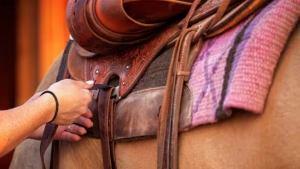
- Saddle fit: a slipping or pinching saddle creates anxiety the moment the rider mounts.
- Bit and bridle: wrong size or aggressive action.
- Kissing spines: increasingly diagnosed in performance horses.
- Hindgut and PSSM-related muscle tension: tying-up syndromes can present as a “stressy” horse.
Removing pain often resolves “anxiety” entirely. It is not a coincidence that the literature on equine welfare and performance has converged on this point in the last decade.
Calming an Anxious Horse on the Ground
Once pain is ruled out, the work is patient ground-up retraining. Six practical steps:
1. Establish a Predictable Routine
Anxious horses thrive on predictability. Same feed times, same turnout times, same handling sequences. Even small changes — different field gates, different mucking-out time — register as stress for genuinely anxious horses.
2. Provide Forage and Friends
Continuous access to forage is not a luxury for the anxious horse — it is therapy. Chewing releases parasympathetic activity that physically calms the nervous system. A horse on ad-lib hay or haylage, in a settled herd of two or three companions, is structurally less anxious than the same horse on restricted forage and isolated turnout.
3. Use Groundwork to Build Confidence
Structured groundwork — see equine groundwork — teaches the horse that the handler controls outcomes. Simple exercises like leading through narrow gaps, halting from voice, backing up on a request, all build trust without the pressure of being ridden.
4. Desensitise Gradually
Identify the specific triggers — clippers, plastic bags, loud lorries, water — and desensitise one at a time. Approach the trigger from a distance the horse can tolerate. Stay until relaxation appears (a sigh, a lick, a head-drop). Move slightly closer. Repeat over days, not minutes.
5. Manage Your Own State
Horses read human nervous systems. A handler with held breath, tense shoulders and a tight rein transmits stress directly. Calm breathing, soft eye contact, slow movement. The handler’s state is half the conversation.
6. Mark Calm Behaviour
Reward the small moments of relaxation — the soft eye, the lowered head, the willing forward step — with a release of pressure, a quiet word, or a small food reward. The horse learns that calm is what wins approval.
Managing Anxiety Under Saddle and on Hacks
Once ground confidence is rebuilt, ridden anxiety is approached with the same patience. Six points that experienced trainers use:
- Warm up properly. Ten minutes of forward walk on a long rein before any school work releases muscle tension and quietens the head.
- Ride forward. Tense horses get more tense when held back. A clear forward rhythm gives the horse something to do with its energy.
- Use the long side, not the corner. Hacking out, ride past spooky objects on the long route, not by squeezing past close to. The horse learns the object isn’t worth attention because nothing happened.
- Ride with a confident companion. A genuinely steady schoolmaster on hacks is worth a year of solo retraining.
- Repetition wins. A horse that has spooked at a wheelie bin once needs to walk past that bin twenty quiet times to reset the association.
- End on a good note. Always finish in calm — even if it means cutting the session short to avoid pressure.
Calming Supplements and When They Help
The UK calming-supplement market is enormous. Most products are based on a small number of ingredients with mixed evidence:
- Magnesium: mild evidence for short-term calming when the horse is genuinely magnesium-deficient. Most stabled horses on a balanced diet are not deficient.
- L-tryptophan: precursor to serotonin. Limited evidence for any consistent calming effect.
- Valerian: herbal sedative. Banned by FEI, BHA and British Showjumping under prohibited substances rules, so unsuitable for any competition horse.
- Thiamine (vitamin B1): often combined with magnesium. Evidence for calming effect is weak.
- Alpha-casozepine and chamomile: some products show modest calming effects in nervous horses.
The honest summary: a supplement may take a 6/10 anxious horse to a 5/10. It will not fix a 9/10 anxious horse. Calming supplements are an aid, not a treatment. Always check the FEI prohibited substances list before competing — see the FEI Clean Sport resource — and read the BHS guidance on equine stress before relying on a product.
The 3-3-3 Rule for a New or Anxious Horse
A question that comes up constantly with newly bought or recently moved horses is the “3-3-3 rule”. Borrowed from rescue-dog rehabilitation and adapted by horse owners, it is a rough timeline for how long a horse takes to decompress in a new home — useful precisely because unrealistic expectations are themselves a source of anxiety for both horse and owner.
- 3 days to come down from the initial flood of stress hormones. In this window the horse may be shut down, off its feed, or unusually reactive. Keep handling minimal and predictable.
- 3 weeks to learn the new routine, settle into the herd and start showing its real personality. Most environmental anxiety eases within this period if management is right.
- 3 months to fully relax, bond with handlers and feel genuinely at home. Only now is it fair to judge the horse’s true temperament.
The 3-3-3 rule is a guideline, not a law — a confident, well-handled horse may settle far quicker, while one carrying learnt anxiety or undiagnosed pain may take much longer. Treat it as a reminder to be patient and to read the individual horse in front of you rather than the calendar. A horse’s underlying temperament and personality shapes the timeline as much as the move itself.
When to Call the Vet or an Equine Behaviourist
Call the vet if:
- The anxiety has appeared suddenly with no obvious trigger — strongly suggests a physical cause
- The horse is losing weight despite adequate feed
- Behaviour is dangerous — rearing, bolting or biting
- The horse is refusing to eat, drink or lie down
- Stereotypies (weaving, crib-biting, box walking) are new or worsening
Call a qualified equine behaviourist (look for a member of the Animal Behaviour and Training Council or the Association for the Study of Animal Behaviour) if pain has been ruled out and you need a structured behavioural programme. A good behaviourist will work alongside the vet — not in place of one. For severe cases, vets may prescribe short-term anti-anxiety medication (such as fluphenazine in specific situations) as a bridge while behavioural work takes effect, but these are last-resort interventions, not lifestyle choices.
Frequently Asked Questions
What is the 3-3-3 rule for horses?
The 3-3-3 rule is a rough guide to how long a horse needs to settle into a new home: about 3 days to come down from the initial stress, 3 weeks to learn the routine and start showing its personality, and 3 months to fully relax and bond. It is a reminder to be patient rather than a fixed law — confident horses settle faster, while those with learnt anxiety or hidden pain take longer.
How can I tell if my horse has anxiety or is just spirited?
Spirit is forward energy with a relaxed eye and soft body. Anxiety is forward energy with tension — a high head, hard eye, clamped tail, sweating without exertion, and reluctance to settle. Spirited horses recover quickly; anxious horses don’t.
Can a horse have a panic attack?
Yes — the equine equivalent of a panic attack is a flight response triggered without an actual threat. Sweating, trembling, refusal to move (or refusal to stop), wide eye and rapid breathing all appear. Get clear of the trigger, return the horse to a familiar safe space, and let the parasympathetic system recover. Don’t punish a horse mid-panic; it makes the next attack worse.
How do you fix separation anxiety in a horse?
You fix it by teaching the horse, in very small steps, that being alone is safe and temporary. Separate a bonded companion for just seconds at first and return before the horse panics, then slowly extend the time. Keep the horse in a settled herd of three or four rather than a single bonded pair, provide forage during alone-time, and pair solo periods with food or grooming. Never force a distressed horse to “get over it” — that deepens the fear. Severe cases need a qualified behaviourist working with your vet.
Do calming supplements work for horse anxiety?
Modestly, in some horses, for some specific kinds of mild anxiety. They will not fix significant anxiety on their own. Always rule out pain first, fix management, do the groundwork, and treat supplements as a marginal aid, not a solution. Always check competition prohibited-substance lists.
Can my horse’s anxiety be a sign of pain?
Very often, yes. Gastric ulcers, kissing spines, dental issues, sub-clinical lameness and ill-fitting tack are all common causes of behavioural change misread as anxiety. The first step on any new anxiety is a vet examination.
How long does it take to fix horse anxiety?
It depends on the cause. Pain-driven anxiety usually resolves within weeks of treating the pain. Management-driven anxiety improves within a month of fixing turnout, forage and companionship. Learnt anxiety from a specific trauma can take six months to two years of patient counter-conditioning. Genetic temperament — the genuinely “hot” horse — is managed for life, not “fixed.”
Should I sell an anxious horse?
Only after a thorough vet workup, a fair attempt at management changes, and ideally a behaviourist consultation. Many “anxious” horses are simply unsuited to their current job or yard and transform when re-homed appropriately. Always be honest with potential buyers about the horse’s history — selling on hidden problems creates worse welfare outcomes for the horse downstream.