Few animals carry as much myth as the wild mustangs of the American West. The romantic picture is a bunch of unbranded horses thundering across a sagebrush basin, free of head-collars and farriers and worming programmes. The reality is a federally managed population of 85,466 horses and burros, roughly three and a half times the number the range is officially set up to carry, and a policy argument that has run for more than fifty years without resolution. This guide covers what wild mustangs actually are, how many are left, how they are managed, and why almost every figure you will read about them online is several years out of date.
All population and budget figures below come from the Bureau of Land Management's own published programme data and were checked against the live BLM figures on 28 August 2026. Where a commonly repeated claim no longer holds, it is flagged in the text rather than quietly dropped.
What Are Wild Mustangs?
Wild mustangs are free-roaming horses living on public land in the western United States. They are descended from domesticated horses that escaped or were turned loose, and they have bred without human selection for generations. In strict zoological terms that makes them feral rather than wild, though both federal law and everyday usage call them wild horses.
Wild horse, feral horse or mustang?
The three terms get used interchangeably and they are not the same thing.
- Wild horse in the biological sense means a horse from a lineage that was never domesticated. On that definition the population is vanishingly small, and the argument over whether any survive at all is covered further down.
- Feral horse means a horse descended from domestic stock that now lives and breeds without management. Mustangs, Australian brumbies and the Namib Desert horses all sit in this category.
- Mustang is the North American case specifically: the free-roaming horses of the western United States, most of them tracing back to Spanish stock.
So every mustang is a feral horse, but not every feral horse is a mustang. A herd in the Nevada desert is a mustang herd. A herd in the Northern Territory is a mob of brumbies.
Why is a horse called a mustang?
The word comes from the Spanish mesteno (also written mestengo), meaning stray or ownerless, which itself derives from the Mesta, the mediaeval Castilian association of livestock owners. An animal that had wandered off the recorded stock was a mesteno. English speakers on the frontier took the word and reshaped it, and by the nineteenth century "mustang" meant a horse running loose on the western plains.
Is the mustang a breed?
Not in the sense that a Thoroughbred or a Quarter Horse is a breed. There is no closed stud book and no breed standard governing which horses on the range count. "Mustang" describes a population and a place, not a pedigree, which is why mustangs vary so much in height, type and colour. Several distinct strains within that population are managed as breeds by private registries, and those are worth knowing separately. Our full Mustang breed profile covers temperament, care and use in more depth than there is room for here.
How Many Wild Mustangs Are Left?
As of 1 March 2026, the BLM estimates 85,466 wild horses and burros on the land it manages: 61,523 horses and 23,943 burros. Against that sits a national maximum Appropriate Management Level of 25,592, the number the agency considers the range can carry alongside other uses. The population is therefore running at roughly 3.3 times the level policy targets.
The animals are not spread evenly. Nevada alone holds 37,426 horses, about 61 per cent of every wild horse on BLM land in the country.
| State | Horses | Burros | Total | Max. AML |
|---|---|---|---|---|
| Nevada | 37,426 | 5,146 | 42,572 | 12,811 |
| Arizona | 268 | 13,546 | 13,814 | 1,676 |
| California | 3,534 | 4,933 | 8,467 | 2,236 |
| Wyoming | 7,165 | 0 | 7,165 | 2,566 |
| Oregon | 5,994 | 86 | 6,080 | 2,700 |
| Utah | 4,611 | 232 | 4,843 | 1,956 |
| Colorado | 1,669 | 0 | 1,669 | 827 |
| Idaho | 564 | 0 | 564 | 617 |
| Montana | 195 | 0 | 195 | 120 |
| New Mexico | 97 | 0 | 97 | 83 |
| Total | 61,523 | 23,943 | 85,466 | 25,592 |
Two details in that table catch most readers out. Idaho, Montana and New Mexico are all close to or below their AML, so the overpopulation problem is not national, it is concentrated. And Arizona's figure is almost entirely burros, which is why the programme is always described as wild horse and burro management rather than a horse programme.
The horses you do not see: off-range holding
A further 58,025 animals (53,773 horses and 4,252 burros) live in off-range corrals and pastures, gathered from the range and never placed. Total capacity across those facilities is 78,751, so the system is running at about three-quarters full.
It is worth correcting a claim that circulates widely, including in earlier versions of this article: you will often read that more mustangs now live in holding pens than run free. On the current figures that is not true. There are 58,025 animals off-range against 85,466 on-range, and even comparing horses alone it is 53,773 against 61,523. The statement was closer to accurate a few years ago when on-range numbers had been pushed down by very large gathers, and it has been repeated ever since without being rechecked.
How Wild Mustangs Reached North America
The mustang's origin story is genuinely unusual, because the horse is both a North American native and a North American import.
The horse evolved here, then vanished
The horse family, Equidae, originated in North America roughly 55 million years ago. Its early members were small, multi-toed browsers sharing the continent with camels and, much later, mammoths. Over millions of years their descendants crossed the Bering land bridge into Asia and Europe, where they eventually gave rise to the Iberian horses of Spain and Portugal.
In North America itself the horse died out somewhere around 10,000 to 12,000 years ago, at the close of the last Ice Age. The usual explanation combines a rapidly changing climate with hunting pressure from newly arrived humans, though the relative weight of the two is still argued over. Either way, the continent on which the horse evolved spent roughly ten millennia without one.
Spanish horses and the return of the species
Columbus carried horses to the West Indies on his second voyage in 1493. Hernan Cortes brought them to the mainland in 1519, and by the mid-1520s there was a breeding population established in Mexico. The decisive moment came in 1598, when Juan de Onate founded a settlement in what is now New Mexico with a reported 75 horses, a herd that multiplied quickly in favourable country.
From there horses moved north through raiding, trade and straightforward escape. By the late 1600s the Comanche, Shoshone, Apache and Navajo had acquired them, and mounted horsemanship reorganised warfare, hunting and trade across the Plains within a couple of generations. Those same escaped and traded animals, mostly of Iberian type, became the foundation stock of the mustang herds. It is why the Andalusian and Sorraia keep turning up in discussions of mustang ancestry.
From Millions to 25,000: Collapse and Protection
At their height, free-roaming horses in North America numbered in the millions. The historian J. Frank Dobie put the peak at no more than two million at any one time, with the heaviest concentrations in Texas, Oklahoma, Colorado and New Mexico. He was explicit that this was an estimate rather than a count, and it should be read that way.
The nineteenth century brought the mustangers, who caught wild horses for sale into agriculture, transport and the army. Demand spiked again around the Spanish-American War and the First World War. Through the first half of the twentieth century horses were also removed wholesale by ranchers competing for grazing, and by commercial gatherers supplying the pet food trade, using aircraft, motor vehicles and poisoned water holes. By 1950 the population was commonly estimated at around 25,000.
Wild Horse Annie and the 1959 Act
The turn came from a Nevada secretary named Velma Bronn Johnston, who became known, initially as an insult, as Wild Horse Annie. Her campaign leaned on letter writing rather than lobbying, and it drew in enormous numbers of American schoolchildren, which is why it is remembered as the Pencil War. Congress passed the Wild Horse Annie Act in 1959, banning the use of aircraft and motor vehicles to hunt free-roaming horses and burros on public land, and prohibiting the pollution of water holes.
The 1971 Act and what it actually says
The 1959 Act restricted methods but gave the horses no protected status. That came twelve years later with the Wild Free-Roaming Horses and Burros Act of 1971, which declared them "living symbols of the historic and pioneer spirit of the West" and made them the responsibility of the Bureau of Land Management and the Forest Service.
The wording matters, because the Act does two things that pull against each other. It requires the agencies to protect free-roaming horses and burros, and it requires them to remove animals in excess of what the range can carry. Every argument about roundups since 1971 is, at bottom, an argument about which half of that sentence takes priority.
How Wild Mustangs Are Managed Today
The BLM manages wild horses and burros across 25.5 million acres of public land in ten western states, divided into 175 herd management areas. The Forest Service manages additional wild horse and burro territories on national forest land under the same 1971 Act.
Herd management areas and Appropriate Management Level
Each herd management area is given an Appropriate Management Level, expressed as a range, representing the number of animals the BLM judges can be sustained there alongside wildlife, watershed and livestock grazing. AML is the number every other decision hangs off, and it is also the number critics attack most often, on the grounds that the forage allocation between horses and cattle is a policy choice rather than an ecological fact.
Gathers, removals and holding
Where a herd exceeds AML, the BLM conducts a gather: horses are moved into temporary corrals, usually by helicopter with riders working the wings, then sorted, freeze-marked and either offered for placement or moved into holding. In the 2025 financial year the agency removed 7,853 animals from the range.
Holding is where the money goes. Of the roughly 153 million US dollars spent on the programme in the 2024 financial year, about 101 million, or 66 per cent, went on off-range holding. Gathers and removals accounted for around 8 million, adoptions 16 million, and monitoring and other activities the remaining 28 million. Congress appropriated 142 million dollars to the programme that year. In other words, two-thirds of the budget is spent feeding horses that have already been taken off the range, which is the single most important fact about how this programme works.
Adoption, and the end of the $1,000 incentive
The BLM has placed more than 290,000 wild horses and burros into private care since 1971 through adoption and sale. In the 2025 financial year it placed 8,080 animals, slightly more than the 7,853 it removed, which is the first encouraging ratio the programme has posted in some time.
One point needs updating everywhere it appears online, including in the previous version of this article. The Adoption Incentive Program, which paid adopters up to $1,000 per animal, was discontinued on 3 March 2025 in compliance with a court order. The BLM can still pay incentives to adopters who completed titling before that date, but no new incentive payments are being made. Any guide that tells you there is $1,000 waiting for you is describing a scheme that no longer exists.
Fertility control
The alternative to removal is to slow reproduction. The BLM uses the immunocontraceptive vaccines PZP, PZP-22 and GonaCon, delivered by dart or by hand during a gather. In the 2025 financial year it carried out 921 treatments, made up of 484 PZP, 99 PZP-22 and 338 GonaCon.
Set 921 treatments against a mare population in the tens of thousands and the limitation is obvious. The BLM's own explanation is blunt: darting is not viable across most herds because the animals avoid people and the herd management areas are too large to find and approach individual mares reliably. Most formulations also need re-dosing every year or two, so a treated mare does not stay treated.
The arithmetic behind the whole problem is that wild horses have virtually no natural predators across most of their range, and the BLM states that herd sizes can double roughly every four years. That is an annual growth rate of about 20 per cent, compounding, against removals and treatments in the low thousands.
What Does a Mustang Look Like?
Because mustangs are a population rather than a breed, description means describing tendencies rather than a standard.
- Height: typically 14 to 15 hands, roughly 142 to 152cm at the withers, so small by modern riding-horse standards and often built more like a substantial pony.
- Build: compact and deep through the girth, with short cannons and dense bone. Nothing about the conformation is refined, and that is the point.
- Feet: the standout feature. Generations of constant movement over abrasive ground have produced hard, well-shaped, self-maintaining feet. This is exactly why the barefoot trimming world takes the wild hoof as its reference model.
- Colour: effectively anything. Bay, black, chestnut, roan, grey, palomino, pinto and appaloosa patterning all occur.
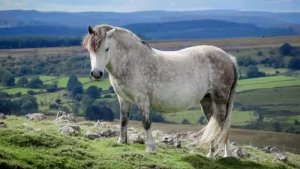
Colour is more informative than it looks. Herds with strong surviving Spanish ancestry show a high frequency of dun and grullo colouring with primitive markings: a dorsal stripe, barring on the forearms and gaskins, and sometimes shoulder shadowing. Where a herd instead shows a lot of chrome, size and quality of movement, it usually reflects later releases of ranch Quarter Horses, Thoroughbreds or draught stock into the range.
The Named Mustang Strains Worth Knowing
Some herds have remained isolated enough, for long enough, to keep a recognisable and consistent type. These are the strains that private registries treat as breeds in their own right, and they are the reason a blanket statement about "the mustang" is usually wrong.
- Kiger Mustang (south-eastern Oregon). The best known of the strains, identified in the 1970s and notable for a high proportion of dun with strong primitive markings and a distinctly Iberian outline.
- Pryor Mountain Mustang (Montana and Wyoming border). A long-isolated herd carrying a high frequency of Spanish genetic markers, again with dun and grullo common.
- Cerbat Mustang (Arizona). A very small herd, and among the most consistently Iberian in type of any surviving group.
- Spanish Mustang. Not a single range herd but a registry breed, assembled from the twentieth century onwards out of animals gathered from remnant herds specifically to preserve the old Spanish type.
- Nokota (North Dakota). Descended from horses enclosed within Theodore Roosevelt National Park when it was fenced, with local ranch and reportedly Sioux bloodlines behind them.
If you are looking at a mustang and trying to work out what is behind it, the colour and the head tend to tell you more than the paperwork does. A dun with a dorsal stripe, a straight to slightly convex profile and a short back is a very different animal from a 15.2hh bay with a Quarter Horse hip, and both are legitimately mustangs.
Can a Wild Mustang Be Tamed?
Yes, and reliably so, but the process is different from starting a domestic youngster and the difference is worth being honest about.
A gathered mustang has usually had no handling at all. Everything a domestic foal absorbs incidentally, being touched, led, having feet picked up, wearing a rug, standing tied, has to be taught deliberately to an adult animal with a fully developed flight response. The phase before ridden work, generally called gentling, is where the real work sits. Once through it, mustangs have a reputation for being unusually straightforward, because a horse that has had to make its own decisions on the range tends to think rather than panic.
The public demonstration of this is the Extreme Mustang Makeover, run by the Mustang Heritage Foundation, in which trainers are given roughly 100 days with an untouched mustang before competing. Adopted mustangs go on to do most things: trail and ranch work, showing, jumping, and in particular endurance, where their soundness and self-maintaining feet are a genuine competitive advantage.
Practical points if you are considering one:
- Facilities matter more than experience. Solid, high, safe fencing and a small secure pen are not optional.
- Budget time in months, not weeks, for the gentling phase.
- Feet are usually excellent but need a farrier or trimmer who will work patiently with an unhandled horse.
- A horse adapted to sparse desert forage is a serious laminitis risk on rich pasture. Manage grazing from day one rather than after the first problem.
One recurring question deserves a direct answer, because it appears constantly in search: people ask what the difference is between a stallion and a mustang. The two words describe different things entirely. Stallion means an entire adult male of any breed. Mustang means a free-roaming horse of the American West of any sex. A mustang can be a stallion, a mare, a foal or, once adopted and cut, a gelding.
Are Wild Mustangs Native or Invasive?
This is the argument underneath every other argument, and it is not really a scientific question so much as a question about what the science obliges anyone to do.
The case for treating mustangs as introduced is that the western ecosystems they occupy spent about ten thousand years without large equids, and reassembled themselves accordingly. On that reading, horses now compete with native wildlife for forage and, more importantly in arid country, monopolise water sources. Range scientists and wildlife bodies generally take this position.
The case for treating them as native is that Equus evolved on this continent, and the Spanish reintroduced an animal that had been absent rather than importing a foreign one. On that reading the mustang is a returned species filling a vacant niche.
The National Research Council's 2013 review of the programme did not settle it, and rather pointedly suggested the framing was unhelpful: the operative question is not whether horses are native but what priority they should be given relative to other authorised uses of public land. That is the crux. The same rangeland is allocated between wild horses and permitted livestock grazing, and livestock receive substantially the larger share of forage. Whatever one concludes about deep history, the number of horses the range "can support" is a decision about allocation, not a fixed ecological constant.
Free-Roaming Horses Beyond America
Mustangs get the attention, but free-roaming horses exist on most continents, and the comparisons are useful because other countries have tried management approaches the United States has not.
- Brumbies (Australia). The closest parallel to the mustang in both origin and controversy, and the subject of a much sharper public argument about culling in the alpine parks.
- Namib Desert horses (Namibia). A small, genetically isolated population in the Namib, living in some of the harshest country any horse occupies, with numbers that swing hard with drought and predation.
- Camargue horses (southern France). Semi-feral rather than feral: they range freely in the marshes but are owned, branded and periodically handled.
- Banker horses (Outer Banks, North Carolina). Spanish-descended, like the mustang, but coastal and managed as small discrete herds.
- Koniks (Poland and, increasingly, Britain). Now widely used as conservation grazers on wetland reserves. Our Konik pony guide covers the Tarpan question in detail.
British readers have their own version much closer to home. The Exmoor, Dartmoor and New Forest ponies all live out on common land year-round in free-ranging herds, and all of them are owned, marked and gathered annually. The contrast with the American model is instructive: British moorland ponies are managed through ownership, drifts and commoners' rights, which puts a named individual behind every animal. Nobody owns a mustang, which is precisely why managing them is so hard. Our guides to pony types and horse breeds cover these in more detail.
Is Przewalski's horse the last true wild horse?
Przewalski's horse of Mongolia is the animal always cited as the only never-domesticated horse left, and it is a real conservation success: extinct in the wild by the 1960s, rebuilt from a handful of captive founders, and reintroduced to the steppe from the 1990s onwards.
The "only true wild horse" line, though, is no longer safe to state flatly. Genetic work published from 2018 onwards indicated that Przewalski's horses may descend from the horses of the Botai culture, which appear to have been domesticated, in which case they would themselves be feral rather than never-tamed. That reading is not universally accepted and the picture is still moving. What can be said without argument is that Przewalski's horse is the most genetically distinct surviving horse population and has never been part of the modern domestic lineage. Our article on the rarest horses in the world covers the population in more detail.
What the Future Holds for Wild Mustangs
The programme is stuck in an arithmetic trap rather than a political one, and the numbers make the shape of it clear. A population growing at roughly 20 per cent a year, removals of around 7,853 animals, placements of 8,080, and fertility control reaching 921 mares. Removal alone cannot close a gap of nearly 60,000 animals above AML, and every horse removed is a horse the taxpayer then feeds, which is why two-thirds of the budget is already committed before a single management decision is made.
Three things would have to change together for the picture to improve: fertility control delivered at a scale an order of magnitude above current levels, placement demand sustained above removals for years rather than a single season, and an honest political settlement about forage allocation between horses and livestock. The FY2025 placement figure edging past removals is the first of those to show any movement.
What is not in doubt is the horses. They have survived an extinction on this continent, a reintroduction, near-eradication by the 1950s, and fifty years of contested management. The open question has never really been whether wild mustangs persist. It is whether human policy can be made to work as well as they do.
Frequently Asked Questions
How many wild mustangs are left?
As of 1 March 2026 the BLM estimates 85,466 wild horses and burros on public rangeland, of which 61,523 are horses. A further 58,025 animals are held in off-range corrals and pastures. Nevada holds about 61 per cent of all free-roaming horses.
Are wild mustangs actually wild horses?
Technically they are feral, not wild: they descend from domesticated horses that escaped or were released. Federal law and normal usage both call them wild horses, and after four centuries of natural selection on the range the distinction is more taxonomic than practical.
Can you still get $1,000 for adopting a mustang?
No. The BLM's Adoption Incentive Program was discontinued on 3 March 2025 following a court order, and no new incentive payments are being made. Adoption itself continues through BLM corrals, online events and adoption days. Many online guides still quote the $1,000 figure as current.
What is a group of wild horses called?
The basic social unit is a band, sometimes called a harem: typically one dominant stallion, several mares and their young, plus a lead mare who largely determines where the band goes. Bachelor stallions form separate bands. Several bands sharing a range are loosely called a herd, and in BLM terminology a herd is the population of a given management area.
Why are mustang numbers so hard to control?
Wild horses have virtually no natural predators across most of their range, and the BLM states herds can double roughly every four years. Fertility control is limited by the practical difficulty of darting animals that avoid people across very large areas, and by the need to re-treat. Removal is limited by what it costs to keep the removed animals, which already consumes two-thirds of the programme budget.
Population, budget, removal, placement and fertility control figures in this article are taken from the BLM Wild Horse and Burro Program Data pages and the herd management area listings, checked on 28 August 2026. On-range population estimates are as of 1 March 2026; removal, placement and fertility control totals are for the 2025 financial year; budget figures are for the 2024 financial year.