A strong, well-developed horse topline is the difference between a horse that carries itself with ease and one that struggles under saddle. The muscles running from the poll, along the neck and back, and into the hindquarters do the heavy lifting in every transition, jump, and dressage movement. When the topline is hollow, the horse compensates with the wrong muscles, the back tightens, and performance, comfort and soundness all suffer. The good news: a poor topline is almost always reversible with the right combination of nutrition, correct work, and patience. This guide walks through how to evaluate, build and maintain your horse’s topline using evidence-based methods recognised by British vets, physios and equine nutritionists.
Table of Contents
What Is a Horse’s Topline?
The horse’s topline is the group of muscles that runs along the upper line of the body, from the poll and crest of the neck, over the withers and back, across the loins and finally into the croup and hindquarters. It is not a single muscle but a chain of postural and locomotor muscles working together: the splenius and rhomboideus in the neck, the trapezius and longissimus dorsi along the back, the multifidus deep against the spine, and the gluteals and biceps femoris over the hindquarters.
This musculature has two jobs. First, it supports the spine when the horse is generating force from behind — cantering across a field, pushing off into a fence, lifting through a half-pass. Second, it gives the horse the strength to carry a saddle and rider without compressing the back. A weak topline is therefore both a performance limit and a soundness risk: the horse that cannot use its back will recruit the wrong muscles and load joints in ways they were never designed for.
How to Tell If Your Horse Has a Good Topline
Stand your horse square on level ground and look at it from the side and from above. A horse with a good topline will show a smooth, slightly convex outline from withers to croup — no dip behind the wither, no visible spinous processes, no hollow either side of the spine, and no “shark-fin” appearance over the loins. The neck should rise cleanly from the shoulder rather than appearing “upside down” with overdeveloped underside muscles.
From above (a torch on a dark winter evening helps), the topline should look full and rounded across the loin and croup, not narrow or A-framed. Run a flat hand along the back: you should feel firm muscle either side of the spine, not a deep groove. Pinching the long back muscles should make them dimple briefly and bounce back; a stringy, weak muscle feels flat and slack.
The Topline Evaluation Score (TES)
The Topline Evaluation Score, originally developed by Dr Kelly Vineyard at Purina and now widely used by British equine nutritionists, grades the topline from A (ideal) to D (very poor) by assessing three areas independently:
- Withers and back: full and level (A) through to dipped behind the wither with visible vertebrae (D).
- Loins: rounded across the spine (A) through to the spine being the highest point with hollows either side (D).
- Hindquarters: full and well muscled (A) through to a sunken, narrow croup with the tuber sacrale standing proud (D).
A horse can score very differently in each area — many older horses score B at the withers but C or D at the hindquarters because the postural muscles fade first. Photograph your horse from the side and from directly behind every four to six weeks to track progress; changes are too slow to see day to day.
Why Horses Lose Topline
Topline rarely fails for a single reason. The most common drivers in UK livery yards are:
- Insufficient quality protein in the diet — particularly the amino acid lysine, which is the rate-limiting amino acid for muscle synthesis in horses.
- Hollow, on-the-forehand work — horses ridden front-to-back rather than back-to-front never engage the topline, regardless of how many hours they school.
- Pain or discomfort — kissing spine, sacroiliac strain, hock arthritis, gastric ulcers and ill-fitting saddles all cause the horse to brace and avoid lifting its back.
- Long-term box rest or paddock-only turnout — without varied terrain and active work, postural muscles atrophy quickly.
- Age — older horses lose muscle faster (sarcopenia) and need a more targeted protein and exercise plan to maintain topline. It is worth tracking overall condition alongside topline using a proper horse body condition scoring system.
- Heavy use of the wrong gadgets — draw reins, side reins fitted tight or poorly used Pessoa systems can lock the horse behind the vertical and disengage the topline rather than build it.
Nutrition for Horse Topline
You cannot exercise muscle into existence without the raw materials to build it. Topline work without correct nutrition produces a fitter horse with the same poor outline. Conversely, feeding huge amounts of protein to a horse standing in a stable does nothing — protein must be paired with the stimulus of correct work.
For an average 500 kg horse in light to moderate work, aim for 1.0–1.4 kg of crude protein per day, with a minimum of 60 g of lysine. A typical British forage-only diet of meadow hay or haylage often falls short on lysine, even when total protein looks adequate on a forage analysis.
The Role of Protein and Amino Acids
Protein quality matters more than protein quantity. Of the ten essential amino acids, three are routinely limiting in equine diets: lysine, methionine and threonine. If any of these falls short, the horse cannot build muscle — even if every other amino acid is in surplus.
Soya bean meal, full-fat soya, alfalfa (lucerne) and good-quality linseed are the most reliable lysine sources. A scoop of soya hulls or a chaff containing alfalfa added to a feed is often enough to fill the gap on a forage diet. Whey protein, occasionally added by competition yards, is highly bioavailable but expensive and rarely necessary for ordinary topline-building.
Forage and Fibre: The Foundation
Always start with forage. A horse should eat 1.5–2.5% of its bodyweight in forage dry matter daily — that is 7.5–12.5 kg of hay for a 500 kg horse. Late-cut, stalky hay is calorie-light but often protein-light too; an early-cut meadow hay or haylage from a leafier sward provides considerably more usable amino acids.
If you are in any doubt, a forage analysis through a UK lab such as Forageplus or Trouw Nutrition costs around £30 and tells you exactly what protein, lysine and minerals your hay is providing. Without that, you are guessing.
Topline Supplements: What Actually Works
The supplement aisle at your local saddler is full of products promising to build topline. Most are simply protein and amino-acid concentrates — useful when forage and feed fall short, useless when the horse is already getting enough.
Look for a balancer that provides 14–20% crude protein with declared lysine, methionine and threonine levels. UK feed brands such as Spillers, Saracen, Baileys and Dodson & Horrell all publish their amino-acid analyses on request. Avoid generic “muscle builders” with vague ingredient lists and unsubstantiated branched-chain amino acid (BCAA) claims; the evidence for BCAA supplementation in horses is weak.
Vitamin E (1,000–2,000 IU/day for a 500 kg horse) supports muscle recovery and is often deficient in horses on UK hay through the winter — a genuine vitamin E deficiency will undermine any topline programme. Salt is non-negotiable: a tablespoon of plain table salt per day, plus free access to a salt lick.
Ridden Exercises to Build Topline
Topline is built when the horse pushes from behind, lifts through the back and stretches into a soft, elastic contact. The single most useful exercise is therefore the long and low stretch in walk and trot — on a long rein, with the horse seeking the bit forward and down, lifting its back and swinging through the shoulder. Five to ten minutes of this at the start of every schooling session is more valuable than half an hour of forced collection.
Once the horse stretches reliably, layer in:
- Transitions — walk-trot-walk and trot-canter-trot, every 10–20 metres. Each transition asks the horse to engage and rebalance, recruiting the abdominal sling and lifting the back.
- Lateral work — leg-yield and shoulder-fore. These activate the inside hind, ask the horse to step under the centre of gravity, and engage the multifidus deep alongside the spine.
- Counter-canter, once basic balance is solid — an excellent loin and hindquarter strengthener.
- Rising trot on the “wrong” diagonal in straight lines — cheap, simple, and surprisingly effective at evening out muscle development across the back.
Groundwork and Pole Exercises
If your horse is too young, recovering from injury, or simply needs a rider-free week, groundwork builds topline as effectively as ridden work — sometimes more so, because there is no rider weight to distort the picture.
Long-reining over poles, in-hand work asking the horse to lower its head and engage from behind, and classical “working in-hand” on a circle all develop the topline without the complication of weight on top. Walking poles set 0.8–0.9 m apart force the horse to lift each leg actively, recruiting abdominal and back muscles. Trot poles 1.2–1.4 m apart progress the work; raised poles (one end on a block) are the gold-standard back-builder and are well supported by UK equine physiotherapy research. A structured gridwork and pole exercise session is one of the most reliable ways to ask the horse to lift through the back.
Lungeing also builds topline, provided it is done correctly. Used well — over poles, on a balanced circle, ideally encouraging the horse to stretch long and low rather than crank it into an outline with tight side reins — lungeing a horse on varied terrain engages the hindquarters and back without rider weight. Off-the-track Thoroughbreds in particular respond well to this approach; see our guide to racehorse retraining for building a second-career topline on an ex-racer.
Hill Work: The Secret Weapon
Walking up gentle hills is the most efficient topline exercise available to most British riders, and it requires no equipment. Going up, the horse must engage the hindquarters and lift through the back to push the body forward and up; coming down, the abdominals work hard to control the descent.
Start with a 10-minute walk hack including two or three modest hills, two or three times a week. Build to 20–30 minutes of varied terrain. Trotting up hills should only be introduced once walk hill work is comfortable and the horse is not rushing or hollowing — a horse that flings its head up going uphill is bracing through the underside, the exact opposite of what you want.
Stretches and Mobilisation
Carrot stretches — tempting the horse to follow a carrot or polo low between its forelegs, between its forelegs and chest, and round to each flank — activate the multifidus and abdominals through full range. A peer-reviewed study led by Dr Hilary Clayton found that three months of dynamic mobilisation (“carrot stretch”) exercises measurably increased the cross-sectional area of the multifidus muscle either side of the spine in adult horses.
Belly lifts (running fingers firmly along the midline behind the girth) ask the horse to round and lift its back actively. Three to five repetitions before tacking up takes a minute and noticeably improves how the horse uses its back in the first 10 minutes of work.
A 12-Week Topline Programme
A realistic plan for a sound, mature horse with a poor topline (TES C or D):
- Weeks 1–2: Saddle, dental and physio check. Add an alfalfa-based balancer plus 1,500 IU vitamin E. 20-minute walk hacks, 4×/week, including hills. Daily carrot stretches and belly lifts.
- Weeks 3–4: Add 10–15 minutes of trot work in long-and-low. Walk poles in hand, three times a week. Continue stretches.
- Weeks 5–8: Trot poles introduced. Schooling sessions include 30–40 transitions. Hill work in walk and steady trot, 2×/week. Begin shoulder-fore and leg-yield in walk.
- Weeks 9–12: Raised poles. Longer, varied hacks. Counter-canter introduced if the horse is balanced. Photograph from the side and rear weekly to confirm progress.
Saddle Fit and Topline
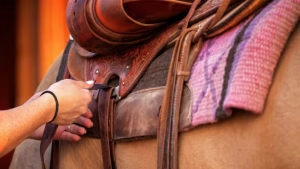
A horse with a building topline is a moving target for the saddler. Even a perfectly fitting saddle in week one will press into newly-developed muscle by week eight, causing pain that immediately undoes the work. Plan for a saddle re-check every 8–12 weeks during a topline-building phase. The Society of Master Saddlers (SMS) maintains a register of qualified UK saddle fitters; insist on SMS qualification.
Signs the saddle is now too narrow include the horse hollowing in the first few minutes of work, swishing the tail, refusing to stretch, and dry patches under the panels after work.
Dental and Bit Fit Checks
A horse cannot stretch into a contact and lift its back if its mouth hurts. Annual dental checks by a BAEDT-qualified equine dental technician or vet are non-negotiable. Bit fit is easily overlooked: many horses school in a bit a size or two too small, pinching the lips and preventing them from working over the back. Re-measure for a bit every couple of years and after any significant change in head shape.
When to Call a Physio or Vet
If your horse refuses to stretch, hollows persistently, bucks into transitions, or is reluctant to go forward despite saddle, dental and rider being correct, ask your vet to rule out kissing spine, sacroiliac dysfunction, ulcers and hind-limb lameness before pushing on with a topline programme. An ACPAT-registered chartered physio working alongside the vet is the gold standard for muscle and posture rehab in the UK.
How Long Does It Take to Build Topline?
Visible change usually appears at 6–8 weeks and is well-established by 12–16 weeks, provided diet and exercise are consistent. Older horses, horses recovering from injury, and horses with deeply ingrained postural patterns may take six months or more. There is no shortcut, and there are no genuinely fast-acting topline supplements — muscle is built one ride and one feed at a time.
Frequently Asked Questions
How can I build my horse’s topline quickly?
The fastest visible improvement comes from combining correct work (long-and-low stretches, transitions, hill walks) with adequate quality protein in the diet. Most horses show clear change in six to eight weeks; expect 12 weeks for substantial development. There is no genuine shortcut, but skipping any element — nutrition, work, or saddle fit — delays results dramatically.
Can you ride a horse with poor topline?
You can, but you risk reinforcing the problem. A horse with a weak topline cannot lift its back to carry a saddle and rider correctly, so it braces with the underside muscles and compresses the spine. Light, correctly ridden work in long-and-low frame, plus groundwork and hill walking, is fine and indeed essential to rebuild. Heavy schooling, jumping or forced collection should be paused until the topline supports the work.
What is the best feed for building topline?
For most horses, a forage-based diet supplemented with an alfalfa-rich chaff and a good-quality protein balancer providing at least 14% crude protein and declared lysine levels is enough. Soya hulls, full-fat soya and linseed are useful additions. Avoid high-starch competition feeds unless the horse needs the calories; muscle is built from protein, not from grain.
Do topline supplements actually work?
Only if the horse’s diet is genuinely short of quality protein and amino acids. A supplement is filling a gap; if there is no gap, the supplement makes no difference. Have your forage analysed and check the protein and lysine levels in your bagged feed before spending money on extras.
Does lungeing build a horse’s topline?
Yes, when done correctly. Lungeing over poles on a balanced circle, encouraging the horse to stretch forward and down rather than forcing a tight outline with side reins, engages the hindquarters and back without rider weight. It is especially useful for young horses, ex-racehorses and any horse that needs topline work without the complication of a rider on board. Avoid endless fast circles on a tight rein, which hollow the back and undo the benefit.
Is hill work safe for older horses with poor topline?
Walking up gentle hills is one of the safest and most effective rehabilitation exercises for older horses, provided they are sound and the saddle fits. Start with five to ten minutes and build gradually. Avoid steep descents, fast trot down hill, and any rushing. If your older horse has known arthritis or a previous back injury, run the plan past your vet first.