Table of Contents
Fun horse facts make for the easiest party tricks in the equestrian world. After six thousand years of domestication and a place in almost every culture on earth, the horse has accumulated more genuinely surprising biology, history, and behaviour than most of us learn in a lifetime of riding. This 2026 collection brings together thirty of the best fun horse facts grouped by theme — anatomy and senses, behaviour and intelligence, racing and record-breaking, history and culture, and a few that even seasoned horsemen tend not to know. Every fact below has been checked against a reliable veterinary, scientific, or racing source.
Anatomy and Senses
- Horses have the largest eyes of any land mammal. Each eye is around 5 cm in diameter — bigger than an elephant’s, bigger than a giraffe’s. Combined with their position on the sides of the head, this gives the horse an almost 360-degree field of vision, with only two small blind spots: one directly in front of the nose and one directly behind the tail.
- Horses cannot vomit. The strong cardiac sphincter at the entrance to the stomach is one-way only. This is why colic from gas, impaction, or poisoning is so dangerous in horses — the stomach can rupture before the horse can expel the contents. See our colic surgery guide for the full picture.
- Horses have ten muscles in each ear. Humans have three. Those ten muscles let the horse rotate each ear independently through nearly 180 degrees, point them in opposite directions, and pick up sound from sources behind them without turning the head. Watch any horse alert in a field and you will see both ears flicking through compass points.
- A horse’s heart weighs around 4–5 kg. Secretariat’s autopsy revealed a heart twice the average size, weighing roughly 10 kg — one of the most cited reasons for his extraordinary stamina and Belmont Stakes record. The “X-factor” gene for an enlarged heart is X-linked recessive and is one of the most studied traits in Thoroughbred genetics.
- Horses have 205 bones. The Arabian breed is unusual in often having one fewer rib, lumbar vertebra, and tail vertebra than other breeds — a small genetic quirk that contributes to the Arabian’s distinctive short back and high tail carriage.
- Horses sweat through their skin. Unlike most mammals (dogs, cats, pigs), horses have a true sweating mechanism almost identical to humans. The protein latherin in equine sweat is what produces the foamy “lather” on a hot horse — and humans share a related gene.
Behaviour and Intelligence
- Horses can sleep standing up. The “stay apparatus” in their legs lets them lock the joints and doze without falling over. But horses must lie down for at least 30–60 minutes a day to enter REM sleep — without it they become sleep-deprived and start collapsing involuntarily. A horse without a safe place to lie flat will eventually develop genuine narcolepsy-like symptoms.
- Horses recognise human emotions from photographs. A landmark 2016 University of Sussex study showed that horses respond differently to photographs of angry vs happy human faces, with their heart rates rising and their attention shifting to the left visual field (the right hemisphere of the brain, which processes negative stimuli) when shown angry faces.
- Horses have facial expressions. Equine ethologists have catalogued 17 distinct facial action units — compared with 13 in chimpanzees. The “horse grimace scale”, developed for pain assessment, is now standard in veterinary medicine for spotting discomfort in stabled horses.
- Horses remember people for years. Studies at the University of Portsmouth and the Wallonia Equine Research Centre show horses recognise and respond differently to humans they have not seen for many months — distinguishing handlers who have treated them well from those who have not.
- A horse’s mood is in its ears. Forward-and-flicking ears = curious, listening. Pinned-back ears flat against the neck = warning, often before a bite or kick. One ear forward and one back = listening to two things at once, often the rider behind and an outside distraction.
Racing and Record-Breaking
- The fastest racehorse ever recorded was Winning Brew. The American two-year-old hit 70.76 km/h (43.97 mph) over two furlongs at Penn National in 2008 — the fastest officially Guinness-recognised speed for a Thoroughbred. Quarter Horses over short sprints have unofficially reached 88 km/h.
- Red Rum is the only horse to win the Grand National three times. 1973, 1974, 1977. He also finished second in 1975 and 1976, making him the only horse ever to be placed in five consecutive Nationals. He raced 110 times in total.
- Arkle had a Timeform rating of 212. Still the highest Timeform rating ever awarded to a steeplechaser. In his Gold Cup years (1964–1966) he was carrying weights so far above the second-favourite that the Irish handicapper introduced two separate handicap weights for races with and without Arkle.
- Sea Biscuit was a horse Hollywood almost rejected. Considered too small, awkwardly-built, and lazy as a three-year-old, he became the American Horse of the Year in 1938. His match race against War Admiral that November is still cited as one of the most-listened-to broadcasts in US radio history.
- The Grand National has 30 fences and is run over 4 miles 514 yards. The race typically features 40 starters; in a typical year, around 17–20 horses complete the course. Becher’s Brook (jumped twice) is named after Captain Martin Becher, who fell into the brook in 1839 — the first running of the race.
- The Cheltenham Festival generates over £100 million for the UK economy. An estimated 280,000 racegoers attend across the four days each March, with the Gold Cup itself watched by around 4 million UK television viewers. The Irish-trained horses have won the Gold Cup in 11 of the last 20 runnings.
History and Culture
- Horses were domesticated around 4,000 BCE on the Pontic-Caspian steppe. Genetic studies published in Nature in 2021 trace nearly every modern domestic horse to a single ancestral population in what is now southern Russia and the Black Sea region.
- The oldest known horse-and-rider depiction is around 5,500 years old. A carved bone plaque from the Botai culture in Kazakhstan shows mounted hunters, and tooth-wear analysis on Botai horse remains shows the wear pattern consistent with bit use.
- The word “horsepower” was coined by James Watt. In the 1780s, marketing his new steam engine to British coal mines, he calculated that a working pony lifted 22,000 foot-pounds per minute. He rounded up to 33,000 to be safe for a draught horse — the figure still used today. A modern Thoroughbred can briefly produce around 14 horsepower.
- The Pony Express in the American West lasted only 18 months. 1860–1861, before being made obsolete by the transcontinental telegraph. In that time, mail riders covered 1,966 miles between Missouri and California in around 10 days, using over 400 horses and 80 riders.
- The Royal Mews still uses Cleveland Bays and Windsor Greys for state occasions. The carriage horses used at Trooping the Colour, state visits, and the King’s birthday celebrations are kept at the Royal Mews at Buckingham Palace. The Cleveland Bay was saved from extinction in the 1960s by HM Queen Elizabeth II.
- There are around 60 million horses in the world today. The largest populations are in the US (around 7 million), Mexico, China, Brazil, and Argentina. The UK has around 1 million horses; South Africa has around 250,000.
Breeds and Genetics
- The Falabella is the world’s smallest horse breed. Adults stand 70–86 cm (around 7–8 hands) — comfortably smaller than a large Great Dane. Despite the size, the Falabella has full horse proportions (not pony proportions) and a horse’s number of vertebrae.
- The Clydesdale is the largest UK draught breed. Modern Clydesdales typically stand 16.2 to 18 hands; one of the largest recorded, Big Jake in the US, stood 20 hands 2¾ inches (210 cm) and held the Guinness world record for tallest horse from 2010 until his death.
- The Akhal-Teke from Turkmenistan has a metallic sheen on its coat. A unique hair structure refracts light, producing a gold or silver shimmer that is impossible to fake or breed into other strains. The Akhal-Teke is one of the oldest surviving breeds, with bloodlines documented back nearly 3,000 years.
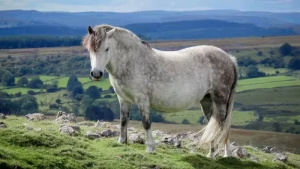
- The Welsh Mountain Pony survived Henry VIII’s 1535 cull edict. The Tudor king ordered the destruction of all horses under 15 hands as part of a military breeding programme. The Welsh ponies survived because they were too wild and remote to be caught — and the breed exists today only because the cull failed in the Welsh hills.
- The grey gene is dominant and progressive. Most grey horses are born dark — bay, black, or chestnut — and turn lighter with age until they are almost white by 7–10 years old. The greying mutation (Syntaxin 17) was identified by Pielberg in 2008 and carries an increased risk of melanoma in older grey horses.
Language, Idiom, and the Horse in English
- “Long in the tooth” comes from horse age judgement. A horse’s teeth continue erupting throughout its life, so older horses literally have longer-looking teeth. Until passport identification became standard, dealers judged age by tooth wear — hence “don’t look a gift horse in the mouth”.
- “Hold your horses” predates the car. The phrase comes from carriage driving, where a sudden command to halt was given as “hold them” — meaning take up the reins firmly. It entered American English in the 19th century via the cavalry.
- The word “chivalry” comes from the French “chevalier” — horseman. The medieval code of knightly conduct was originally a code for mounted soldiers, and many of the most enduring concepts of honour in Western culture trace back to the relationship between a knight and his warhorse.
Fun Horse Facts — Frequently Asked Questions
What is the most surprising fact about horses? The most surprising fact for most people is that horses cannot vomit — a one-way sphincter at the stomach entrance means colic is far more serious than indigestion in most other mammals. Closely followed by the fact that horses can sleep standing up but still need to lie down for REM sleep.
How long do horses live? Most domestic horses live 25–30 years. Ponies often live longer — 30 to 40 years is common. The oldest recorded horse, Old Billy, lived to 62 years old in 19th-century Lancashire. Modern veterinary care and feed mean horses born this century are increasingly reaching their late thirties.
Can horses see colour? Yes, but not as humans do. Horses are dichromats — they see blues and yellows clearly, but reds and greens appear as shades of grey or yellow. Showjumping course designers use yellow and blue fences for maximum visibility to the horse.
How fast can a horse run? A racing Thoroughbred sprinting at full pace reaches around 65 km/h (40 mph). Quarter Horses over a quarter-mile sprint reach 88 km/h (55 mph). The fastest officially recorded racehorse speed is 70.76 km/h (Winning Brew, 2008). The average riding horse canters at around 17 km/h (10 mph).
Do horses have good memories? Yes — horses have one of the best long-term memories in the animal kingdom. They remember handlers, routes, and training experiences for years, sometimes decades. This is why bad early handling can create lifelong problems and why kind, consistent handling produces a sound horse for life.
For deeper reading, see our profiles of Akhal-Teke bloodlines, the KWPN warmblood, the Connemara pony, and our companion article on interesting horse facts for thirty more verified equine tidbits.