Camping with horses is one of the most rewarding ways to spend a long weekend in the saddle — combining hacking through bridleways, forest trails or coastal paths with the simple pleasure of unsaddling and pitching a tent within sight of your tied horse. Interest in horse camping across the UK has climbed steadily, driven by a wave of new equestrian-friendly campsites, BHS-permitted Forestry England rides, and the appetite for low-cost overnight breaks where your horse comes too. This guide covers everything you need to know before you load up: planning the trip, choosing a UK campsite, conditioning your horse, a full packing list, overnight containment, feed and water on the trail, hoof and leg care, first aid, and what is (and isn’t) legal under English, Welsh, Scottish and South African access rules.
Table of Contents
What Is Horse Camping?
Horse camping (sometimes called equine camping or horse-and-rider camping) is an overnight or multi-day trip where you ride to or stable at a campsite, with your horse turned out, hi-tied or stabled within walking distance of your pitch. In the UK most horse camping happens at dedicated equestrian campsites — typically working livery yards or smallholdings that offer grazing paddocks, electric pens or stabling alongside grass pitches for tents, motorhomes and horseboxes. A smaller subculture rides longer distances point-to-point, picking up overnight grazing en route, and some hardy souls wild camp with their horses in the Scottish Highlands where the law allows it.
The appeal is straightforward: you get to ride somewhere genuinely new, your horse experiences a fortnight’s worth of varied stimuli in 48 hours, and the cost is a fraction of an organised riding holiday. The catch is that camping with horses is logistically more demanding than ordinary camping, and your horse’s welfare on the trip depends entirely on preparation done weeks before you leave.
Planning a Horse Camping Trip
Good horse camping is 90% planning and 10% adventure. Work backwards from your departure date and give yourself at least eight weeks — enough time to condition the horse, book a site, sort vaccinations and rehearse your kit. The single most common mistake first-timers make is being too ambitious: a short, low-stakes first trip teaches you more than a heroic multi-day expedition you are not ready for.
A sensible planning timeline
- 8 weeks out — book the campsite, start the conditioning programme, check insurance covers away-from-home grazing.
- 4 weeks out — confirm flu vaccinations are in date, book the farrier for 7–10 days before departure, plan your route on OS maps.
- 2 weeks out — do a full kit rehearsal, including erecting your electric pen or hi-line at home and loading the saddlebags for a training hack.
- Final week — taper the horse’s work, buy forage and hard feed, save the local equine vet’s number, and pack.
For a first trip, choose a site within 90 minutes of home so you can bail out early if anything goes wrong, and plan a single night rather than a long weekend. South African riders on the trail-and-endurance circuit face the same fundamentals — condition the horse, sort containment, carry your own water — but with the added variables of heat, African horse sickness vaccination status and long transport distances between suitable overnight stops. Wherever you ride, the checklist below travels well.
Choosing a Horse-Friendly Campsite
The number of UK campsites that explicitly welcome horses has grown steadily since 2020, and they cluster in regions with extensive bridleway networks: the Lake District, North Yorkshire Moors, the New Forest, Exmoor, the Peak District, mid-Wales, the South Downs and Galloway Forest in Scotland. Useful starting points for finding campsites with horse riding in the UK include the Campsites.co.uk “horses” filter, the British Horse Society’s access and off-road riding resources, and word-of-mouth via local riding clubs.
What to look for
- Secure overnight grazing — fenced paddock, electric pen or stables. Avoid sites that only offer tying to the horsebox overnight.
- Mains water — for filling buckets and damping down hay.
- Hard standing for the horsebox or trailer — soft turf will rut after rain.
- Direct access to bridleways — being able to ride out from the pitch saves hours of loading.
- Muck heap — most sites require you to remove dung from grazing daily.
- Hay sale on site — useful if the journey eats your supply.
Booking practicalities
Equestrian campsites usually charge per pitch plus a small per-horse fee (typical 2026 rates: £20–£35 per pitch per night, £10–£15 per horse). Booking 8–12 weeks ahead is essential for bank holiday weekends in popular regions. Most sites will ask for a copy of your horse’s recent flu vaccination record (within 6 months for some yards, 12 months for most) and proof of public liability insurance — usually covered by your BHS Gold membership or equivalent.
Where You Can Go Camping With Horses: Access and the Law
The legality of wild camping with a horse varies sharply across the UK. Get this wrong and you’re trespassing, blocking a Public Right of Way, or breaching forestry by-laws. When in doubt, book a permitted equestrian site — it is almost always simpler than negotiating access on the day.
England
Wild camping is generally not permitted on open access (CRoW Act 2000) land — only on rights of way with the landowner’s permission. Dartmoor is the one meaningful exception. The High Court removed the right to wild camp on the Dartmoor commons in January 2023, the Court of Appeal restored it in July 2023, and the Supreme Court upheld it in May 2025, ruling that camping by people who reach the commons on foot or on horseback is covered. Check the Dartmoor National Park Authority’s current camping rules before you take a horse there. In practice, English wild camping with a horse means asking a landowner for written permission. Check exactly what any given route allows using the government’s rights of way and open access land guidance. Forestry England occasionally permits horse rallies but does not allow casual overnight tethering.
Wales
No general right to wild camp. Eryri National Park (Snowdonia) says wild camping is not permitted anywhere in the park without prior permission from the landowner or farmer, and Bannau Brycheiniog National Park (Brecon Beacons) says it is illegal without the landowner’s permission, so horses should be confined to permitted equestrian sites or land you have written permission to use.
Scotland
The Land Reform (Scotland) Act 2003 grants a statutory right of responsible access on most land for camping — and that right extends to horses. The Scottish Outdoor Access Code is your reference document. Its camping guidance says to stay no more than two or three nights in one place and to camp well away from buildings and roads (it sets no distance in metres). Leave no trace, avoid enclosed fields of crops or farm animals, and keep clear of stalking and lambing in season. Loch Lomond and the Trossachs introduced camping management byelaws in some lochside zones — check the local rules before you arrive.
Northern Ireland
No right of responsible access; wild camping with horses requires landowner consent.
South Africa
There is no equivalent statutory right of access. Trail and endurance rides almost always run through private farmland, nature reserves or organised venues, so overnight camping with horses is arranged by permission or as part of a booked trail. Reserves that permit horses set their own rules on containment, grazing and dung removal, and many require proof of African horse sickness and tetanus vaccination before you arrive. Confirm water availability in advance — in the dry season, natural water on the trail cannot be assumed.
Conditioning Your Horse for Camp
The single biggest welfare issue at horse camps is undertrained horses being asked to hack four to six hours a day across unfamiliar terrain. Build a six-to-eight week conditioning programme before camp — the same principle endurance horses are legged up on, scaled to your goals.
Six-week conditioning outline
- Weeks 1–2 — 30–45 min walking hacks 4 days a week, plus one schooling session.
- Weeks 3–4 — extend to 60–75 min including 5–10 min steady trot blocks; introduce hill work twice a week.
- Weeks 5–6 — full 2–3 hour hacks once a week with hills, varied surfaces, water crossings and a packed saddle.
- Final 5 days — taper. Two short hacks plus rest. Don’t arrive at camp on a tired horse.
Pay particular attention to resting heart rate and recovery times — a fit horse should drop to under 60 bpm within 10 minutes of finishing a 30-minute trot. Never leap a horse from light hacking straight into back-to-back long days: sudden hard work on an unconditioned horse is a classic trigger for azoturia (tying up). If you want to benchmark distances properly, Endurance GB publishes graded ride distances that make a useful fitness yardstick.
Foot, teeth, vaccinations
Book the farrier 7–10 days before the trip — fresh shoes need a few days to settle. Confirm flu vaccinations are in date and that you have the original passport (not a photocopy) to take with you. If your horse is barefoot, consider hoof boots even if you don’t normally use them; UK bridleways include long stretches of road work and abrasive forest tracks.
Overnight Containment Options
How you contain your horse overnight is the safety question that matters most. Each option has trade-offs — the right choice depends on the site, your horse’s temperament and how much kit you can carry.
Stables
Best for: first-time campers or anxious horses. Most equestrian campsites offer a small number of stables for an extra £8–£15 per night. Bring your own buckets and bedding (some yards charge £5–£10 for shavings). Downside: limited availability, and a stable-kept horse misses the grazing that keeps the gut moving.
Portable electric corral (pens)
Best for: the most popular option at UK horse camps. A 3-strand polywire pen roughly 6 m × 6 m gives a horse enough room to lie down and turn. Run the energiser from a 12V leisure battery and check the volts each evening. Downside: naïve horses can charge through and bolt before they learn the lesson, so pre-train your horse to respect electric fencing at home. Not permitted on some forest sites where ground stakes are banned.
High line (hi-line)
Best for: forest sites where ground anchors aren’t allowed. Use a rope of 3/8 to 1/2 inch (about 10-13 mm) strung tight between two trees with tree-saver straps, and tie the lead rope, with a swivel in it, to a fixed knot or loop in the line so it cannot slide along. Tie it just long enough for the horse to get his head to the ground and no longer, or he can step over the rope. That is the set-up in the trail guides from East Slope Back Country Horsemen and Horse&Rider; a thin 5 mm cord and a sliding tie point are not. A high line keeps horses away from tree trunks and roots, though the ground under it still gets trampled. Downside: requires practice at home and is not suitable for horses that paw or lean back.
Picket line and corral panels
Best for: larger horse-camping rallies where several riders travel together and share kit. A picket line is a low ground-level line the horse is tied to, while portable metal corral panels build a solid temporary yard. Downside: heavy and bulky — generally only practical with a horsebox and multiple hands.
Tethering and hobbling
Best for: short, supervised grazing stops rather than unattended overnight containment. A single tether stake or a hobble should never be your only overnight plan — a tethered horse can tangle a leg, and hobbles are for horses trained to them from a young age. Downside: high risk of injury if left unsupervised; illegal or frowned upon at many sites.
Horse Camping Packing List
Print this camping-with-horses checklist and tick it off as you load. Test the full weight of your horse camping gear on a training hack before you commit to it on the trail.
For the horse
- Passport (original, not photocopy — required by law for travel)
- Headcollar, lead rope, spare lead rope
- Bridle with a bit appropriate to the horse, plus a spare hackamore or bitless option for emergencies
- Saddle, numnah and at least one spare
- Saddlebags or cantle bag (test loaded weight at home first)
- Hi-line kit (50 m of 3/8-1/2 inch, about 10-13 mm, hi-line rope, two tree-saver straps, prusiks, tie ring)
- Electric fence kit (battery energiser, four posts, 50 m polywire)
- Two collapsible buckets — one for water, one for feed
- 48–72 hours of forage (small-holed haynets reduce waste)
- Hard feed in pre-measured bags
- First aid kit: vet wrap, stable bandages, gamgee, hibiscrub, wound powder, tweezers, thermometer, electrolytes, and the emergency vet contact for the region
- Hoof pick, hoof boot for a thrown shoe, glue-on or strap-on emergency shoe
- Fly mask, fly spray, sweat scraper, sponge
- Lightweight travel rug for cool nights
For the rider
- Riding hat (PAS 015 or VG1 minimum), back protector if hacking unfamiliar terrain
- Body warmer, waterproof, gloves, half-chaps
- Spare riding boots and dry socks
- Tent or roof tent on the horsebox, sleeping bag rated 5°C lower than expected lows
- Head torch, plus spare batteries
- OS Explorer maps for the region (don’t rely on phone signal)
- Whistle, basic human first aid kit, painkillers
- Power bank, in-car charger
- Cash for honesty boxes and rural pubs without cards
Feed and Water on the Trail
A horse working long days needs more forage, not less, and steady access to water. The golden rule is to change as little as possible: carry the same hard feed your horse eats at home, because a sudden diet change on top of the stress of travel is a fast route to digestive upset. Read up on the basics in our horse feeding guide before you tweak anything for camp.
- Forage first — aim for at least 1.5–2% of bodyweight in forage per day, more when the horse is working. Pack extra; hungry horses chew fences and eat bedding.
- Water little and often — offer water at every sensible opportunity on the trail. A horse can drink 25–45 litres a day, and far more in heat.
- Encourage drinking — horses are fussy about strange water. Adding a splash of apple juice to one bucket, or training them to drink flavoured water at home, keeps them hydrated away from the yard.
- Electrolytes — replace salts lost in sweat on hot or long days, but only alongside free access to plain water, never instead of it. Watch for early signs of dehydration in horses such as tacky gums, and do not rely on the skin-pinch test: the BHS says research has shown it is not an accurate measure of hydration.
- Graze with care — sudden access to rich spring grass after a hay-based diet can trigger laminitis in susceptible horses and ponies. Restrict lush grazing for good-doers.
Hoof and Leg Care
Feet and legs take the punishment on a horse camping trip, and problems that would be trivial at home become serious when you’re miles from the box. Whether your horse is shod or barefoot, understanding the basics of hoof protection and care pays off on the trail.
- Pick out feet twice a day — before you ride and again at the pen. Grit and stones packed against the frog cause bruising and abscesses.
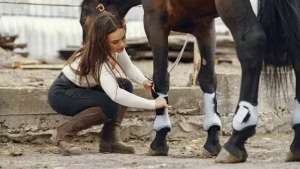
- Carry a spare — a strap-on hoof boot rescues a barefoot horse or covers a thrown shoe until you can reach a farrier.
- Check legs every evening — run your hands down each leg for heat, swelling or cuts after the day’s work. Cold-hose or cold-pack any filling.
- Mind the going — deep mud, hard-baked tracks and long tarmac stretches all jar legs and feet. Vary your pace and your surfaces.
- Keep it clean and dry — persistent wet and mud invite thrush and mud fever, so let feet and lower legs dry off overnight where you can.
First Aid and Emergency Planning
Before you leave, make a plan for the three most common camp emergencies and know your horse’s resting TPR (temperature, pulse, respiration) baseline so you can spot when something is wrong.
Lameness on trail
Carry a hoof pick, hoof boot and a glue-on emergency shoe. If your horse goes suddenly and severely lame, dismount and check the foot first, because most sudden lameness starts there. But if he cannot bear weight on the leg, do not walk him back in hand: keep him quiet and still where he is, call a vet immediately, and ask the campsite to have transport ready in case the vet decides he has to be moved. Walking him back to the box is the instinct to resist. Horse & Hound’s first-aid advice on suspected fractures is to call your vet for emergency attention and not to move a horse that is suddenly unable to bear weight. Save the local equine vet’s number to your phone before the trip – signal may be patchy on the day.
Colic at camp
If your horse is dull, off feed, pawing or rolling repeatedly, call a vet immediately on the signs alone, as the BHS REACT colic advice says. Do not delay the call to take a temperature first: B&W Equine Vets tell owners not to waste time measuring parameters beforehand. While you wait, feed comes away but water stays: Horse & Hound’s vet library (Karen Coumbe MRCVS) says the horse should not eat, although water should not be withheld. The leading cause of camp colic is dehydration, so encourage drinking from the moment you set off. Know how far the nearest equine hospital is before you book the trip.
Loose horse
Even with electric fencing, horses can escape. Make sure your horse is microchipped, the chip number is in the passport, and you have a recent photo on your phone. Notify the campsite warden first; they’ll know which neighbours to call.
Trail Safety and Bridleway Etiquette
The UK bridleway network is the legal backbone of horse camping. Bridleways are shown as long green dashes on OS Explorer maps (pink on OS Landranger, as Ordnance Survey’s rights of way guide shows) and are open to horse riders, cyclists and walkers. Restricted byways and BOATs (Byways Open to All Traffic) also permit horses, but only BOATs are open to motor vehicles, so that is where you may share the route with 4×4s (GOV.UK). Footpaths are not legal for horses. For a fuller primer on riding out safely, see our guide to hacking best practice.
Trail riding etiquette
- Walk past walkers, ramblers and dog walkers with a polite greeting; offer to pass slowly so dogs don’t get spooked.
- Trot or canter only when sight lines are clear for at least 100 m.
- On forest tracks, sound a horn or call out before blind corners — mountain bikers descend at speed.
- If you open a gate, close it behind you. If livestock are in the field, ride single file at a walk.
- Avoid soft going after rain — your hoofprints can wreck a footpath the BHS spent years securing access to.
Distance planning
A fit, conditioned horse can comfortably cover 20–25 miles a day on varied terrain, but most novice horse campers underestimate the toll of carrying a full set of saddlebags. For a first trip, plan 12–15 miles a day with a long lunch break and a midpoint water stop.
Biosecurity and Welfare
Bringing your horse into contact with strange horses, shared water troughs and unfamiliar grazing carries a disease risk that is easy to manage and expensive to ignore.
- Vaccinations up to date — equine flu and tetanus as a minimum, and keep the record with the passport. Many sites won’t admit you without it.
- Don’t share buckets — bring your own water and feed buckets and never let your horse drink from a communal trough where you can avoid it.
- Isolate the poorly — a coughing or snotty horse stays home. Nasal discharge, a temperature over 38.5°C or new coughing are reasons to cancel, not to travel.
- Clean kit between trips — disinfect buckets, headcollars and grooming kit, especially after a site where your horse mixed with others.
- Leave no trace — remove all dung from grazing and pitches, scatter nothing that isn’t biodegradable, and protect the access that riders before you fought to keep.
Frequently Asked Questions
Can I take my horse wild camping in the UK?
Legally in Scotland under the Land Reform (Scotland) Act 2003, and even then with restrictions on duration, distance from buildings, and respect for stalking and lambing seasons, and on the Dartmoor commons, where the Supreme Court confirmed in 2025 that the right to camp covers people who arrive on horseback. Elsewhere in England, and in Wales and Northern Ireland, wild camping with a horse requires the landowner’s written permission. Everywhere else, book a permitted equestrian campsite.
How much does horse camping in the UK cost?
Typical 2026 rates at equestrian campsites are £20–£35 per pitch per night plus £10–£15 per horse. Stables add £8–£15 per night. A weekend with one horse and one rider usually works out at £80–£140 plus diesel and forage.
What should be on my camping with horses checklist?
At a minimum: the horse’s passport, headcollar and spare lead ropes, tack plus a bitless spare, your chosen containment kit (electric pen or hi-line), collapsible buckets, 48–72 hours of forage and hard feed, an equine first aid kit, a spare hoof boot, and your own tent, maps and layers. Rehearse the full load on a training hack before you leave.
What’s the best breed for camping with horses?
Native UK breeds are unbeatable for this kind of work. The Welsh Cob (Section D), Exmoor Pony, Fell Pony, Dales Pony, New Forest Pony and Connemara were all bred for hardy long-distance work on rough ground. For serious distance and heat tolerance, the Arabian remains the classic endurance choice.
How long should my horse’s first camping trip be?
One night, two days. Pick a campsite within 90 minutes of home so you can return early if anything goes wrong. Build to two- and three-night trips once you’ve ironed out the kit list and your horse settles overnight.