Understanding the behaviour of horses is one of the most important things you can do as a horse owner, rider, or trainer. Horses communicate constantly — through their ears, eyes, tail, posture, and voice. The better you read those signals, the safer and more rewarding your relationship with your horse will be. This guide covers the key aspects of equine behaviour, from natural instincts to common behaviour problems.
Table of Contents
Why Horses Behave the Way They Do
Horses are prey animals. Everything about their behaviour — their skittishness, their herd instinct, their sharp senses — evolved to keep them alive in the wild. Their primary survival strategy is flight. When threatened, a horse’s first response is to run, and if it cannot run, it will bite, kick, strike, or rear.
This fight-or-flight response is hardwired. When a horse perceives danger, the amygdala triggers a hormonal cascade: adrenaline and noradrenaline flood the bloodstream, blood pressure rises, and oxygen is redirected to the muscles. The result is a horse that can go from calm to explosive in a split second. Once the threat passes, the parasympathetic nervous system kicks in, releasing endorphins and returning the horse to a resting state.
Understanding this biology helps explain why a horse might spook at a plastic bag or a discoloured rock. To a prey animal, an unfamiliar object could be a predator. This is not “bad behaviour” — it is a survival mechanism that thousands of years of domestication have not erased.
The Role of Senses in Equine Behaviour
Horses have panoramic vision with a small blind spot directly in front and directly behind them. They can see two separate images simultaneously, one from each eye, which means each side of the brain processes information independently. This is why a horse may need to be introduced to something on both its left and right side separately — what it learns on one side does not automatically transfer to the other.
Their hearing is far keener than ours. Horses can rotate each ear independently through 180 degrees to pinpoint the source of a sound. On a windy day, when normally stationary objects start moving unpredictably, a horse’s heightened sensitivity to movement makes it far more reactive than usual.
Their sense of touch is remarkably sensitive — a horse can feel a single fly on one hair. This is why a light leg aid from a rider is sufficient, and why heavy-handed handling causes distress.
The Herd: Understanding Social Behaviour of Horses
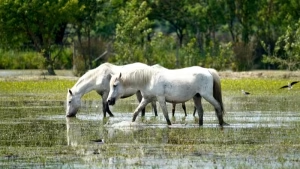
Horses are highly social animals. In the wild, they live in bands of mares and their offspring, led by a dominant mare rather than the stallion. The lead mare guides the herd to food and water, sets the daily routine, and ensures the group’s general wellbeing. The stallion’s role is primarily that of protector and guardian, patrolling the perimeter and staying at the rear when the herd moves.
Newer research has moved away from the old idea of a strict linear pecking order. Wild horses communicate largely through positive reinforcement and subtle body language rather than constant dominance displays. Reading those signals accurately is a skill in its own right — our guide to decoding horse body language works through them ear by ear and tail by tail. A stable hierarchy reduces conflict and keeps the group cohesive, but it is not maintained through continuous aggression.
What Happens When Horses Are Isolated
A horse kept alone will often become anxious, difficult to manage, and stressed. This is not simply a personality quirk — it is a genuine welfare concern. Horses that live without equine company may require a substitute companion such as a goat, donkey, or even a barn cat to reduce stress.
When a horse becomes anxious about separation from its herd while being handled, it is described as being “herd-bound.” With correct training, horses learn to trust a human handler enough to be comfortable away from other horses. However, it is important to understand that humans cannot truly replace herd companionship — they are a different species, and horses know it.
How Horses Communicate
Body Language
The body language of horses is rich and consistent. Learning to read it accurately can prevent accidents and improve training outcomes.
Ear position is one of the most reliable indicators of a horse’s attention and mood. Ears pricked sharply forward mean the horse is alert, focused on something ahead. Ears pointing loosely outward, sometimes called “airplane ears,” suggest tiredness or low mood. Ears pinned flat against the neck are a serious warning — this horse is angry and may bite or kick.
The eyes tell their own story. A soft, relaxed eye with no white showing indicates a calm horse. When the whites of the eyes are visible, the horse is frightened or angry. Tense muscles above the eye, forming an upside-down V shape, are a reliable sign of worry or pain.
The tail is equally expressive. A high, flagging tail signals excitement or alarm. A tail clamped tightly against the hindquarters can indicate cold, fear, or pain. Aggressive tail swishing — not the gentle flick used to dislodge flies — is a warning that irritation or anger is building.
Vocalisation
Horses are not particularly vocal animals, but they do have four main vocalisations. The whinny or neigh is the most familiar: a long, high-pitched call used to locate herd mates or announce the horse’s own position. The nicker is a softer, low-pitched sound — a mare nickers to her foal, a stallion nickers while courting, and a stabled horse often nickers at feeding time. The snort is generally a sign of mild interest or the clearing of the nasal passage. The squeal is a sharper sound, most often heard when horses first meet or when a mare rejects a stallion’s advances.
Natural Behaviour of Horses: Grazing, Movement, and Sleep
Grazing
Horses are designed to graze for 12 to 16 hours a day, moving slowly across a range and consuming small amounts of forage almost continuously. Their digestive systems depend on this trickle-feeding approach. Long gaps between meals can cause gastric discomfort, stress, and problem behaviours. A stabled horse fed only twice a day is working against its own biology.
Movement
In the wild, horses travel many kilometres daily. This steady movement keeps circulation healthy, wears down the hooves naturally, and provides mental stimulation. Domestic horses kept in small paddocks or stables with limited turnout are being deprived of something fundamental to their wellbeing.
Sleep
Horses can sleep standing up, thanks to a passive stay apparatus in their legs that locks the joints without muscular effort. This allows them to doze safely as prey animals, always ready to flee. However, horses must lie down to achieve REM sleep. They only need one to two hours of lying-down sleep every few days, but if they are denied the opportunity — perhaps because the stable is too small or the social environment feels unsafe — they will become sleep-deprived. A horse kept alone may also sleep poorly because its instinct demands constant vigilance.
Problem Behaviour of Horses
Aggression
Aggressive behaviour in horses includes flattened ears, rapid tail lashing, snaking of the neck, pawing, biting, and kicking. It is a common problem, particularly when unfamiliar horses are introduced to an existing group and must establish a new hierarchy.
Aggression towards people often occurs in the stable, where a horse feels confined and may defend its space. It can be fear-based, pain-induced, hormonal, or learned. A fearful horse tucks its tail and turns its ears to the side. An offensively aggressive horse lashes its tail and pins its ears back. Recognising the difference matters because the response to each is different.
Punishment is rarely an effective solution and can make matters significantly worse. Positive reinforcement, desensitisation, and addressing the underlying cause — whether that is pain, social instability, or learned behaviour — is always the better approach.
Stereotypies
Stereotypic behaviours are repetitive, apparently purposeless actions that affect an estimated 10 to 20 percent of domestic horses. They are almost never seen in wild or free-ranging horses, which tells us something important: they are a product of the domestic environment, not a character flaw.
Cribbing is one of the most common stereotypies. The horse grabs a fixed surface with its incisor teeth, arches its neck, and sucks air into the throat with a characteristic grunting sound. It is strongly linked to confinement and a high-grain diet, and is associated with gastric ulcers, colic risk, and dental wear. Once established, cribbing typically persists even if management improves.
Weaving involves the horse rocking its head and neck from side to side while shifting weight between its front legs. It is most often performed at a stable door and can occur up to 90 times per minute. Over time, weaving causes orthopaedic strain, uneven muscular development, and weight loss from energy expenditure.
Stall walking (also called box walking) is the repetitive circling of a stable. Some horses will walk in circles for hours, and increasing the size of the space they are given does not stop the behaviour — they simply circle in a smaller area of a larger space. This stereotypy can predispose horses to a serious condition called rhabdomyolysis, in which skeletal muscle fibres break down.
Wood chewing differs from cribbing in that the horse actually ingests the wood. The primary cause is insufficient roughage in the diet. Once nutritional needs are met, the behaviour often decreases. Risks include tooth wear and gastrointestinal problems from swallowed wood and any chemicals it may have been treated with.
The most effective way to prevent stereotypies is to ensure horses have constant access to forage, regular social contact, adequate turnout, and an environment that allows them to express natural behaviour. Punishing a horse for stereotypic behaviour does not address the cause and is counterproductive.
Fears and Phobias
Horses have an innate suspicion of new things, known as neophobia. This explains many common handling challenges, including trailer loading problems. A horse that has had a bad experience in a trailer, or that finds the enclosed dark space threatening, may refuse to load entirely.
The best treatment for fear-based behaviour is slow, systematic desensitisation combined with positive reinforcement. This takes time but produces lasting results. Forcing a frightened horse or punishing it during trailer loading will worsen the fear and create a more dangerous situation for everyone involved.
Reading Behaviour as a Health Indicator
A horse’s behaviour is one of the clearest windows into its health. A sudden change in behaviour — increased aggression, withdrawal from the herd, unusual lethargy, or loss of appetite — should always be investigated. These changes can be the first signs of pain, illness, or injury.
A healthy horse is alert and inquisitive, participates in normal herd activities like mutual grooming, has a good appetite, moves freely without signs of lameness, and passes manure eight to twelve times a day without straining. Deviations from this baseline are worth taking seriously.
If you notice unexplained changes in your horse’s behaviour, consult your vet first. If a physical cause is ruled out, a qualified equine behaviourist can help identify and address the underlying issue.
Final Thoughts
The behaviour of horses makes complete sense once you understand who they are: highly social, acutely sensitive prey animals shaped by millions of years of survival on open grasslands. Their seemingly irrational reactions, their need for company, their compulsive habits when confined — all of it has a logic rooted in their biology.
The best horse owners and handlers are not those who dominate or control, but those who observe, listen, and respond. Spend time watching your horse. Learn what normal looks like for that individual animal. When something changes, ask why. The answer is almost always in the behaviour itself.
Frequently Asked Questions
Why do horses spook at seemingly harmless things like plastic bags or puddles?
Horses are prey animals with a powerful fight-or-flight instinct. To a horse, any unfamiliar object could potentially be a predator. Their vision also makes depth perception tricky — a puddle can look like a bottomless hole. This is normal behaviour, not disobedience.
How can I tell if my horse is in pain just by watching its behaviour?
Common signs include a tense, upside-down V shape above the eye, square nostrils, ears held back, excessive tail swishing, unusual aggression, lethargy, or a reluctance to move freely. Any sudden change from your horse’s normal behaviour warrants a call to your vet.
Is cribbing a learned behaviour that my horse picked up from other horses in the stable?
Research shows this is largely a myth. Horses in the same group that develop similar stereotypies are almost always responding to the same stressful environment, not copying each other. The real causes are confinement, high-grain diets, and insufficient roughage and turnout.
Do horses need other horses, or can a human owner provide enough companionship?
Horses are highly social herd animals and genuinely need equine company for their wellbeing. While a strong bond with a human handler is valuable, it cannot replace the companionship of another horse. A horse kept entirely alone is at real risk of stress and developing stereotypic behaviours.
At what point should I be concerned about my horse’s repetitive behaviours like weaving or stall walking?
Any repetitive behaviour that replaces normal activities like eating, drinking, or resting is a welfare concern. Both weaving and stall walking can cause physical damage over time, including joint strain and muscle breakdown. Rather than trying to stop the behaviour directly, focus on addressing the root cause — more turnout, forage, and social contact.