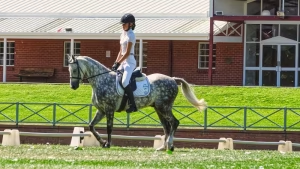
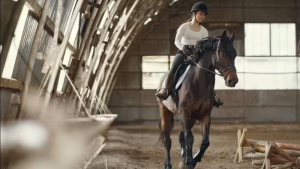
The extended trot is one of the most eye-catching movements in dressage: the horse covers maximum ground with huge reach from the hind legs, a raised forehand, and the kind of suspension that makes the audience gasp. Unlike a collected trot, the extended trot allows the horse’s frame to open slightly and the nose to come marginally in front of the vertical, emphasising freedom, energy and a long, elastic stride.
This guide breaks down the extended trot for British and South African dressage riders: how it differs from working, medium and collected trot, what the judge is looking for, exercises to build it at home, the training progression from novice to advanced, and the common mistakes that keep a promising horse stuck at “medium with extra speed”.
Table of Contents
What Is the Extended Trot?
The extended trot is a two-beat diagonal gait where the horse covers the greatest possible distance with each stride while maintaining rhythm, balance and uphill self-carriage. The frame lengthens, the nose comes slightly forward of vertical, and the hind legs drive visibly under the body. The forelegs extend freely from the shoulder; the hindquarters produce the power.
A true extended trot is the product of collection. The horse is not simply going faster — it is converting the hind-leg engagement of collected work into forward-flowing ground cover. In British Dressage and FEI tests, extensions appear from Advanced Medium level upwards and become a headline movement from Prix St Georges through Grand Prix.
Extended, Medium and Collected Trot Compared
Understanding the scale of trot variations is essential before attempting extensions.
Working trot
The natural, unexaggerated trot asked for at the lower levels. The horse moves forward freely in a steady rhythm, balanced between collection and extension.
Collected trot
Shorter, higher, more active strides. The horse carries more weight behind, the neck rises, and the forehand lightens. Collection is the engine room of extension; without it, true extended trot is physically impossible.
Medium trot
Moderate lengthening. The hind legs step clearly forward under the horse, the frame opens slightly, but the stride is not yet at maximum reach. Medium trot is the bridge between working and extended trot.
Extended trot
Maximum stride length and ground cover, while retaining rhythm and balance. The forelegs should reach to the point where the hoof lands in line with the tip of the nose. The horse’s frame lengthens without losing uphill carriage.
Quick reference comparison
- Collected: shortest stride, highest self-carriage.
- Working: natural, balanced stride.
- Medium: moderate lengthening, clear reach, still contained.
- Extended: maximum lengthening, open frame, suspension.
What the Dressage Judge Looks For
- Maintenance of rhythm — the tempo stays the same; only the stride length changes. Rushing loses marks immediately.
- Clear reach from the shoulder — the forelegs must swing freely, not kick upward in exaggerated “goose-step” action.
- Engaged hind legs — the hind hoof should land where the fore hoof left, or further forward.
- Uphill balance — the wither remains at or above the level of the croup.
- Transitions — the preparation, departure and return to collection are marked separately in FEI tests; bad transitions lose as many marks as a poor extension itself.
- Straightness — the horse must stay straight on the diagonal, with no drift or swinging quarters.
Preparing Your Horse for the Extended Trot
Fitness and topline
Extension is physically demanding. The hind legs must carry weight under the body while the forelegs produce power and reach. A horse without good topline and core strength simply cannot do it. Expect 6–12 months of systematic fitness work, including hill work, transitions, pole exercises and lateral work, before a horse is physically ready for meaningful extension.
Collection first
Extension is the release of stored collection. Until a horse can sit a balanced collected trot with genuine hindquarter engagement, there is no “storage” to release. Trot-halt-trot transitions, walk-canter-walk and lateral work (shoulder-in, travers, half-pass) are all building blocks that develop the carrying strength needed.
Suppleness and straightness
A crooked horse cannot extend. Daily work on suppling the neck, ribcage and hindquarters is essential — think leg-yielding on both reins, circles of varying sizes, and serpentines that check bend either way.
Exercises to Build the Extended Trot
Transitions within the trot
The single most important exercise. Ride working trot down the long side, collect for three or four strides at the corner, then ask for a medium for four or five strides, then return to collected. Repeat daily. Transitions within the gait build the horse’s ability to modulate its own stride.
Trot-canter-trot transitions
Canter recruits the hindquarters powerfully. A few strides of canter followed by an immediate trot often produces a freer, more forward trot that contains elements of extension. Use the canter to “charge” the trot.
Long-side lengthenings
In a 20×60 m school, start in collected trot at the short side, ride a medium trot down the long side, and return to collected before the next corner. As the horse’s fitness and balance grow, ask for more stride length over fewer steps.
Diagonal lengthenings
Once the horse lengthens reliably down the long side, ride a medium or extended trot across the diagonal. The diagonal is the competition line and the horse needs to feel comfortable with the geometry.
Pole exercises
Trotting poles set at extended-stride distances (around 1.5–1.6 m apart for most horses, closer for ponies) encourage the horse to open the stride in a mechanical way that the rider can then translate to open-arena riding.
Hill work
Trotting up gentle hills in a lengthened frame builds the hindquarter strength required for true extension. Always walk the horse back down.
Riding the Extended Trot Correctly
- Prepare with collection — one or two circles of collected trot at the corner before the long side or diagonal.
- Half-halt — a clear half-halt just before asking balances the horse and signals an aid is coming.
- Apply a driving leg aid — both legs, short and firm, not constant squeezing.
- Allow with the hand — the contact lengthens as the horse’s neck opens; the rider must soften the hand by an inch or two without dropping the contact entirely.
- Sit tall, not back — leaning back tips the horse onto its forehand. Stay over the centre of gravity.
- Rise in rhythm — most riders perform extensions in rising trot at working levels. At Grand Prix, extensions are sitting.
- Prepare the return — in the final few strides, apply a gradual half-halt and close the hand to bring the horse back to collected trot.
Maintaining the Extension Across the Diagonal
Many horses produce a big first few strides and then lose the extension as they cross the diagonal. To keep the extension alive:
- Keep your leg on — extensions fade when riders stop asking. A steady driving aid throughout is essential.
- Keep the contact soft but steady — not dropping it.
- Look up and forward — riders who look down encourage horses onto the forehand.
- Ride in thirds — think of the diagonal as three sections: ask, maintain, prepare to collect. That mental structure keeps you actively riding rather than admiring.
Common Mistakes and How to Fix Them
Running instead of extending
The horse quickens the tempo but does not lengthen the stride. Fix: go back to transitions within the trot; use poles to enforce a longer stride; half-halt before and during the extension.
Losing balance and falling onto the forehand
The horse drops the wither and drags itself forward. Fix: return to collected trot and leg-yield exercises; re-establish the hind-leg engagement before trying again.
Hollowing the back
The horse throws its head up and drops the back as you ask. Fix: leave extensions for a week and work on long-and-low stretching, Pessoa or chambon lunging to rebuild the topline.
Goose-stepping
The forelegs flick upwards rather than reaching forward. Fix: this is usually an imbalance issue, not a foreleg issue — work on true engagement behind before asking for ground cover in front.
Drifting off the diagonal
The quarters swing right or left. Fix: ride with a clearer outside rein and leg; practise the diagonal in working trot repeatedly before adding extension.
Breed and Conformation Considerations
Not every horse has a natural extended trot. Conformation matters:
- Warmbloods — many modern European warmbloods are bred for extension; a Hanoverian, KWPN or Oldenburg with an uphill shoulder and open stride has the mechanical advantage.
- Iberian horses — Andalusians and Lusitanos collect beautifully but can find true extension harder owing to a slightly shorter, more arched frame.
- Thoroughbreds — often gifted at medium and extended trot through natural athleticism, but need careful work on collection to develop the balance.
- Cobs and native ponies — a Welsh Cob or Connemara can produce surprisingly impressive extensions, but the judge will be looking for correctness of the movement, not size of stride.
Conformationally, a horse with a sloping shoulder, a long forearm, strong loins and well-set hindquarters has the physical advantage. Work with what your horse has — a correct medium trot is worth more marks than an exaggerated, rhythm-losing extension.
Practical Riding Tips
- Film yourself — a phone on a tripod at C tells you more about your extension than any instructor watching from the ground.
- Count beats — a true extension retains the tempo of working trot, not a faster one. Count under your breath.
- Work on fitness first — 20 minutes of polework, transitions and hill work three times a week builds the strength to extend safely.
- Ride lots of diagonals in working trot — your horse needs to feel comfortable on the geometry long before you add extension.
- Train less, school better — three or four quality extensions a session are enough; repetition fatigues the horse and produces worse rather than better work.
- Warm up thoroughly — never ask for extended trot cold. At least 15 minutes of walk and working trot first.
Frequently Asked Questions
What is the difference between medium and extended trot?
Medium trot is a moderate lengthening of stride and frame with clear engagement behind. Extended trot is the maximum lengthening possible while maintaining rhythm, balance and uphill carriage. The horse covers more ground, the frame opens further, and there is more visible suspension in the extended stride.
At what dressage level is extended trot asked for?
In British Dressage, extended trot appears from Advanced Medium upwards. At FEI level, true extensions are a cornerstone of tests from Prix St Georges through Grand Prix. Medium trot, a precursor movement, appears from Elementary level upwards.
How do I stop my horse running in extended trot?
Rushing means the horse is lengthening the tempo rather than the stride. Return to transitions within the trot, use half-halts to rebalance, and try trotting poles spaced at extended-stride distances to force a longer stride at a steady rhythm.
Should extended trot be ridden rising or sitting?
At working dressage levels and in general schooling, extensions are usually ridden rising to free the horse’s back. From Prix St Georges upwards they are ridden sitting. Build sitting trot fitness progressively — it is physically demanding for both horse and rider.
Can any horse learn extended trot?
Almost any sound, well-schooled horse can produce a functional extended trot. The size of the stride depends on conformation and breed, but correctness — rhythm, balance, engagement, straightness — matters much more to judges and to long-term welfare than spectacular reach.
How long does it take to train extended trot?
For a horse already competing at Elementary with a reliable medium trot, expect 6–12 months of systematic work to develop a consistent extended trot. Horses that need to build collection and topline first may take 12–24 months.
What exercises help develop extended trot fastest?
Transitions within the trot (collected–medium–collected), trot-canter-trot transitions, hill work at a lengthened trot, trotting poles at extended-stride distances, and plenty of lateral work (shoulder-in, travers, half-pass) to build the hindquarter engagement that powers the extension.