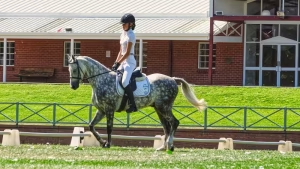
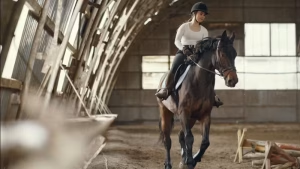
The manège is the riding arena — the enclosed schooling space in which generations of British and European horses have learned their craft. Classical riding, the discipline that developed inside the walls of the Spanish Riding School, the French Cadre Noir, and Portugal’s Escola Portuguesa de Arte Equestre, treats the manège as a precise and deliberate training ground. A manège horse, then, is simply a horse schooled with care and correctness within that space — whether the goal is Grand Prix dressage, a steadier hack, or a safer jumping horse. This guide explains how to use the manège well, what classical riding has to offer modern equestrians, and how to build a better horse through considered schooling.
Table of Contents
What Is a Manège?
“Manège” is the French word — borrowed directly into English — for a covered or outdoor horse riding school. In Britain it is used interchangeably with “arena”, “school”, or “ménage” (though the latter is a spelling error that has become stubbornly common). A standard dressage manège measures 20 m × 40 m for small arenas and 20 m × 60 m for the full international arena. The surface is usually a specialist riding material — silica sand, rubber crumb, fibre, or a waxed mix — over a stone drainage base.
The manège is more than a boundary. The walls and markers shape the horse’s way of going. A wall offers straightness that an open field cannot; the markers (A, K, E, H, C, M, B, F) give the rider repeatable reference points for figures and movements. Good riders treat the manège like a musical staff — a framework that disciplines the work.
What Is Classical Riding?
Classical riding is the system of horse training codified over centuries at the great European riding schools. Its principles descend from Xenophon’s On Horsemanship (written around 350 BC), refined through the Renaissance by William Cavendish and François Robichon de la Guérinière, and preserved in a living tradition at institutions such as:
- The Spanish Riding School of Vienna — home of the Lipizzaner and the airs above the ground
- The Cadre Noir at Saumur — France’s national equestrian school
- The Escola Portuguesa de Arte Equestre — Portugal’s Lusitano-based classical tradition
- The Royal Andalusian School of Equestrian Art — Jerez, Spain
Classical riding is not a discipline in the modern sports sense — it is a philosophy of how horses should be developed. Its guiding idea is simple: the horse is trained gradually, over years, to carry the rider in balance, strength, and willingness. Force has no place. Modern competitive dressage traces its lineage back to classical training, though at the top end of the sport, purists would argue the two have drifted apart.
Understanding the Manège Horse
The term “manège horse” has two meanings in British and European riding culture. In the older sense, it refers to a horse trained specifically for the high school airs — the levade, courbette, and capriole — as performed by the Lipizzaners at Vienna. In the everyday modern sense, it simply means a horse schooled correctly in the manège — a riding-school horse with straightness, rhythm, and a good basic training.
A well-trained manège horse moves freely forward, bends evenly in both directions, accepts the rider’s contact, and executes transitions cleanly. None of that happens by accident. It is the product of correct work, consistently applied, over months and years — not a technique that can be installed in a few sessions.
The Key Principles of Classical Riding
Classical training rests on a small number of enduring principles. Understanding them gives any rider — not just dressage specialists — a framework for working their horse better in the manège.
1. Forward, always forward
The horse must move freely forward from a light leg aid. Nothing in classical riding works if the horse is behind the leg. Forward is not fast — it is the honest, active response that allows the rider to then shape and refine the gait.
2. Rhythm and regularity
Each gait has a correct rhythm: four beats at walk, two at trot, three at canter. A good manège horse maintains the rhythm regardless of what the rider is asking. Training begins and ends with rhythm.
3. Lightness
Classical riding aims at “lightness” — the horse responding to the smallest possible aid. This is not achieved by the rider being light; it is achieved by the horse being sufficiently trained that light aids are all that is needed.
4. Suppleness
A supple horse is one that bends and stretches evenly, moves through its whole body, and releases in its back. Schooling exercises are chosen to build suppleness before asking for collection.
5. Straightness
Most horses are naturally crooked — one side stronger and stiffer than the other. A central goal of the manège is to straighten the horse by systematically working the weaker side.
6. Collection
The final product: a horse who carries more weight on the hindquarters, shortens the frame, and responds with power and elevation. Collection is the reward for correct basics, not a shortcut around them.
Building Balance and Straightness
Every session in the manège contributes, consciously or not, to the horse’s balance. Useful exercises for developing balance include:
- Circles of varying sizes — 20 m, 15 m, 10 m, progressively introduced as the horse becomes more supple
- Transitions between and within paces — walk to trot, trot to canter, and collected to working within each
- Leg yield — teaches the horse to move sideways away from the leg, introducing lateral work without collection. See our leg yield guide.
- Serpentines and figures of eight — develop changes of bend without loss of rhythm
- Pole work — builds strength and engagement. Our pole exercises guide has full schooling plans.
Straightness is built slowly. Most riders notice their horse’s crookedness first when they try to leg-yield — one direction flows easily, the other feels like pushing through treacle. The harder direction is the one that needs more work.
Gaining Control Through the Scales of Training
The German Scales of Training — Rhythm, Suppleness, Contact, Impulsion, Straightness, and Collection — are the classical system expressed in a modern training framework. They are the foundation of the British Horse Society’s ride leader and instructor syllabus and guide almost every good schooling session in a British manège. Read them as a pyramid, not a checklist: each scale supports the one above it, and you cannot skip a rung.
- Rhythm — establish regular, steady beats in all three gaits
- Suppleness — ensure the horse moves through its back and body freely
- Contact — develop a soft, consistent connection to the bit
- Impulsion — cultivate energy and thrust from the hindquarters
- Straightness — correct any natural crookedness
- Collection — build carrying power through the hindquarters
For a fuller discussion, see our article on the scales of training in dressage.
Practical Schooling Exercises in the Manège
Variety matters. Horses — and riders — stagnate when the manège is used for the same twenty-minute routine every session. Here are exercises that belong in almost every schooling plan:
Loops and circles
- 20 m circle at C, ridden evenly in trot, transitioning to canter and back to test rhythm
- Three-loop serpentine across the long side, keeping the change of bend smooth
- Spiral in, spiral out on a 20 m circle, maintaining rhythm and bend
Lateral work
- Leg yield on three- or four-track lines from quarter-line to track
- Shoulder-fore on the long side, introducing collection without asking too much
- Shoulder-in (advanced) on the long side to develop collection and straightness
Transitions
- Walk-trot-walk transitions every half school, focusing on softness into and out of the trot
- Canter-trot-canter transitions through a 10 m circle at K or M
- Transitions within the pace: working to medium trot across the diagonal, back to working at the short side
Pole and cavaletti work
- Four trotting poles on a curve to encourage bend and engagement
- Canter poles down the long side for rhythm
- Raised poles (cavaletti) to build top-line and back strength
Free walk and stretch
- A long walk on a long rein between every exercise — non-negotiable
- Stretchy trot on a 20 m circle as a litmus test of suppleness
Common Mistakes to Avoid
- Drilling the same exercise until the horse goes sour. Rotate exercises; keep sessions short and focused.
- Working on a contact too early. A young horse must first go forward on a long rein before being asked to accept the bit.
- Ignoring the weaker side. Most riders warm up on their strong rein and leave the difficult side under-practised.
- Schooling through pain. Back soreness, poor saddle fit, and dental issues all show up as “schooling problems”. Rule out pain before blaming training.
- Trying to teach collection before straightness. Collection built on a crooked horse produces tension, not carriage.
- Neglecting hacking. The best manège horses are not the ones ridden only in the manège. Hacking, pole work, and the occasional jump keep a schooling horse mentally fresh.
Manège Maintenance and Setup
A manège is a working surface, and it requires maintenance. Points to check:
- Level surface — ruts develop on the track and at corners; drag and level at least weekly
- Drainage — a waterlogged manège is dangerous; check base drainage every spring and autumn
- Surface depth — too deep strains tendons, too shallow jars joints; maintain 75–100 mm consistent depth
- Dust control — waxed surfaces rarely dust; loose sand in summer needs watering
- Markers clear and legible — faded A, K, E, H, C, M, B, F markers frustrate schooling
- Fencing safe — post and rail at a minimum; no sharp edges, protruding nails, or gaps a hoof could catch
A well-kept manège is a safer and more useful training space. A neglected one is a soft tissue injury waiting to happen.
Patience, Persistence, and Progress
Classical riding is slow by design. The Vienna Spanish Riding School takes six years to train a Lipizzaner to Grand Prix; most amateur combinations need similar time, if not more. The consolation is that horses trained this way stay sound longer, remain willing into old age, and develop a quality of ride that flashy shortcuts never produce.
Set small, honest goals: better transitions this month; genuine contact by the end of next; a clean change of bend by summer. Keep a schooling diary — it is the quickest way to notice real progress. And use a ground-based pair of eyes regularly, whether that is a trainer, a knowledgeable yard mate, or occasional video. Riders cannot feel everything that is happening beneath them; a second opinion is part of the classical tradition.
Frequently Asked Questions
What is the correct size of a dressage manège?
A small dressage arena is 20 m × 40 m; the full international arena is 20 m × 60 m. Both use the standard marker pattern (A, K, E, H, C, M, B, F). Most UK yards have 20 m × 40 m arenas; affiliated competition venues provide the larger size from Advanced Medium level upwards.
Is “manège” the same as “arena”?
In British English, yes — they are used interchangeably along with “school”. “Ménage” is a misspelling that has become common but is technically incorrect; “ménage” means “household” in French and has nothing to do with horses.
How often should I school a horse in the manège?
Three to four focused schooling sessions a week, each of 30 to 45 minutes, is more than enough for most horses. Combine with regular hacking, one rest day, and variety — jumping, pole work, or quiet hacking in between — to keep the horse fresh. More is not better; tired, sour manège horses are an unfortunately common sight.
Do I need a manège to practise classical riding?
No. Much of the groundwork and basic ridden work can be done in a safe field or quiet lane. A manège is helpful but not essential. The principles — rhythm, suppleness, contact, straightness — travel with the horse and rider wherever they go.
How do I know if my horse is progressing in the manège?
Good markers include: better balance on circles, softer transitions, willingness to stretch forward and down on a long rein, and a more even feel on both reins. Record short video clips every month or two — progress is hard to see day-to-day but clear over a few months.
For more on schooling and dressage, browse our dressage archive, or read related guides on long reining, equine groundwork, and counter canter.