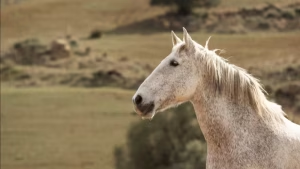
Horse enrichment is anything that gives a horse more chances to behave like a horse: to forage, move, explore, solve a problem or spend time with friends. Most owners get the basics right without thinking about it. Good forage, clean water, shelter and a vet when needed are second nature. What gets overlooked is how much of a stabled horse's day can pass with nothing to do.
This guide covers enrichment for horses in the stable, in the field and on box rest, including the toys, treats and turnout ideas that cost very little. It draws on the British Horse Society's enrichment guidance, the Defra welfare Code of Practice and the published research, named as we go, including where the evidence is thinner than the marketing suggests.
Table of Contents
What Is Horse Enrichment?
Enrichment means adding variety and choice to a horse's surroundings and routine so that it can express natural behaviour. It is not the same as meeting basic needs. A horse that has forage, water and company is being kept properly; enrichment is about how those things are delivered and what else the horse gets to do with its day.
The Types of Enrichment for Horses
The BHS groups equine enrichment into four types. A good routine draws on all of them:
- Social: being able to see and engage with other horses or donkeys for grooming, sleeping, grazing and play. The BHS adds that horses can also benefit from interaction with other species and with people.
- Physical: the layout of the stable or field, such as more than one food and water source, varied terrain and shelter.
- Nutritional: varied forage and ways of feeding that slow eating down and make the horse search and work for food.
- Sensory: things to look at, listen to, smell and feel, from a view of the yard to a scratching brush.
We would add a fifth for the owner's side of things: giving the horse something to learn. Short, reward-based training sessions are some of the most absorbing enrichment there is, and they make everyday handling easier as well.
Why Enrichment for Horses Matters
How Horses Spend Their Day
The Defra Code of Practice for the Welfare of Horses, Ponies, Donkeys and their Hybrids (2018) says that in a natural state horses "would spend 16-20 hours a day grazing and browsing for forage" and that, as a result, "they have a strong behavioural need to chew". They also move a great deal. The BHS cites a study of feral horses in outback Australia (Hampson et al., 2010) for daily travel of between 8 and 23 kilometres.
Studies that measure time budgets vary with the horses, season and method. A 2021 review of 12 time-budget studies (Auer et al., Animals, PMID 33802908) found eating took up anywhere from 10% to 66.6% of the day. Free-living Przewalski's horses on summer pasture spent 46.4% of the 24 hours feeding, rising to 68.2% between 8pm and midnight (Boyd, Carbonaro and Houpt, Applied Animal Behaviour Science, 1988).
The domestic figure you often see quoted, that stabled horses spend "as little as 10%" of their day eating, comes from a specific situation. Elia, Erb and Houpt (Physiology and Behavior, 2010, PMID 20869976) fed eight mares either unlimited hay or a complete pelleted feed. On pellets they spent 10% of the day eating; on hay, 61.5%. They chewed 10,036 times a day on pellets and 43,476 times on hay, and on pellets they spent more time standing and sifting through their shavings for scraps. The lesson is that forage, not the stable itself, is what fills a horse's day.
Boredom, Frustration and Stable Vices
When a horse cannot do what it is strongly motivated to do, some develop repetitive behaviours known as stereotypies, or stable vices. The familiar ones are crib-biting, windsucking, weaving and box walking.
The best UK data on how they start comes from a four-year study of 225 young Thoroughbred and part-Thoroughbred horses (Waters, Nicol and French, Equine Veterinary Journal, 2002, PMID 12357996). Abnormal behaviour affected 34.7% of them. Crib-biting began in 10.5% at a median age of 20 weeks and weaving in 4.6% at a median of 60 weeks. Weaning in a stable or barn rather than a paddock was associated with a faster rate of developing abnormal behaviour, and housing in barns rather than at grass after weaning raised it further.
"Boredom" is the usual shorthand, but frustration is often closer to the mark. When Mills and Riezebos (Applied Animal Behaviour Science, 2005) studied six weaving horses, the timing of their head movements suggested they were "not associated with boredom, or lack of stimulation but rather acute frustration". That matters for enrichment. A toy that keeps a horse busy is useful, but it cannot replace the company, forage and movement the horse actually wants.
What the Research on Enrichment Shows
The research is encouraging but mostly small. A French study at the Alfort veterinary school's equine clinic compared six hospitalised horses given an enriched box (hay nets, a feed dispenser, a flavoured lick, a nylon brush, a permanent neighbour and an extra daily visit) with six in standard boxes, all recovering from surgery (Le Moal et al., 42nd Journée de la Recherche Équine, IFCE, 2016). The standard group crib-bit for an average of 27 minutes a day; the enriched horses showed less than one minute of stereotypies a day. Five of the six standard horses showed stereotypies, against two of the six enriched horses. The enriched horses also reacted less to veterinary care and had lower scores for complications or inflammation. Their pain scores only tended to be lower, which was not statistically significant, and their heart and breathing rates were actually higher. The authors note the small groups and that scoring was not blinded.
In a week-long trial of nine horses, Thorne and colleagues (Applied Animal Behaviour Science, 2005) found horses offered several forages foraged more often and for longer than horses on a single forage, and weaving only occurred on the single-forage diet. When Horse & Hound reported a 2025 enrichment study, World Horse Welfare's Malcolm Morley put it simply: "It's really important to provide horses with the three Fs - friends, forage and freedom. Nothing replaces regular turnout with companions."
Forage Gaps and Gastric Ulcers
Long gaps without forage are bad for the stomach as well as the mind. In a study of 201 Danish horses not in race training (Luthersson et al., Equine Veterinary Journal, 2009, PMID 19927579), 53% had clinically significant gastric ulcers. The risk of significant ulcers in the non-glandular part of the stomach rose when straw was the only forage, when a meal exceeded 1 g of starch per kg of bodyweight, when there was no water in the turnout paddock, and when the interval between forage feeds was more than six hours. In an older American study (Murray and Eichorn, American Journal of Veterinary Research, 1996, PMID 8915437), six of seven horses had squamous ulceration after seven days of stall confinement with unlimited hay, against reddening in two after seven days at pasture.
Enrichment that spreads forage across the day is therefore doing two jobs at once. For the clinical side, see our guide to equine gastric ulcer syndrome.
Friends, Forage and Freedom Come First
Both the BHS and World Horse Welfare frame a horse's fundamental needs as friends, forage and freedom. No enrichment toy makes up for a shortfall in any of the three, so start here.
- Friends. The Defra Code (para 4.1) says horses "should be able to socialise with members of their own species" and that isolating a horse "can have a negative psychological impact". Other animals can provide company, "however the company of other horses is by far the better option". A calm companion horse beats any gadget.
- Forage. The aim is a forage-based diet delivered in a way that fills the day. Our guide to nutrients in hay explains what your forage is actually providing.
- Freedom. The Code (para 3.1) says that all stabled horses, apart from those on box rest for veterinary reasons, "will benefit from daily turnout in the field to allow them to graze and socialise with other horses", which may also reduce the risk of windsucking, weaving, crib-biting, box walking and wood chewing. Even a short spell of turnout counts.
The research backs this up. When 16 horses rotated through four housing types for five days each (Yarnell et al., Physiology and Behavior, 2015, PMID 25725117), horses housed singly with no physical contact had significantly higher faecal stress-hormone levels and were significantly harder to handle than in the other housing types. In a 12-week study of 36 two-year-old Dutch Warmbloods stabled for the first time (Visser, Ellis and Van Reenen, Applied Animal Behaviour Science, 2008), 67% of the individually housed horses were performing one or more stereotypies by the end of the study.
Horse Enrichment Ideas for the Stable
Stabled horses face the biggest deficit in movement, foraging and social contact, so this is where enrichment earns its keep. The BHS stable enrichment guide is the best single UK reference, and most of what follows builds on it.
Make the Hay Last Longer
A hay net with smaller holes, or a slow feeder, is the simplest boredom buster there is. In an American trial of eight horses (Glunk et al., Journal of Equine Veterinary Science, 2014), horses took 3.1 hours to finish hay fed off the floor and 3.4 hours from a large-holed net. Given unlimited time, they took 5.1 hours from a medium net (4.4 cm openings) and 6.5 hours from a small net (3.2 cm openings).
Not every device is equal. Rochais, Henry and Hausberger (Applied Animal Behaviour Science, 2018) watched 38 horses in their own stables: both hay bags and slow feeders increased time spent eating hay, but the hay bags were associated with more frustration behaviour, while the slow feeder reduced stereotypic behaviour. The BHS suggests introducing small-holed nets gradually, by packing the net loosely at first or reducing the hole size in stages, and giving a little hay on the floor first so a hungry horse is not frustrated from the start.
There is a trade-off for horses with respiratory problems. In young Thoroughbreds entering race training, horses fed from hay nets breathed in significantly more dust and endotoxin and had more airway inflammation than horses fed from the ground (Ivester et al., Journal of Veterinary Internal Medicine, 2014, PMID 24773603). That was a small convenience sample, but if your horse coughs, talk to your vet about how to feed it. The BHS also advises against hay nets for horses with neck or back problems, because of the unnatural head position. Hang nets in more than one place in the stable to encourage movement, and tie them with a quick-release knot such as the horseman's knot so they can be dropped in an emergency.
Offer More Than One Forage
Variety is one of the best-supported ideas in this whole field. In short trials with up to 12 horses (Goodwin, Davidson and Harris, Equine Veterinary Journal, 2002, PMID 12455839), horses given a single forage looked over the stable door more, moved about more and picked through their straw bedding more than horses given six forages. Horses also preferred multiple forages in multiple locations in a follow-up study (Goodwin et al., Veterinary Record, 2007, PMID 17449710). The authors were clear that longer studies were needed, which is where the week-long Thorne trial above comes in.
In practice that means a choice of hay, a little haylage, a bucket of chaff, some fibre cubes or a few handfuls of grass, placed at different heights and in different corners. Our guide to hay alternatives covers the options. The BHS says good-quality straw can make up to half of the forage ration, built up gradually over at least 10-14 days to avoid colic. Keep it as part of a mix, though: in the Luthersson study, straw as the only forage was one of the ulcer risk factors.
Treat Balls and Stable Toys
Treat balls and feeding toys make a horse work for its feed. The evidence is modest. When six horses were given their evening feed in an Equiball (Henderson and Waran, Animal Welfare, 2001), stereotypic behaviour fell in five and rose slightly in one, an overall trend that did not reach statistical significance. In another study of 12 stabled horses with three foraging devices (Goodwin, Davidson and Harris, Applied Animal Behaviour Science, 2007), every horse showed some frustration, pawing or biting at the device.
So a treat ball is a useful extra, not a fix. The BHS suggests teaching it: put a little feed on the floor next to the ball, and if the horse does not move the ball, scatter food over a small area and roll the ball yourself so the horse learns that moving it pays. Use part of the existing ration rather than extra food, and check that the ball cannot roll under the door or a fence out of reach.
Fruit and Vegetable Kebabs
Thread carrots, apples, parsnips, swede or turnips onto baler twine or thin rope and hang them in the stable. The BHS says to make sure there is no loop the horse could get caught in, to offer kebabs only under supervision and to horses with good teeth because of the risk of choke, and to slice fruit and vegetables lengthways. Its choke advice says the same: "Slice all succulents, such as carrots and parsnips lengthways before being fed."
Introduce anything new slowly. The BHS enrichment guide says to "Introduce any new food gradually over a minimum of 14 days to decrease the risk of colic". Our guide to the best treats for horses lists which fruit and vegetables are safe.
Licks and Ice Blocks
A lick hung in the stable or offered in a tub gives a horse something to work at, and mineral or salt licks have a practical use too. The BHS warns that some flavoured licks are high in sugar and that horses "have been known to devour a whole tub in one night", so use them in moderation and under supervision. For biosecurity, do not share licks between horses.
On hot days, the BHS suggests freezing chopped fruit and vegetables in water to make an ice block the horse can lick and push about. Count the sugar in anything you add, especially for a horse prone to laminitis.
Stable Mirrors
A mirror can stand in for a neighbour when a horse has to be stabled out of sight of others. Mirrors are among the best-studied stable enrichment, though every study is small:
- McAfee, Mills and Cooper (Applied Animal Behaviour Science, 2002) gave six known weavers a 1 m by 1.5 m mirror for five weeks and found it significantly reduced weaving.
- Mills and Davenport (Animal Science, 2002) found weaving was significantly higher in an ordinary stable than in one with a 1 square metre acrylic mirror or one with a grilled window onto a neighbour, with no significant difference between the mirror and the window.
- Mills and Riezebos (2005) found a life-size poster of a horse's face reduced weaving in six horses compared with a blank or scrambled image, which suggests it is the image of another horse that matters.
- Kay and Hall (Applied Animal Behaviour Science, 2009) found 12 horses travelling alone in a trailer with an acrylic mirror spent less time head turning, vocalising and head tossing and ate more, but their physiological responses did not change. A live companion did better.
The BHS advice on fitting one: use a safe material such as acrylic, introduce it outside the stable first, position it so the horse can choose whether to look at it, avoid covering a whole wall or placing it by the feed, and remove it if the horse responds with constant aggression. It says some horses "can take a couple of weeks to accept and benefit from the mirror". Horse & Hound's boredom busters guide adds: do not choose a huge one.
Music and the Radio
Quiet music is easy to try. In a study of 120 young Arabian racehorses in their first racing season (Kędzierski et al., Pferdeheilkunde, 2017), both relaxing music piped into the stable and massage lowered salivary cortisol compared with controls. The effect does not always last. In 20 geriatric horses played relaxation music for 28 days (Wiśniewska et al., Journal of Equine Veterinary Science, 2019, PMID 31203990), heart-rate measures showed a short-term relaxing effect of one to two weeks, which then faded.
Keep the volume low and the sessions short, watch the horse's reaction, and remember the neighbours may not share your horse's taste. World Horse Welfare's advice on occupying stabled horses says "there is some evidence to suggest horses like classical music played quietly".
Scents and Herbs
Horses rely heavily on smell. The BHS lists horse-safe herbs such as comfrey, valerian, rosemary, meadowsweet, mint, thyme, dandelion and garlic, and suggests citrus zest, garlic or ginger on a mat or in a bucket. Introduce smells outdoors, where the horse can move away, and away from food and water. Avoid essential oils near pregnant mares, and if you compete, check your governing body's clean sport rules first, because some herbs and feed ingredients are prohibited.
A Better View
Being able to see the yard and other horses matters. Cooper, McDonald and Mills (Applied Animal Behaviour Science, 2000) found that opening up a side panel between stables, or a fully open design, cut weaving compared with a top door alone, while an extra back window on its own did not. If you are building or changing a stable block, our guide to stable design covers windows and grilles. The Defra Code also advises keeping the top door secured open.
Horse Field Toys and Paddock Enrichment
Turnout with company is enriching in itself, but a few changes make field time more interesting, especially on a restricted grazing area or a dry lot. Our guide to paddock care covers the field itself.
Spread the Forage
Put hay out in several small piles spread well apart rather than in one heap, so horses walk between them as they would when grazing. When several horses share a field, put out more piles than there are horses so a low-ranking horse is never left without one. There is good evidence that space at feeding matters. In a preliminary German study of up to 28 horses fed at time-controlled hay racks (Baumgartner, Erhard and Zeitler-Feicht, Frontiers in Veterinary Science, 2023, PMID 36699339), biting and kicking fell when there were three times as many openings as horses, compared with only 20% more or twice as many.
Choose where you spread forage carefully in autumn and spring. The BHS atypical myopathy guidance says feeding hay from the floor or close to sycamore trees can increase the risk of horses eating sycamore seeds or seedlings, which cause this often fatal muscle disease.
Safe Branches and Hedgerow Browse
Browsing on branches is natural, and fresh branches give a horse something to strip, chew and scratch against. The Mare and Foal Sanctuary's enrichment handout lists apple, birch, hazel, beech, field maple and willow as safe trees for treat branches, and World Horse Welfare suggests willow and hazel. The same handout also lists oak "(no acorns)", but we leave oak out: the BHS and the Defra Code both list oak among the trees dangerous to horses. The Code (para 1.6) names privet, yew and laburnum (including their clippings) as extremely toxic, with sycamore seeds and oak most dangerous in autumn. Our checklist of trees toxic to horses covers the rest.
The BHS lists cow parsley and cleavers among horse-safe hedgerow plants, but only pick what you can identify with certainty. Its poisonous plants guide warns that water dropwort and cowbane are "often mistaken for Cow Parsley", and that cow parsley "can be identified by its ridged stems similar to celery and a fresh herby smell". World Horse Welfare's poisonous plants page adds that poison hemlock "has a round, hollow stem with purple streaks whereas cow parsley has a celery shaped stem". If in doubt, leave it. Our guide to plants poisonous to horses has pictures of the dangerous ones.
Variety Underfoot
The BHS suggests more than one food and water source, varied terrain and shelter, whether natural or built, as physical enrichment. A strip of hardstanding next to grass, a few logs to step over, a sand patch to roll in or a hedge to stand behind all give the horse choices about where to be.
Balls and Field Toys
Some horses, often youngsters, will push a large ball around the field or carry a tough rubber toy. Check toys regularly for damage, remove anything that has split or lost a handle, and take toys out if they cause squabbles in a group.
Enrichment Activities You Can Do Together
Grooming and Scratching
Horses groom each other, and the withers and base of the neck are favourite spots. Feh and de Mazières titled their study in Animal Behaviour (1993) "Grooming at a preferred site reduces heart rate in horses", and the BHS box rest guidance says scratching the wither area and around the base of the neck can lower your horse's heart rate. In 18 ridden horses (Thorbergson et al., Journal of Applied Animal Welfare Science, 2016, PMID 26958705), each given a minute of no interaction, neck patting and wither scratching after a short obstacle course, wither scratching produced a significantly longer duration of relaxed behaviour.
Not every horse enjoys every touch. When 30 horses and ponies were stroked on different parts of the body (Janczarek et al., Animal Science Journal, 2018, PMID 30155991), they were more excited when stroked than at rest, and the authors concluded that stroking the head may be beneficial whereas the trunk should be treated with caution. Find what your horse likes with a soft brush or a rubber curry comb, and watch for the twitching top lip or the offer to groom you back. In spring, a session with a shedding blade as the winter coat comes out is often when the itchiest spots show themselves.
In-Hand Walks and Grazing
A walk in hand gives a stabled horse new sights, sounds and smells, plus a chance to pick at grass and hedgerows away from the field. Keep to verges you know, because roadsides collect litter and poisonous plants. On a hack, the same curiosity is why a horse that has been allowed to look at things at its own pace is easier to manage; our guide to what to do when a horse spooks covers the other side of that.
Positive Reinforcement and Target Training
Training is enrichment as well. In a small American study, five Quarter Horse mares that had previously been loaded with aversive methods were taught to touch a target, which was then moved step by step into a trailer (Ferguson and Rosales-Ruiz, Journal of Applied Behavior Analysis, 2001, PMID 11800182). Inappropriate behaviour "fell to zero immediately after target training" and all five completed the loading sequence. In 32 six-month-old meat horses in Italy (Dai et al., Frontiers in Veterinary Science, 2019, PMID 31681807), those trained with targeting and positive reinforcement loaded in an average of 44 seconds, against 463 seconds for untrained horses.
Our guides to clicker training horses, liberty training and equine agility are good places to start. A few minutes of teaching a horse to touch a target, stand on a mat or pick up an object is time well spent on a wet day.
Enrichment for Horses on Box Rest
Box rest is where enrichment matters most and where it needs the most care, because the vet's instructions come first. The BHS guide to improving the box rest process, written with qualified equine behaviourist Justine Harrison, suggests:
- Asking your vet whether the horse can have short spells of turnout, a small outside area or walks to graze in hand.
- Keeping a calm companion in, ideally where the horses can touch. At a minimum, the horse must be able to see another horse. Yards can take turns keeping a friend in.
- Offering a choice of forages at different heights and positions, and short-chopped forages that take longer to eat.
- Swapping stables for part of the day, if it is safe, for a change of view and smells.
- Grooming daily and finding the itchy spots.
The BHS stable guidance also advises regular fat scoring for horses confined for long periods, because they can gain or lose weight quickly. Any toy that encourages the horse to move about more than the vet wants should wait, so ask before adding treat balls or rolling toys for a horse on strict rest.
Stable Toys for Laminitic and Overweight Horses
Horses with laminitis, equine metabolic syndrome or a weight problem often need enrichment most, because their rations are restricted, and they are the horses most at risk from sugary licks and treats. The BHS is clear that with any food-based enrichment you should check the sugar levels, and that "Any food given should count as part of their daily ration."
- Use part of the existing forage ration in slow feeders, multiple small nets or hay balls rather than adding food.
- Swap sugary licks and treats for low-sugar options. Writing for Horse & Hound in 2025, vet Edward Busuttil MRCVS suggested "Low-sugar treats like swede or celery, or hay-based, low-sugar licks" for horses on box rest.
- Lean on non-food enrichment: company, a mirror, grooming, scents and short training sessions.
- Speak to your vet before adding feed-based toys for a horse that has had laminitis.
Our guide to equine obesity management explains how to body condition score and plan a diet.
How to Introduce Enrichment Safely
Horses are wary of new things, and that is a survival instinct rather than stubbornness. The same instinct that makes a horse balk at a flapping banner on a hack can make it reluctant to go near a new toy in the stable. How you introduce something matters. In a study of 27 naive two-year-old Danish Warmblood stallions (Christensen, Rundgren and Olsson, Equine Veterinary Journal, 2006, PMID 16986605), horses introduced to a frightening object gradually, in steps, showed fewer flight responses and needed fewer sessions to learn to react calmly than horses exposed to the full object straight away. Every horse trained the gradual way eventually habituated, whereas some on the other methods did not. A green youngster deserves that kind of patience with anything new.
Practical steps, most of them from the BHS:
- Introduce new items outside the stable, such as in an arena, so the horse can approach in its own time and move away if worried.
- Supervise the first sessions with anything new, and remove it if the horse is stressed or frustrated.
- Make sure rolling toys cannot roll out of reach under a door or fence.
- Clean new items before use, and do not share licks between horses.
- Check homemade items for staples, sharp edges, string loops or anything a leg or head could get caught in.
- Think about the neighbours, who may be stressed or frustrated by something new next door.
- Rotate activities. The Mare and Foal Sanctuary handout advises varying enrichment and changing activities daily so they stay interesting.
If a horse that used to enjoy enrichment suddenly ignores it, or a new behaviour appears, look at the whole horse rather than reaching for another toy. Our guides to anxiety in horses and horse body language can help you read what is going on, and pain is always worth ruling out with your vet.
Horse enrichment does not need to be expensive. A spread of forage, a friend over the fence, a few minutes of grooming and the occasional new smell or puzzle will do more for most horses than any single product.
Frequently Asked Questions
What is enrichment for horses?
Enrichment means giving a horse more chances to behave like a horse: to forage, move, explore, solve problems and spend time with other horses. The BHS groups it into social, physical, nutritional and sensory enrichment. Examples range from spreading hay in several piles and offering more than one forage to grooming, a stable mirror or a walk in hand.
How do I know if my horse needs more enrichment?
Look at how the day is spent. A horse that finishes its forage quickly and then stands with nothing to do, paces, looks over the door constantly, chews wood or starts crib-biting, windsucking, weaving or box walking needs more forage, company or turnout. Horses on box rest, restricted grazing or long hours of stabling are most at risk. Any new behaviour is also worth checking with your vet in case pain is behind it.
Can enrichment stop stable vices like crib-biting and weaving?
It can help, but it is not a guaranteed cure. In a small French study of hospitalised horses, six in standard boxes crib-bit for an average of 27 minutes a day while six in enriched boxes showed less than one minute of stereotypies a day. Small studies have also found stable mirrors reduce weaving. Established habits often persist, so prevention through turnout, company and plenty of forage works best.
How often should I give my horse enrichment activities?
Every day. Forage-based enrichment such as slow feeders, multiple forages and spread-out hay piles can be part of the daily routine. Rotate novel items such as kebabs, treat balls, scents and toys so the horse does not lose interest, and review what still works, because the effect of some enrichment, such as music, has been found to fade over a few weeks.