Ask almost any top dressage or show jumping rider what they are sitting on and there is a good chance the answer includes the letters KWPN. The KWPN horse, better known in English as the Dutch Warmblood, is one of the most successful sport horse breeds in the world — dominant in international dressage, a perennial fixture at the top of show jumping leaderboards, and increasingly visible on the eventing circuit. This guide explains what a KWPN horse actually is, how the studbook works, and why the breed has become the gold standard for competitive equestrian sport.
Table of Contents
What Does KWPN Mean?
KWPN stands for Koninklijk Warmbloed Paardenstamboek Nederland — the Royal Dutch Sport Horse studbook. It is the registration body that governs the breeding of Dutch Warmblood horses, based in Ermelo in the Netherlands. A KWPN horse, therefore, is any horse registered with the studbook. The organisation was founded in 1969 when several regional Dutch studbooks merged, and it has grown into one of the most influential warmblood registries in the world.
It is worth getting the terminology straight: “KWPN horse” and “Dutch Warmblood” are not quite synonyms in the strictest sense. The KWPN registers several distinct sub-types, the most visible of which is the riding horse used in dressage and jumping. When someone says “Dutch Warmblood” in the UK or South Africa, they almost always mean the KWPN riding horse.
History of the KWPN Horse
The KWPN is a relatively young breed by European standards. Its origins lie in two older Dutch working horse types — the heavier Groningen from the north and the lighter Gelderlander from the east. Both were bred for agriculture, carriage work, and light cavalry, and both faced extinction as mechanisation swept Dutch farms in the mid-twentieth century.
Rather than let the types disappear, Dutch breeders began crossing them with Thoroughbreds, Hanoverians, Holsteiners, Trakehners, and Selle Français to create a modern sport horse. Strict selection based on performance rather than aesthetics shaped the breed from the outset. Within two decades, the KWPN had produced its first Olympic champions — Marius, Dutch Courage, and Optiebeurs Sunrise among them — and by the 1990s the studbook was ranked the number one sport horse breed in the world by the World Breeding Federation for Sport Horses (WBFSH), a position it has held almost continuously since.
The Three KWPN Studbook Types
Unlike many warmblood registries, the KWPN officially maintains three distinct types within the same studbook. Each has its own breeding goal and conformation standard:
1. Riding Horse (Rijpaard)
The best-known type — the modern sport horse used in dressage, show jumping, and eventing. Within this type, breeders further specialise into dressage lines (emphasising paces, elasticity, and submission) and show jumping lines (emphasising scope, power, and careful technique). A rider looking at a KWPN prospect should always ask which direction the pedigree leans — the two lines have become genetically distinct.
2. Harness Horse (Tuigpaard)
A flashy, high-stepping carriage horse descended from the Gelderlander, with enormous knee action and a showy presence. These are the horses you see at Dutch royal events and competitive driving classes. They are rarely seen under saddle and are not suitable as riding horses.
3. Gelder Horse (Gelders Paard)
The oldest type, kept going as a heritage line. A sturdier, more traditional all-rounder used for light driving, riding, and pleasure work. Rare compared to the riding horse but important for genetic diversity.
There is also a small KWPN pony programme, though this is far less prominent than the main three types.
Physical Characteristics
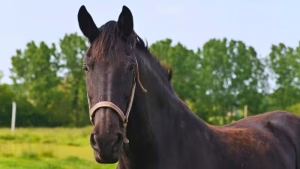
A well-bred KWPN riding horse is immediately recognisable: tall, rectangular, uphill, and with a long, well-set neck. Typical breed standards for the riding type include:
- Height: 16.0 to 17.0 hands (162–173 cm), with most mature horses around 16.2 to 16.3 hh
- Weight: 550–650 kg
- Colour: Predominantly bay, dark bay, black, chestnut, and grey — tobiano pinto patterns are permitted in the studbook
- Head: Refined, intelligent, well-set on the neck
- Shoulder: Long, sloping, giving the freedom of movement the breed is known for
- Hindquarters: Strong, muscular, with a well-developed second thigh for propulsion
- Legs: Correct, dry, with good bone relative to frame
- Hooves: Well-proportioned, hard-walled — a particular focus of the KWPN selection process
Harness and Gelder types differ substantially, with the harness type carrying more knee action and the Gelder type a more compact, cob-like build.
Temperament and Personality
KWPN horses are bred to be trainable. Rideability — the horse’s willingness to listen and respond to the rider — is one of the traits explicitly scored during the grading inspections that govern which stallions are approved for breeding. The result is a horse that tends to be:
- Intelligent and quick to learn
- Work-willing and forward without being hot
- People-oriented and generally easy to handle
- Sensitive but not spooky — the best examples combine reactivity with level-headedness
Temperament varies between dressage and jumping lines. Dressage-bred KWPNs tend to be more reactive and elastic; jumping-bred KWPNs are often cooler under pressure but sharper to the fence. A good amateur prospect sits somewhere in the middle.
KWPN Horses in Equestrian Sport
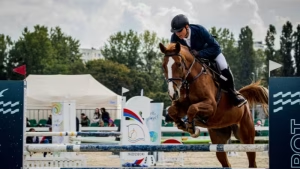
Few breeds match the KWPN’s sporting record. The studbook has led the WBFSH dressage rankings and regularly tops jumping rankings, with eventing performance improving year on year. A few of the sport’s most celebrated horses have been KWPN:
- Totilas (dressage) — the horse who redefined Grand Prix dressage scoring, ridden to multiple world records by Edward Gal
- Valegro (dressage) — Charlotte Dujardin’s Olympic, World, and European champion, with world records that stood for years
- Parzival (dressage) — Adelinde Cornelissen’s longtime partner and multiple medallist
- Hickstead (show jumping) — Canadian Eric Lamaze’s Olympic gold medal partner
- Big Star (show jumping) — Nick Skelton’s double Olympic mount
For British and South African riders in particular, the KWPN is a common choice at medium and advanced levels across dressage and jumping. UK-based KWPN breeders have established strong domestic programmes, and the KWPN-NA (North America) and KWPN-ZA (South Africa) daughter studbooks run regular inspections to support breeding in both regions.
The KWPN Grading System
What sets the KWPN apart from many registries is the rigour of its grading system. Every mare and stallion considered for breeding is inspected, scored, and categorised by independent judges. The most important tiers include:
- Ster (Star): Awarded to mares and young horses showing above-average conformation and movement
- Keur: A higher tier, awarded after additional performance testing
- Preferent: For mares who have produced multiple high-quality offspring
- Prestatie: Awarded to mares whose offspring have competed successfully at sport
- Elite: The highest honour, combining conformation, performance, and offspring quality
Stallions face an even more demanding pathway, including a 70-day performance test that evaluates trainability, gaits, jumping technique, and temperament. Only a small percentage of colts passed through the inspection process are ever approved for breeding — which is why the breed quality has stayed high.
Health and Care of the KWPN Horse
KWPN horses are generally a hardy breed, but their size, competitive careers, and concentrated bloodlines bring some common veterinary considerations:
- Osteochondrosis (OCD): Developmental joint disease that can affect young warmbloods. The KWPN studbook screens for it as part of stallion approvals. See our guide to osteochondrosis.
- Kissing spines: Overlapping of the dorsal spinous processes, more common in tall, long-backed horses. Covered in detail in our kissing spines article.
- Sport injuries: Suspensory desmitis, tendon strains, and hock arthritis are occupational hazards for any sport horse ridden to upper levels — see suspensory desmitis.
- Warmblood Fragile Foal Syndrome (WFFS): A rare hereditary condition now screened for through genetic testing prior to breeding.
Day-to-day care is similar to any large warmblood — good forage, balanced hard feed for the workload, regular farriery every five to six weeks, and routine dental, physio, and saddle-fit checks. Because of their size, KWPN horses need well-fitted rugs and adequate turnout space; cramped stabling and poor-quality hay show up quickly in a breed this athletic.
Buying a KWPN Horse
If you are looking to buy a KWPN horse in the UK or South Africa, a few practical points are worth knowing:
- Check the passport. A genuine KWPN will have a KWPN passport (white cover, black KWPN stamp). Daughter studbooks issue their own passports but reference the parent registry.
- Look at the pedigree direction. Dressage, jumping, harness, and Gelder lines are distinct. Match the pedigree to your ambitions.
- Budget realistically. A useful young KWPN under saddle in the UK typically starts around £15,000 to £25,000, rising sharply for proven competition horses. South African-bred KWPNs can be more accessible, with careful shopping.
- Vet thoroughly. A five-stage vetting with x-rays is standard for any warmblood at a sport-horse price point. Ask specifically about the hocks, stifles, and back.
- Consider the amateur suitability. Top-line KWPNs can be over-horse for a weekend rider. Look at temperament, not just bloodline.
Is a KWPN Horse Right for You?
A KWPN is an outstanding choice if you compete in dressage, show jumping, or eventing and want a horse capable of reaching the levels you aspire to. The breed rewards correct, consistent training — and exposes gaps in riding quickly, because these horses are bred to be ridden well. They are not ideal for absolute beginners, nor for riders looking for a plodding all-rounder; there are better breeds for that.
If your priority is a competitive partner with scope, rideability, and a trail of international success behind it, the KWPN horse has earned its reputation. If you want a hardy native hacking horse, look elsewhere — perhaps at a Welsh Cob, Irish Draught, or Highland Pony.
Frequently Asked Questions
Is a KWPN the same as a Dutch Warmblood?
Yes, in common usage. “KWPN horse” and “Dutch Warmblood” are used interchangeably in the UK and most of the English-speaking world. Technically, KWPN is the studbook, and it registers three types (riding, harness, and Gelder), but most people mean the riding horse when they say either term.
How much does a KWPN horse cost?
Prices vary enormously. A young KWPN prospect in the UK typically starts around £10,000 to £15,000 for an unstarted youngster, £20,000 to £40,000 for a well-schooled five- to seven-year-old, and well into six figures for proven international horses. Sales prices at KWPN auctions such as the Excellent Dressage Sales and Excellent Jumping Sales regularly exceed €250,000.
Are KWPN horses good for amateurs?
Many are, provided the temperament is right. Look at horses from amateur-friendly pedigrees, with steady, rideable mothers — not just flashy sire lines. A KWPN can absolutely take an ambitious amateur rider from unaffiliated classes to regional championships, but temperament matching is essential.
How long do KWPN horses live?
KWPN horses typically live 25 to 30 years with good care. Sport careers usually last into the late teens for lower levels, with upper-level horses often retiring between 15 and 18 years old. Lifespan depends far more on workload, injury history, and veterinary care than on breed alone.
What disciplines are KWPN horses best suited to?
Dressage and show jumping are the two dominant disciplines, with eventing a close third. KWPN riding horses are not traditionally used for pony club games, endurance, or Western sports, though individuals have excelled in almost every discipline given the right training.
Looking for more breed information? Browse our full horse breeds archive, or read up on related warmbloods such as the Hanoverian, Holsteiner, and Oldenburg.