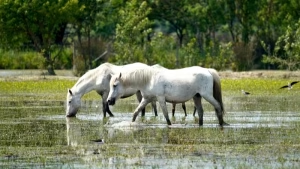
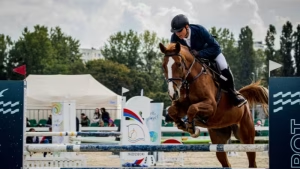
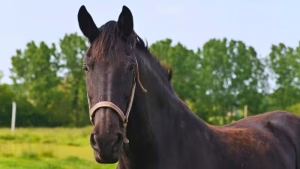
War horse breeds — the phrase is a useful shorthand but a slightly misleading one. Across four thousand years of cavalry warfare, no single “war horse” template existed. Armies bred for whatever the job demanded, and the job changed with terrain, armour weight, weapon range and battlefield doctrine. The destrier of the medieval French knight, the Mongol pony of Genghis Khan, the Marwari of a Rajput cavalryman and the modern Cavalry Black of the Household Cavalry are all war horses, and yet they share almost nothing in physical type.
What follows is the working history: which breeds and types carried which armies, what made them suited to the work, the famous horses whose names are still remembered, and which of those old war horse lineages are still recognisable today. The Household Cavalry in London is the final stop, because mounted ceremonial work is the surviving continuation of European cavalry tradition.
Table of Contents
Why horses changed warfare
Speed, reach and shock
The horse made armies faster. A messenger on foot covers around 30 miles a day; a mounted messenger with access to fresh horses can manage two or three times that. That speed compressed campaigns, made supply lines viable across continents, and shifted the tempo of battle. Where infantry took weeks to march to a frontier, cavalry took days, and an enemy under-prepared by even 48 hours could be cut off.
Mounted forces also delivered shock. A line of armoured riders at the gallop converted body weight and momentum into a force that ranks of foot soldiers struggled to absorb. The historian Dan Jones, writing in Powers and Thrones, put it neatly: with a couched lance at his disposal the knight “had become the medieval equivalent of a guided missile”.
It is worth adding the counter-argument, because the cavalry charge is one of the most over-romanticised events in military history. John Keegan, in The Face of Battle, argued that the shock of a charge was principally moral rather than physical — horses will not willingly run into a solid, unbroken line of men, and disciplined infantry who held their ground had far less to fear than the paintings suggest. Agincourt in 1415 is the standing example: stakes driven into the mud and massed archery broke the French mounted attack before contact. Cavalry won battles by exploiting gaps, panic and pursuit far more often than by smashing through formed infantry.
The stirrup, the saddle and the couched lance
Cavalry effectiveness rose in step with equipment. The Romans managed without stirrups, bracing the rider in a four-horned saddle. Stirrups reached Europe from the Central Asian steppe via the Avars, and were in use across much of the continent by the 8th century. Rigid saddles with high cantles followed, and together the two locked the rider into the horse rather than balancing him on top of it. By the time of the Norman invasion in 1066, a rider could couch a lance against his body and transmit the impact through the horse rather than through his arm.
Historians still argue over how much the stirrup alone explains — the so-called “stirrup thesis” has been heavily qualified since it was first proposed — but the broader point stands. Cavalry doctrine was reshaped by metalwork and leatherwork before it was reshaped by tactics.
Roles beyond the charge
Most horses in any army never charged anything. They carried scouts, messengers and officers, towed artillery, pulled supply wagons, ferried wounded and provided remounts for cavalry losses. This is the single most consistently overlooked fact about horses in war: the overwhelming majority were transport and draught animals, and that remained true right through to the mechanised era.
Medieval war horse types: destrier, courser, palfrey, rouncey
Medieval Europe categorised war horses by function and price, not by breed. Studbooks and the modern idea of breed purity did not exist. The same animal might be described differently in different contracts, but four broad types dominate the records.
Destrier — the great horse of war
The destrier was the medieval knight’s reserved battlefield and tournament mount, and the most expensive horse most people would ever see. It was valued for a deep chest, powerful hindquarters, and above all a willingness to face crowds, noise and impact.
Its size is the most persistently misreported detail in the whole subject. The University of Exeter’s Warhorse project, the first systematic archaeological study of medieval warhorses in Britain, examined skeletal remains from around AD 800 to 1550 and found nothing resembling the Shire-sized animal of popular imagination. Contemporary continental records point the same way, describing warhorses as rarely exceeding about 160cm at the withers — roughly 15.3 hands. Many were smaller still. The destrier was a compact, muscular, explosively athletic horse, closer in stamp to a modern cob or middleweight hunter than to a draught horse.
The name comes from Old French, ultimately from the Latin dextrarius, “of the right hand” — the squire led the warhorse with his right hand while riding another horse, keeping the knight’s battle mount fresh for the day it was needed.
Courser — speed and skirmish
The courser was lighter and faster than the destrier and was a common cavalry mount in the 14th and 15th centuries. Ridden by men-at-arms who could not justify the cost of a destrier, it was preferred for raids, pursuit and the running fight — the kind of work that actually filled most campaigning seasons. On the Anglo-Scottish frontier that same preference for light, quick horses defined the Border Reivers, whose raiding is why the Border burghs rode their boundaries each year, a custom that survives today as the Border Common Ridings.
Palfrey — the riding horse
A palfrey was an ambling horse used for travel rather than combat, prized for a smooth four-beat gait that made long days in the saddle bearable. A high-quality palfrey could cost more than a destrier and was a status symbol in its own right. The gait itself is still recognised in the horse world — see our note on the amble.
Rouncey — the workhorse
The rouncey was the all-purpose horse of the medieval soldier: versatile, affordable and suitable for archers, sergeants, scouts and ordinary cavalry. It is the type that most often saw combat, simply because there were vastly more of them than there were destriers.
What made a good war horse
Temperament before conformation
Cavalry trainers across cultures and centuries agreed on one principle: the horse that can be ridden in close combat is far rarer than the horse that can be ridden well. Tolerance for noise, smoke, crowding, armour against the flanks, sudden movement and the press of other horses is the essential prerequisite, and no amount of conformation compensates for its absence.
The same logic survives in modern police and ceremonial horse training in the UK, where flags, drums, smoke and recorded crowd noise are introduced by degrees until the horse becomes what riders still call “bombproof”.
Soundness, hardiness and recovery
Long campaigns demanded horses that could keep working on poor forage, cold nights and bad ground. Breeds developed in tough climates — Arabian, Barb, Akhal-Teke, Mongol — repeatedly proved their worth at long ranges where heavier European horses broke down. The Mongol expansion across Asia in the 13th century remains the clearest demonstration of strategic endurance in the historical record.
Strength and “carry”
For armoured cavalry, “carry” — the ability to move in balance under weight — mattered far more than raw size. A 15.2hh horse with strong loins, short cannon bones and good feet was more use than a towering animal that tired in twenty minutes. A mounted knight’s full kit of armour, weapons, saddle and padding came to roughly 50kg: heavy, but comfortably inside the working capacity of a horse of 500–600kg. Height was never the point, which is why the giant medieval warhorse is a myth rather than a lost bloodline. For context on horses that genuinely are enormous, see our guide to the tallest horses.
War horse breeds that shaped history
It helps to read the following list in terms of the three broad weight classes military historians still use. Light horses carried scouts, skirmishers and mounted archers, and prized speed and stamina. Middleweights — closest to the modern warmblood — carried armoured cavalry and did the bulk of the fighting. Heavy horses were rarely ridden into battle at all; their moment came later, hauling guns and supply wagons.
Arabian
The Arabian is one of the oldest documented riding horses and the foundation of countless modern breeds. Bedouin breeders selected for stamina, intelligence, sound feet and a close working bond with the rider. Arabians carried the Islamic conquests across North Africa and into Iberia in the 7th and 8th centuries, and their blood reached almost every European cavalry breed that followed.
Barb
The Barb of North Africa is the Arabian’s great counterpart and is arguably under-credited. Hardy, fast and famously tough-footed, the Barb carried Berber and Moorish cavalry into Spain and contributed heavily to the Iberian breeds, to the Thoroughbred and to the horses that Spanish colonists later took to the Americas.
Akhal-Teke
The Akhal-Teke of Turkmenistan is one of the oldest war horse breeds in continuous existence, famous for extraordinary endurance and the metallic sheen of its coat. Horses of this type carried the cavalry of the Central Asian steppe for millennia. As a demonstration of the breed’s residual quality, an Akhal-Teke named Absent won individual dressage gold at the 1960 Rome Olympics under Sergei Filatov.
Andalusian and Iberian horses
The Andalusian (Pura Raza Española) and the closely related Lusitano were the war horses of Iberia and, after 1500, of the Spanish empire across the Americas. Balanced, agile and brave, they were the preferred mounts of Renaissance cavalry and dominated the formal riding academies of the 16th and 17th centuries.
Lipizzaner
The Lipizzaner emerged from Iberian, Arabian and Italian stock at the Lipica stud, founded in 1580 in what is now Slovenia. Bred for the Habsburg court and cavalry, the breed is inseparable from the Spanish Riding School in Vienna. The “airs above the ground” — capriole, courbette and levade — are widely described as having military origins, though how far they were ever genuinely used in combat rather than developed as displays of control is debated among classical riders and historians alike.
Friesian
The Friesian served as a knight’s horse in the Low Countries and northern Germany. Black, powerful, with feathered legs and a high-stepping gait, it carried armoured riders in the medieval period before being refined into a coach and parade horse in the early modern era — the role that shaped the breed we see today.
Hanoverian, Holsteiner and Trakehner
The German warmbloods were built by state and military studs. The Holsteiner traces back to monastic breeding in Schleswig-Holstein in the medieval period; the Hanoverian was formalised with the founding of the state stud at Celle in 1735; the Trakehner grew out of the East Prussian stud established at Trakehnen in 1732 and became the classic cavalry remount of the Prussian and later German armies. All three were selected for the strength, soundness and steadiness that heavy cavalry and horse artillery required, and all three converted to sport horse roles after 1945. They now dominate Olympic dressage and showjumping — the clearest living proof that war horse selection produced athletes.
Marwari and Kathiawari
The Marwari of Rajasthan is one of the most distinctive war horse breeds in the world, bred by the Rathore rulers from the medieval period onwards and instantly recognisable by its inward-curving “lyre” ears. Marwari cavalry fought across India and into Afghanistan, valued for spirit, agility and surefootedness. The Kathiawari, from Gujarat, served the same role on the western coast and shares the curled ear.
Mongol horse
Smaller than European horses at around 12–14 hands, the Mongol horse is among the most strategically important war horses in history. Mongol cavalry under Genghis Khan and his successors used its hardiness and self-sufficiency to operate hundreds of miles from any supply line. Each warrior kept a string of several mounts and rotated them, which allowed the army to sustain a rate of advance no contemporary force could match — the horses foraged for themselves where other armies needed grain convoys.
Thoroughbred
The Thoroughbred was developed in 17th and 18th-century England by crossing imported Arabian, Barb and Turkoman stallions with native running mares. It became the preferred light cavalry horse and officer’s charger of the British Empire, and supplied British remounts through the Napoleonic Wars, the Crimean War, the Anglo-Boer War and into the First World War.
American Saddlebred
Bred in Kentucky from Narragansett Pacer, Thoroughbred and gaited stock, the American Saddlebred — then usually called the American Saddle Horse — was the officer’s mount of choice in the American Civil War. Generals on both sides rode them, and for the same practical reason the palfrey had been prized four centuries earlier: a comfortable gait and a level head let a commander stay in the saddle all day and think while he was there.
Percheron and other heavy horses
The Percheron, Ardennais, Boulonnais and other French and Belgian heavy breeds carried armoured riders in the medieval period and later hauled the artillery of Napoleonic and First World War armies. The Percheron in particular combined great strength with a notable willingness to work in noise and chaos, which is why it was bought in such numbers as a gun horse. Our guide to heavy horse breeds covers the group in more detail.
Shire and Clydesdale
The Shire is the heaviest British horse, and it descends from the English “Great Horse” that Tudor policy went to some lengths to protect — though the Shire as a defined breed with a studbook is a much later development, and it was never itself a medieval cavalry mount. Henry VIII legislated twice on the subject: the Breed of Horses Act 1535 required owners of enclosed deer parks to keep mares of at least 13 hands to be bred only to stallions of 14 hands or more, and the Horses Act 1540 barred stallions under 15 hands from running on common land altogether. The intent was explicitly military: England wanted bigger horses for war. The Clydesdale followed a parallel Scottish path and, like the Shire, made its real military contribution in harness rather than under saddle.
Irish Draught
The Irish Draught served the British Army as a versatile cavalry and artillery horse in the 19th and early 20th centuries. Its modern descendants, Irish Sport Horses, fill much of the Household Cavalry’s Cavalry Black ranks today — one of the few genuinely unbroken threads between the cavalry remount trade and a horse you can still watch on Horse Guards Parade.
Famous war horses
Bucephalus
Alexander the Great’s black stallion, reputedly tamed by the young Alexander when no one else could ride him, carried the king through the campaigns that built the Macedonian empire. He died around the time of the Battle of the Hydaspes in 326 BC, and Alexander founded the city of Bucephala in his honour — one of very few cities in history named after a horse.
Marengo
Napoleon’s grey Arabian, Marengo, is traditionally said to have carried the Emperor at Austerlitz, Jena, Wagram and Waterloo, and a skeleton displayed as his has been on public exhibition in London since 1868, now at the National Army Museum. The story deserves a caveat that most retellings omit: no contemporary French stable record names a horse called Marengo, and in Marengo: The Myth of Napoleon’s Horse the historian Jill Hamilton argues that the animal’s actual name was probably Ali and that “Marengo” was applied later. The skeleton is real and the horse was real. The name, and the tidy list of battles, are less secure than they look.
Copenhagen
The Duke of Wellington’s chestnut stallion carried him for some seventeen hours at the Battle of Waterloo. A grandson of the great racehorse Eclipse, he was a Thoroughbred with Arabian blood close up on his dam’s side. After his death in 1836 he was buried with military honours at Stratfield Saye, where his grave is still marked.
Comanche
A US Cavalry gelding who survived the Battle of the Little Bighorn in 1876, Comanche was recovered badly wounded from the field and nursed back to health, becoming a regimental celebrity and living out his days as a mascot of the 7th Cavalry. He is popularly remembered as the only survivor of Custer’s command, and that is not quite right: no US soldier of the five companies survived, but a great many cavalry horses did — historians’ estimates run to around a hundred — and were taken from the field. Comanche’s distinction is that he was the horse the army found, treated and chose to memorialise.
Warrior
Jack Seely’s bay Thoroughbred, Warrior, served on the Western Front from 1914 to 1918, surviving the Somme, Passchendaele, burning stables and burial in mud and rubble. When he died in 1941 at the age of 32, The Times ran an obituary under the byline “the horse the Germans could not kill”. In 2014 he received an honorary PDSA Dickin Medal to mark the centenary of the outbreak of war, awarded on behalf of all the animals that served in it — the only recipient to predate the medal’s creation in 1943.
Sergeant Reckless
A small Mongolian-bred mare bought from a Korean stableboy, Reckless carried recoilless rifle ammunition for the US Marines during the Korean War. At the Battle of Outpost Vegas in March 1953 she made 51 solo trips up the hill in a single day, unled, under fire, having learned the route. She was later promoted to staff sergeant — one of the very few horses to hold formal military rank.
Horses in the First and Second World Wars
The First World War
The British Army mobilised roughly a million horses and mules for the First World War, drawn from Britain, Ireland, North America, Australia, South Africa and Argentina. The great majority served in transport and artillery. Mounted action was rare on the Western Front, where wire, trenches and machine guns made cavalry charges suicidal, but far more common in Palestine and Mesopotamia — the Australian Light Horse action at Beersheba in 1917 is usually cited as one of the last successful mounted charges in military history.
Around 484,000 British horses died during the war, the majority from disease, exhaustion and exposure rather than enemy fire. The Animals in War Memorial on Park Lane in London commemorates them. Our piece on the untold story of WW1 horses covers the period in more depth.
The Second World War
Tanks dominate the public memory of the Second World War, but both the German Wehrmacht and the Soviet Red Army depended heavily on horses for transport and artillery haulage throughout. Germany is estimated to have used some 2.75 million horses over the course of the war — more than in 1914–18, not fewer. Soviet cavalry divisions remained operational on the Eastern Front, where horses coped with mud and winter that defeated wheeled transport.
The Household Cavalry and modern ceremonial war horses
The Cavalry Black
The Household Cavalry — the Life Guards and the Blues and Royals — keeps more than 280 horses at full strength between London and training. Most are “Cavalry Blacks”, bought at around four to five years old and typically Irish Draught or Irish Sport Horse types, with some Cleveland Bay, Hanoverian, Holsteiner and other warmblood blood. A Cavalry Black should stand at least 16.2 hands and be black with minimal white markings, though the colour standard has been relaxed somewhat as sourcing has become harder. The trumpeters’ horses are the deliberate exception: they are greys, so the trumpeter can be picked out instantly.
The Drum Horse
The Drum Horse is a different animal entirely — a Clydesdale or Shire standing roughly 16.3 to 18 hands, chosen for sheer weight-carrying ability and an unshakeable temperament. It carries a pair of solid silver kettledrums of around 60lb (27kg) each, plus a rider in full state dress. Because the drummer needs both hands free to play, the horse is steered by reins attached to the rider’s feet.
The drums themselves are older than any horse carrying them: George III presented a pair to the Royal Horse Guards in 1805, and William IV presented further pairs to the 1st and 2nd Life Guards in 1831, which remain in ceremonial use. Drum horses are officially named by the reigning monarch, traditionally from Greek and Roman mythology — recent names include Perseus, Atlas, Apollo and Juno, the first mare to hold the role, named by Queen Camilla in 2023.
King’s Troop, Royal Horse Artillery
The King’s Troop maintains around 110 horses, mostly Irish Draught and Irish Sport Horse types, and fires ceremonial gun salutes in Hyde Park, at the Tower of London and elsewhere on royal anniversaries and state occasions. The Troop draws the 13-pounder field guns that saw active service in the First World War, which makes it the closest thing Britain has to a working horse artillery battery. The Windsor Greys that draw the royal carriages come from a separate tradition again.
Which war horse breeds still exist today
Most of the classic war horse breeds survive, though in smaller numbers and in changed roles. Some types, the destrier among them, were never breeds at all and were absorbed into wider populations once the demand disappeared. Here is where the living war horse breeds are most likely to be found today.
- Arabian and Barb — endurance racing, showing, foundation bloodstock worldwide.
- Akhal-Teke — endurance, sport and conservation breeding in Turkmenistan and Russia.
- Andalusian and Lusitano — classical dressage, working equitation, Iberian sport and bullfighting traditions.
- Lipizzaner — the Spanish Riding School in Vienna and classical haute école.
- Friesian — dressage, driving, film and parade work.
- Percheron, Shire and Clydesdale — heavy harness, ceremonial duties, forestry and brewery dray teams.
- Marwari and Kathiawari — Indian ceremonial cavalry and conservation breeding.
- Thoroughbred — flat and jump racing, eventing.
- American Saddlebred — saddle seat showing and pleasure riding.
- Hanoverian, Holsteiner and Trakehner — Olympic dressage and showjumping.
- Irish Draught and Irish Sport Horse — eventing, hunting, and the Household Cavalry.
War horse breeding never really ended; it changed direction. The traits selected across centuries of combat — courage, soundness, rideability, a willingness to work under pressure — are precisely the traits that win at Olympic dressage, on a cross-country course, on the racetrack and on Horse Guards Parade. For a closer look at the domestic side of that inheritance, see our guide to British horse breeds.
Frequently Asked Questions
What is a destrier and is it a real breed?
The destrier was a medieval war horse type, not a breed — medieval Europe classified horses by function and price rather than by studbook. Destriers were the knight’s reserved battle and tournament mount, valued for strength, agility and courage rather than height. Archaeological evidence indicates they generally stood well under 16 hands. The type was absorbed into wider horse populations once armoured cavalry declined, so no modern breed descends from a distinct destrier line.
Which horse breed is best for war?
There is no single answer, because the requirement changed with the job. Light, hardy breeds such as the Arabian, Barb, Akhal-Teke and Mongol horse were unmatched for raiding, scouting and long campaigns. Middleweight types — the ancestors of today’s warmbloods and the Iberian breeds — carried armoured cavalry. Heavy breeds such as the Percheron and Shire were rarely ridden into battle but were indispensable for hauling guns and supplies. Temperament under fire mattered more than any physical trait in all three groups.
Were medieval war horses really 18 hands tall?
No. This is the most common myth about war horse breeds. The University of Exeter’s Warhorse project, which studied medieval horse remains from across Britain, found no evidence of the Shire-sized animals of popular imagination, and continental records describe warhorses rarely exceeding about 160cm — roughly 15.3 hands — at the withers. The giant destrier comes from later art and fiction. Real war horses were compact, powerful and athletic, selected for the ability to carry armoured weight in balance rather than for height.
Which breeds are used by the Household Cavalry today?
The Cavalry Blacks ridden by the Life Guards and Blues and Royals are mostly Irish Draught and Irish Sport Horse types, with some Cleveland Bay and warmblood breeding. They stand at least 16.2 hands and are black with minimal white markings, while trumpeters ride greys. Drum Horses are Clydesdales or Shires standing around 16.3 to 18 hands, and carry solid silver kettledrums of about 60lb each.
How many horses died in the First World War?
Around 484,000 British horses died during the First World War, out of roughly a million mobilised, and total animal losses across all combatant nations ran into the millions. Most died from disease, exhaustion and exposure rather than in mounted combat, since the overwhelming majority were transport and artillery animals rather than cavalry mounts. The Animals in War Memorial on Park Lane in London commemorates them.
What was Napoleon’s horse called?
Napoleon’s best-known mount was Marengo, a grey Arabian traditionally said to have carried him at Austerlitz, Jena, Wagram and Waterloo, and a skeleton displayed as his is held by the National Army Museum in London. Historians have questioned the name, however: no contemporary French stable record lists a Marengo, and the historian Jill Hamilton has argued the horse was actually called Ali. Napoleon rode many horses, and the Marengo legend probably consolidated several of them.
Why was the Mongol horse so effective in war?
Mongol horses were small, exceptionally hardy and able to forage for themselves, which freed Mongol armies from the grain convoys that tethered other forces to their supply lines. Each warrior kept a string of several mounts and rotated them to keep one fresh, giving the army a sustained rate of advance no contemporary opponent could match. The advantage was strategic mobility rather than size or shock power.