The Akhal-Teke horse is one of the oldest and most visually striking breeds in existence. Originating in the deserts of Turkmenistan over 3,000 years ago, the Akhal-Teke is instantly recognisable thanks to its metallic, shimmering coat — a feature so distinctive that the breed has earned the nickname “Golden Horse.”
But the Akhal-Teke is far more than a pretty coat. Bred for survival in one of the harshest environments on earth, these horses are exceptionally tough, fiercely loyal, and surprisingly versatile. From endurance riding to dressage and show jumping, the Akhal-Teke has proven itself across disciplines — and its influence on modern breeds, including the Thoroughbred, runs deep.
Table of Contents
| Origin | Turkmenistan (Akhal oasis, Kopet Dag mountains) |
| Height | 14.2–16 hands (147–163 cm) |
| Weight | 400–500 kg |
| Colours | Bay, black, chestnut, palomino, buckskin, cremello, perlino — often with a metallic sheen |
| Temperament | Intelligent, sensitive, courageous, intensely loyal “one-person” horse |
| Lifespan | 20+ years |
| Best for | Endurance, dressage, experienced riders |
| UK price | £5,000–£100,000+ |
History and Origins
The Akhal-Teke takes its name from the Teke tribe of Turkmenistan and the Akhal oasis along the northern slopes of the Kopet Dag mountains, where the breed was developed. These nomadic horsemen selectively bred their horses for speed, stamina, and the ability to survive on minimal food and water — qualities essential for raiding, warfare, and long desert crossings.
The breed is thought to descend from the ancient Turkoman horse, one of the foundation types from which many modern breeds trace their lineage. Chinese historical records from the 2nd century BC refer to horses from this region as “Heavenly Horses” (Tien Ma), and they were so prized that Emperor Wu of Han launched military campaigns to obtain them.
Influence on Modern Breeds
The Akhal-Teke’s influence on global horse breeding is significant. The breed contributed to the foundation of the Thoroughbred through the Byerley Turk, one of the three foundation sires of the Thoroughbred studbook. Some historians believe the Byerley Turk was actually an Akhal-Teke or closely related Turkoman horse rather than an Arabian as traditionally assumed.
The breed also influenced the development of the Russian Don, the Trakehner, and several other Central Asian breeds. During the Soviet era, Akhal-Teke breeding was centralised and nearly destroyed through forced crossbreeding programmes, but dedicated Turkmen horsemen preserved the purebred lines.
The 1935 Ashgabat to Moscow Ride
Perhaps the most famous demonstration of the Akhal-Teke’s endurance came in 1935, when a group of Turkmen riders covered 4,300 kilometres from Ashgabat to Moscow in 84 days. The route included a crossing of the Karakum Desert — 360 kilometres of sand with virtually no water — completed in just three days. The horses arrived in Moscow in good condition, astonishing Soviet officials and cementing the breed’s reputation for extraordinary toughness.
The Metallic Coat Explained
The Akhal-Teke’s most famous feature is its metallic, iridescent coat. This sheen — which can make the horse appear to be cast in gold, silver, or bronze — is caused by the unique structure of the hair itself.
In most horse breeds, the opaque core (medulla) of each hair shaft is surrounded by a translucent outer layer (cortex). In the Akhal-Teke, the medulla is reduced or absent in some hairs, allowing light to pass through and refract off the cortex, producing that distinctive metallic glow. The effect is most dramatic in horses with cream dilution genes:
- Cremello and perlino — appear almost white-gold or platinum, with an intense metallic shimmer
- Buckskin and palomino — the classic “golden horse” appearance
- Bay and chestnut — a rich, burnished bronze or copper sheen
- Black — a subtle blue-black metallic quality, like polished steel
Not all Akhal-Tekes display the metallic sheen equally — it varies between individuals and is influenced by genetics, nutrition, and coat condition. Horses with the most dramatic sheen are highly sought after and command premium prices.
Physical Characteristics
The Akhal-Teke has a distinctive conformation that sets it apart from virtually every other breed:
- Height: 14.2–16 hands (147–163 cm)
- Weight: 400–500 kg (880–1,100 lbs)
- Build: Lean, narrow, and athletic — often described as having a “greyhound-like” build
- Head: Refined and elegant, with large, expressive eyes (often described as “hooded” or almond-shaped) and long, thin ears
- Neck: Long and set high, often carried vertically
- Body: Narrow chest, long back, sloping croup
- Legs: Long, lean, and clean with prominent tendons
- Mane and tail: Fine and often sparse — some individuals have almost no mane at all
The breed’s lean build is an adaptation to the desert environment. Less body mass means less water and food required, while the thin skin and fine coat aid heat dissipation. The long, elastic stride — with distinctively smooth, ground-covering movement — reflects centuries of selection for covering vast distances efficiently.
Temperament and Bonding
The Akhal-Teke is often described as a “one-person horse.” These horses form intense bonds with their primary handler and can be deeply suspicious of strangers. This trait stems from the breed’s history — Turkmen horsemen kept their horses tethered beside their tents, hand-feeding them and sleeping alongside them. The result is a breed that is extraordinarily loyal to its person but can be reserved, aloof, or even defensive with unfamiliar handlers.
Key temperament traits:
- Intelligence — Akhal-Tekes are sharp, quick learners who bore easily with repetitive work
- Sensitivity — they respond to subtle cues but react poorly to harsh or forceful handling
- Independence — less “trainable” in the conventional sense than a warmblood, but deeply cooperative with a trusted rider
- Courage — bred for desert survival and warfare, the breed has genuine nerve in testing situations
This temperament makes the Akhal-Teke a poor choice for novice riders but an exceptional partner for experienced horsemen who appreciate an honest, character-driven relationship with their horse.
The Akhal-Teke in Sport
Endurance Riding
The breed’s natural strength lies in endurance, where its desert heritage gives it obvious advantages: efficient metabolism, heat tolerance, and the ability to cover long distances on minimal rations. Akhal-Tekes have excelled in international endurance competitions, particularly over 80–160 km distances.
Dressage
The Akhal-Teke’s natural elevation and light, elastic movement make it well-suited to dressage. The most famous Akhal-Teke in dressage history was Absent, who won individual gold at the 1960 Rome Olympics under Soviet rider Sergei Filatov. Absent remains the only Akhal-Teke to win an Olympic gold medal, and his success demonstrated that the breed could compete at the highest level against European warmbloods.
Show Jumping and Eventing
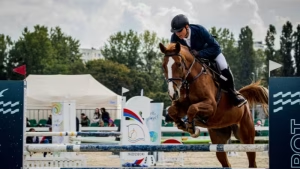
While not a typical choice for show jumping, several Akhal-Tekes and Akhal-Teke crosses have competed successfully at national level. Their scope and courage make them natural jumpers, though their lean build means they lack the raw power of warmblood specialists. In eventing, the breed’s combination of endurance, courage, and agility is a genuine asset.
Flat Racing
In Turkmenistan, Akhal-Teke racing remains a major national sport. The breed also races in Russia and some European countries. They are typically faster than Arabians over distances of 1,000–2,000 metres but slower than Thoroughbreds over standard racing distances.
Health and Genetic Concerns
The Akhal-Teke is generally a hardy breed, but a small gene pool (estimated at around 6,000–8,000 purebred individuals worldwide) has led to some hereditary health concerns:
- Naked Foal Syndrome (NFS) — a fatal genetic condition where foals are born without skin or hair. It occurs when both parents carry the recessive gene. Genetic testing can identify carriers, and responsible breeders test all breeding stock.
- Cervical Vertebral Malformation (CVM) — also known as Wobbler syndrome, this condition affects the spinal cord in the neck and can cause coordination problems. It occurs at a slightly elevated rate in Akhal-Tekes compared to some other breeds.
- Cryptorchidism — retained testicles in stallions occur more frequently in the breed than in the general horse population.
The small population makes careful breeding decisions critical. Inbreeding coefficients should be monitored, and breeders increasingly use genetic testing to manage hereditary conditions.
Akhal-Teke Price and Availability in the UK
Akhal-Tekes are rare in the UK, with only a handful of breeders and imported horses available at any given time. Prices vary significantly:
- Foals and youngstock: £5,000–£15,000
- Riding horses (broken and trained): £10,000–£30,000
- Breeding stock with strong bloodlines: £15,000–£50,000+
- Elite competition or show horses: £30,000–£100,000+
The metallic coat colour significantly affects price — a cremello or palomino with strong sheen will command a considerable premium over a plain bay. Import from Turkmenistan, Russia, or Germany is an option but adds transport, quarantine, and veterinary costs.
For UK buyers, the Akhal-Teke Association of Great Britain maintains a register and can connect prospective owners with reputable breeders. These figures place the Akhal-Teke firmly among the costlier breeds to buy — see our guide to the most expensive horses for wider context on equine prices.
Frequently Asked Questions
Why do Akhal-Teke horses shine?
The Akhal-Teke’s metallic sheen is caused by the structure of its hair. The opaque core (medulla) found in most horse hair is reduced or absent, allowing light to refract through the translucent outer layer and produce an iridescent, metallic glow.
How much does an Akhal-Teke horse cost?
In the UK, expect to pay £5,000–£15,000 for a foal and £10,000–£30,000 for a trained riding horse. Elite specimens with strong metallic coats and proven bloodlines can exceed £50,000. Prices are generally higher than comparable warmblood breeds due to the breed’s rarity.
Are Akhal-Teke horses good for beginners?
No. The Akhal-Teke’s sensitivity, independence, and tendency to bond with a single handler make them challenging for inexperienced riders. They are best suited to confident, experienced horsemen who can build a trusting partnership.
How many Akhal-Teke horses are there in the world?
The global purebred population is estimated at 6,000–8,000 horses, with the majority in Turkmenistan and Russia. Smaller populations exist in Germany, the UK, the USA, and several other European countries. The breed is considered rare and listed on some endangered breed registries.
Why are Akhal-Teke horses so rare?
The global purebred population is only around 6,000–8,000 horses. The breed was nearly lost during the Soviet era, when centralised breeding programmes and forced crossbreeding decimated the purebred lines, and slaughter quotas in the 1930s reduced numbers further. A small, carefully managed gene pool — combined with limited exports from Turkmenistan — keeps the breed rare and its best individuals expensive to this day.
Can you buy an Akhal-Teke horse in the UK?
Yes, though availability is limited. A small number of UK-based breeders produce foals each year, and imported horses occasionally appear for sale. The Akhal-Teke Association of Great Britain is the best starting point for finding available horses.