The Thoroughbred horse is arguably the most influential breed in equestrian history. Developed in England during the 17th and 18th centuries specifically for speed, the Thoroughbred went on to shape horse racing into a global industry and become the foundation stock for dozens of modern sport horse breeds. Today, Thoroughbreds excel far beyond the racecourse — in show jumping, dressage, eventing, polo, and as all-round riding horses across the UK and worldwide.
Table of Contents
The Origins of the Thoroughbred
The Thoroughbred horse was created in England during the late 1600s and early 1700s through a deliberate programme of crossing imported Eastern stallions — primarily Arabian, Barb, and Turkoman horses — with native English mares known as “running mares.” These English mares were themselves selectively bred for speed and stamina, likely carrying Hobby and Galloway blood from earlier centuries of racing.
The aim was straightforward: produce the fastest possible horse for match races between wealthy landowners. The result was a breed that combined the stamina and refinement of Eastern bloodlines with the size and power of English stock — creating an athletic, courageous animal built for speed over distances from five furlongs to two and a half miles.
The Three Founding Stallions
Every modern Thoroughbred traces its tail-male line (father to father to father) back to one of three founding stallions:
- The Byerly Turk (c.1680): A Turkoman horse captured at the Battle of Buda in 1686 by Captain Robert Byerly. He served as Byerly’s cavalry charger before standing at stud in County Durham. His most famous descendant through the male line is Herod (1758).
- The Darley Arabian (c.1700): An Arabian stallion purchased in Aleppo, Syria, by Thomas Darley and shipped to Yorkshire. He is the most influential of the three, with approximately 95% of modern Thoroughbreds tracing back to him through his great-great-grandson Eclipse (1764).
- The Godolphin Arabian (c.1724): Sometimes called the Godolphin Barb, this stallion’s exact origins are debated — he may have been Arabian or Barb. He was found pulling a water cart in Paris before being recognised for his quality and brought to England. His most famous descendant is Matchem (1748).
These three stallions — through the male lines of Herod, Eclipse, and Matchem — established the bloodlines that define the breed to this day.
The General Stud Book
The General Stud Book (GSB), first published in 1791 by James Weatherby, is the official registry of Thoroughbred horses in Great Britain and Ireland. It was the world’s first formal breed registry and remains the definitive record of Thoroughbred pedigrees.
To be registered as a Thoroughbred, a horse must be the product of a registered Thoroughbred stallion and a registered Thoroughbred mare, with a live covering (natural mating) — artificial insemination is not permitted. This closed stud book policy has been in place for over 200 years and is enforced worldwide by member organisations of the International Stud Book Committee (ISBC).
Physical Characteristics
The Thoroughbred is a refined, athletic horse with a distinctive appearance:
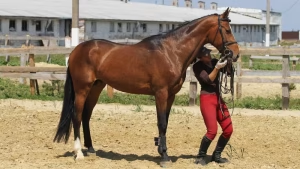
- Height: Typically 15.2 to 17 hands (157–173 cm), with 16 to 16.2hh being the most common range for flat racehorses
- Weight: 450–550 kg (990–1,210 lb)
- Build: Long, lean body with a deep chest, sloping shoulders, powerful hindquarters, and long legs with dense bone
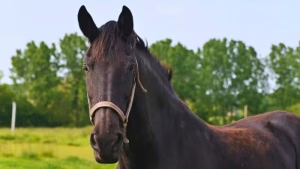
- Head: Refined, with a straight or slightly dished profile, large eyes, and alert ears
- Colours: Bay, chestnut, brown, and grey are the most common. Black, roan, and palomino occur rarely. White markings on the face and legs are common
- Legs: Clean-limbed with well-defined tendons. The legs are built for speed but can be vulnerable to strain under intense racing workloads
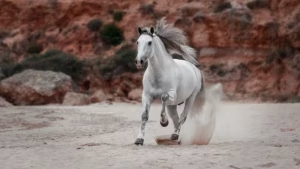
The Thoroughbred’s conformation is optimised for speed. A long stride, powerful propulsion from the hindquarters, and an efficient respiratory system allow the breed to reach speeds of over 40 mph (65 km/h) at full gallop.
Thoroughbred Temperament and Character
Thoroughbreds are intelligent, sensitive, and forward-going horses. They are bred to be brave and competitive, which makes them outstanding athletes but sometimes challenging for inexperienced riders.
Key temperament traits include:
- Sensitivity: Thoroughbreds are highly responsive to rider aids, which is a benefit for skilled riders but can make them reactive to rough or inconsistent handling
- Energy: They are naturally forward-moving horses with a strong work ethic. A bored or under-exercised Thoroughbred can become difficult to manage
- Intelligence: Quick learners that can also become anxious if stressed or confused. They respond best to calm, consistent training
- Courage: Bred to race at speed in close company, Thoroughbreds are generally bold and willing when well-handled
- Bonding: Many Thoroughbreds form strong attachments to their riders and handlers, making them loyal and rewarding horses to work with
Thoroughbreds in Racing
Horse racing — “the sport of kings” — was the Thoroughbred’s original purpose, and the breed still dominates the sport worldwide. In the UK, Thoroughbred racing is governed by the British Horseracing Authority (BHA) and takes two main forms:
- Flat racing: Horses race over distances from 5 furlongs (1,000m) to 2 miles 6 furlongs (4,400m) on turf or all-weather surfaces. Major UK flat races include the Derby at Epsom, the 2,000 and 1,000 Guineas at Newmarket, the Oaks, and the St Leger — collectively forming the five Classic races.
- National Hunt racing: Also known as jump racing, this involves racing over hurdles or steeplechase fences. Cheltenham Festival and the Grand National at Aintree are the pinnacle events. National Hunt horses tend to be slightly larger and later-maturing than flat horses.
The UK racing industry is enormous — over 1,400 race meetings take place annually across 59 racecourses, with a breeding industry centred in Newmarket (the historic headquarters of British racing) and Ireland.
Famous Thoroughbred Racehorses
The history of racing is rich with legendary Thoroughbreds:
- Eclipse (1764): Unbeaten in 18 races and the most influential stallion in Thoroughbred history. The saying “Eclipse first, the rest nowhere” captures his dominance.
- Frankel (2008): Trained by Sir Henry Cecil and ridden by Tom Queally, Frankel retired unbeaten in 14 races with a peak official rating of 147 — the highest ever recorded by Timeform.
- Arkle (1957): Widely considered the greatest steeplechaser of all time. Won three consecutive Cheltenham Gold Cups (1964–66) and was so dominant that the handicapping system was essentially redesigned around him.
- Desert Orchid (1979): A beloved grey who won the King George VI Chase four times and the 1989 Cheltenham Gold Cup in heavy ground that should have been against him.
- Enable (2014): Won the Prix de l’Arc de Triomphe twice and amassed career earnings of over £11 million. One of the greatest racehorses of the 21st century.
Life After Racing: The Ex-Racehorse
With thousands of Thoroughbreds retiring from racing each year in the UK, rehoming and retraining ex-racehorses has become a significant part of the equestrian landscape. Organisations like Retraining of Racehorses (RoR) — British racing’s official charity for the welfare of retired racehorses — work to ensure that Thoroughbreds transition successfully into new careers. Our guide to racehorse retraining walks through the reschooling process in detail.
Ex-racehorses (sometimes called OTTBs — off-the-track Thoroughbreds) can make excellent riding horses, but they require patient, knowledgeable retraining:
- Let-down period: A retiring racehorse needs time to decompress — typically 2 to 3 months of turnout and relaxation before any new training begins
- Reschooling: Racehorses are trained to go forward at speed. Retraining focuses on developing balance, adjustability, and responsiveness to lighter aids. Walk and trot work on circles and transitions form the foundation
- Feeding adjustments: Racing diets are high-energy. Transitioning to a forage-based diet with reduced concentrates helps the horse settle mentally and physically
- Patience: Many ex-racehorses have only ever known a training yard environment. Everyday experiences — hacking in traffic, standing in a field, working in company — may all be new
Thoroughbreds in Other Disciplines
The Thoroughbred’s athleticism, courage, and scope make it a natural competitor across multiple disciplines:
- Eventing: The Thoroughbred’s stamina, bravery, and speed make it ideal for the cross-country phase. Many top eventers are Thoroughbreds or Thoroughbred crosses. The breed has dominated the sport at Olympic level
- Show jumping: While warmbloods dominate the sport at Grand Prix level, Thoroughbreds and Thoroughbred crosses are common at lower levels and have a natural athletic jump
- Dressage: Pure Thoroughbreds are less common at international dressage level, but their movement quality and sensitivity can produce impressive results when trained correctly
- Polo: The speed, agility, and competitive nature of the Thoroughbred make it the preferred breed for polo worldwide
- Hunting: Thoroughbreds and Thoroughbred crosses are popular in the hunting field for their speed, stamina, and boldness across country
- All-round riding: With the right temperament and handling, a Thoroughbred can be a superb hack, trail horse, or all-rounder
Caring for a Thoroughbred
Thoroughbreds have specific care requirements that reflect their breeding and physiology:
Feeding
Thoroughbreds tend to be good doers in some cases but can also be notoriously hard to keep weight on. Their high metabolism and naturally lean build mean many need more forage and higher-quality feed than sturdier native breeds. Feed according to the individual horse’s condition, workload, and temperament — avoid excess energy in the diet for a horse in light work, as this creates behavioural issues.
Turnout
Many Thoroughbreds benefit from daily turnout for both physical and mental health. Ex-racehorses in particular may need to learn how to live in a field — some have never experienced turnout in a group before leaving the training yard. Introduce turnout gradually and ensure secure fencing, as Thoroughbreds can be athletic escapologists.
Rugging
Thoroughbreds tend to feel the cold more than native breeds due to their thin skin and fine coat. Most will need rugging in winter, particularly if clipped. Monitor body condition regularly through the colder months.
Hoof Care
Thoroughbreds are known for having flat, thin-soled feet that can be prone to bruising and thrush. Regular farrier visits (every 4–6 weeks) are essential, and many Thoroughbreds benefit from supportive shoeing or the use of hoof supplements containing biotin.
Common Health Issues
Thoroughbreds are predisposed to certain health conditions, many related to the physical demands of racing:
- Gastric ulcers: Extremely common in Thoroughbreds, particularly those in training or competing. Studies suggest up to 90% of racehorses in work have some degree of ulceration
- Tendon and ligament injuries: The stresses of galloping place enormous strain on the flexor tendons and suspensory ligaments. Old tendon injuries from racing may resurface later in life
- Exercise-induced pulmonary haemorrhage (EIPH): Bleeding from the lungs during intense exercise, common in racehorses
- Orthopaedic issues: Degenerative joint disease, bone chips, and stress fractures can occur as a legacy of racing careers
- Colic: Thoroughbreds can be sensitive to dietary changes and stress, both of which are risk factors for colic
A thorough pre-purchase vetting is essential when buying any Thoroughbred, particularly an ex-racehorse, to identify any existing conditions.
Is a Thoroughbred Right for You?
Thoroughbreds are rewarding horses for the right person, but they are not for everyone:
- Best suited to: Confident, experienced riders who enjoy a sensitive, forward-going horse. Particularly good for those interested in eventing, hunting, or retraining projects
- Less suitable for: Complete beginners, nervous riders, or those wanting a quiet, bombproof horse for light hacking. The Thoroughbred’s sensitivity and energy can be too much for an inexperienced handler
- Consider the costs: Thoroughbreds can be more expensive to keep than hardy native breeds due to higher feed requirements, rugging needs, and potential for veterinary issues
Frequently Asked Questions
How fast can a Thoroughbred horse run?
Thoroughbreds can reach speeds of over 40 mph (65 km/h) at full gallop. The fastest recorded speed for a racehorse is 43.97 mph, set by Winning Brew at Penn National Race Course in 2008 over two furlongs. In a typical flat race, Thoroughbreds sustain speeds of 35–40 mph over distances from five furlongs to a mile and a half.
Are Thoroughbreds good for beginners?
Generally, Thoroughbreds are not recommended for complete beginners. Their sensitivity, forward-going nature, and reactivity require a confident rider with a secure seat and quiet hands. However, some older, retired Thoroughbreds with calm temperaments can suit more experienced novice riders, particularly those with regular access to professional instruction.
What is an OTTB?
OTTB stands for off-the-track Thoroughbred — a Thoroughbred that has retired from racing and is being retrained for a second career in another equestrian discipline. In the UK, the charity Retraining of Racehorses (RoR) supports the rehoming and retraining of ex-racehorses, and the term is widely used in the equestrian community.
How long do Thoroughbred horses live?
The average lifespan of a Thoroughbred is 25 to 30 years, comparable to most horse breeds. However, the intense physical demands of racing can sometimes lead to earlier retirement and health complications. With good care, many retired racehorses enjoy long, healthy second careers and live well into their late twenties.
Why are Thoroughbreds so expensive?
The cost of Thoroughbreds varies enormously. Well-bred yearlings destined for racing can sell for millions at auction. However, retired racehorses are often available for modest fees or even free through rehoming charities. The ongoing costs of keeping a Thoroughbred — feed, rugging, veterinary care, and farriery — tend to be higher than for hardier native breeds, which is worth factoring into the total cost of ownership.
What makes a horse a Thoroughbred?
A Thoroughbred is not simply any well-bred horse. To be a Thoroughbred, a horse must be registered in the General Stud Book (or an equivalent stud book recognised by the International Stud Book Committee), which means both its sire and dam must be registered Thoroughbreds, and it must be the product of a live covering rather than artificial insemination. Every Thoroughbred traces its tail-male line back to one of three foundation stallions: the Darley Arabian, the Godolphin Arabian, or the Byerly Turk.
Is a Thoroughbred faster than an Arabian?
Over typical racing distances, yes. The Thoroughbred is the fastest horse breed over middle distances, reaching speeds of over 40 mph (65 km/h), and it dominates flat and jump racing worldwide. The Arabian is slower over a sprint but is bred for stamina and excels at endurance racing over distances of 50 to 100 miles, where its efficiency and heat tolerance outclass the Thoroughbred. In short, the Thoroughbred wins for speed, the Arabian for long-distance endurance.