The Haflinger horse — also called the Avelignese — is the unmistakable golden chestnut, flaxen-maned mountain breed of the Tyrol. Compact, sure-footed and famously good-natured, the Haflinger has spent the last 150 years working its way down from the high Alps to become one of Europe's most versatile family horses. This guide covers everything from breed history and conformation to temperament, common health issues and what UK buyers should look for when sourcing a Haflinger.
Haflinger Horse Overview
The Haflinger is a small, muscular Alpine horse breed developed in South Tyrol — the mountainous region that today straddles northern Italy and southern Austria. Every modern Haflinger traces its bloodline back to a single 1874 foundation stallion, 249 Folie, which makes the breed one of the most genetically traceable in the world. Haflingers are always chestnut with a flaxen mane and tail, stand around 13.2–15 hands high (134–152 cm), and combine pony-like hardiness with a horse's ridden athleticism.
Origins and History
The breed takes its name from Hafling, a small village above Merano in South Tyrol. Local farmers needed a horse small and sure-footed enough for narrow Alpine paths, strong enough to pull timber and carts, and tough enough to overwinter on poor mountain pasture. The breed registry was formalised in 1874 with 249 Folie, a half-bred stallion by an Arabian sire (133 El Bedavi XXII) out of a refined local mare. Every modern purebred Haflinger descends from him via one of seven recognised stallion lines: A, B, M, N, S, ST and W.
The breed survived two World Wars, was selected during the Italian/Austrian border conflicts as a pack animal for both armies, and has since become an international leisure-horse staple. The Haflinger Society of Great Britain, founded in 1970, oversees the UK studbook and hosts the National Show each summer.
Haflinger Height, Weight and Conformation
- Height: 13.2 to 15 hands (134–152 cm). UK breed standard accepts 13.2–14.2 hh as the typical range, with up to 15 hh in modern sport-bred lines.
- Weight: 360–500 kg.
- Build: well-muscled, deep-chested, with a powerful sloping shoulder and a strong, well-set neck. The hindquarters are broad and rounded.
- Head: refined, often showing the Arabian influence — large eyes, wide nostrils, a slightly dished or straight profile.
- Bone: dense, with short cannon bones and well-defined joints — the legacy of mountain breeding.
The breed has been quietly modernised in the last forty years. Heavier draught lines remain popular in driving and forestry; lighter sport lines, often with discreet Arabian or warmblood crosses in older pedigrees, are increasingly competitive in lower-level dressage and jumping.
Coat Colour and Markings
One of the easiest breeds to identify on sight: every Haflinger is chestnut with a flaxen (white or pale cream) mane and tail. Body shade ranges from pale palomino-style gold through deep liver chestnut. White markings are restricted by the breed standard — a small star is acceptable, but extensive face white or any leg white above the fetlock is grounds for studbook refusal.
Note that despite the colour, Haflingers are not palominos in the genetic sense. Palomino is produced by the cream dilution gene acting on chestnut; Haflingers are pure chestnut with naturally light mane and tail genetics, fixed over generations of selective breeding.
Haflinger Temperament
Haflingers are widely regarded as one of the most beginner-friendly breeds in the world. They are calm in traffic, sensible around children and livestock, slow to take offence and quick to learn. They are not, however, dull — they have a strong personality and will test inconsistent handling. The standard owner advice from the Haflinger Society of Great Britain is "fair, firm and consistent" — they respond beautifully to clear leadership and remember everything, both good and bad.
For nervous adult riders, returning riders or families with mixed-ability riders, the Haflinger is one of the best all-round choices. They are also the breed of choice in many European therapeutic-riding centres for exactly this reason.
Uses and Disciplines
- Family riding — the breed's bread and butter; suits adult riders up to roughly 13 stone (82 kg) including kit.
- Driving — singles, pairs and four-in-hand. Haflingers are mainstream at British carriage-driving trials.
- Trail riding and trekking — the original Alpine use; still excels at long distances on uneven ground.
- Lower-level dressage and Riding Club competition.
- Showing — in-hand and ridden classes at the Haflinger Society of GB National Show, Royal Highland and county-level mountain & moorland classes (where eligible).
- Therapeutic riding (RDA) — calm temperament, broad back and steady gaits.
- Vaulting — increasingly popular at international level due to their balanced canter.
- Light forestry and farm work — alive and well in parts of the Tyrol and a niche revival in the UK.
Care, Feeding and Common Health Issues
The Haflinger is a "good doer" — an efficient feed-converter that thrives on poor pasture and rapidly gets fat on rich UK grass. The most important management decision most owners make is to under-feed rather than over-feed.
- Forage: meadow hay, ideally late-cut and low-sugar. Haylage and rich ryegrass hay are usually too energy-dense.
- Hard feed: for most leisure Haflingers, a low-calorie chaff plus a vitamin-mineral balancer is plenty. Add a low-starch concentrate only for hard-working competition or driving horses.
- Grazing: use track systems, strip grazing or grazing muzzles; full unrestricted grazing on improved pasture is a fast route to obesity.
- Body condition score: aim for a 5/9. Ribs should be feelable but not visible.
- Hoof care: trim every 6–8 weeks. Most Haflingers do well barefoot due to their dense hoof horn.
Common Haflinger health issues include:
- Laminitis — the single biggest welfare risk; obesity-driven and largely preventable.
- Equine metabolic syndrome (EMS) — high prevalence among native and Alpine breeds.
- PSSM Type 1 and Type 2 — polysaccharide storage myopathy is reported at higher rates than in many breeds; a simple genetic test is available.
- Sweet itch — many Haflingers are sensitive to Culicoides midges from May to October.
- Sarcoids — common across all UK horses, no breed-specific tendency but worth monitoring.
Haflinger Lifespan
A well-kept Haflinger commonly lives to 25–30 years and many remain ridden into their mid-20s. Lifespan drops sharply with chronic obesity and untreated laminitis — both are preventable with sensible feeding and regular farrier care.
Buying a Haflinger in the UK
UK Haflinger prices typically range from £2,500 for an unbacked youngster up to £8,000+ for a confirmed schoolmaster or proven driving horse. Before buying:
- Confirm registration with the Haflinger Society of Great Britain and check the passport.
- Ask about PSSM testing — the breed is at higher genetic risk and the test is inexpensive.
- Get a full pre-purchase vet examination including a body condition assessment.
- Check the horse's hooves carefully — long-toed, under-run heels are a red flag in any good-doer breed.
- Ride at all three paces and try the horse in traffic if possible.
- Ask for honest weight history — Haflingers ridden out of obesity often have residual metabolic issues.
Haflinger vs Similar Breeds
Buyers often weigh the Haflinger against other versatile mid-sized breeds:
- Haflinger vs Fjord horse: both are sure-footed, hardy, family-friendly Alpine/Scandinavian breeds. Fjords are usually slightly heavier, dun, and a touch stockier; Haflingers are lighter and more "horse-like" in outline.
- Haflinger vs Welsh Cob (Section D): Welsh Cobs cover more ground and have more knee action, making them sportier in the show ring; Haflingers are typically calmer with novice riders.
- Haflinger vs Connemara Pony: Connemaras are jumpier and more competitive cross-country; Haflingers are slightly heavier and steadier.
- Haflinger vs Black Forest Horse: the Black Forest is darker chestnut and traditionally heavier draught; very similar temperament and use.
Frequently Asked Questions
Is a Haflinger a horse or a pony?
Officially a horse. Most Haflingers stand between 13.2 and 14.2 hands, which by strict UK definition would make them ponies, but the Haflinger Society of Great Britain and the World Haflinger Federation classify the breed as a horse on conformation grounds — they have horse-like proportions and movement rather than pony build.
Are Haflingers good for beginners?
Yes — well-handled Haflingers are widely considered one of the best beginner and family-horse breeds in Europe. They are calm in traffic, slow to spook, sensible with novice riders and trustworthy enough for therapeutic riding programmes. As with any "good doer" breed, expect to manage their weight and grazing carefully.
What two breeds make a Haflinger horse?
The breed traces back to a single 1874 foundation stallion, 249 Folie, who was sired by the Arabian stallion 133 El Bedavi XXII out of a refined Tyrolean mare. So the foundation cross was Arabian × native Tyrolean mountain mare — though more than 150 years of selective breeding has long since fixed the breed type.
Can a Haflinger jump?
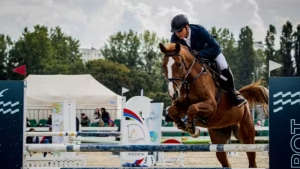
Yes — Haflingers regularly compete to British Show Jumping novice and discovery levels, and many work successfully at Riding Club affiliated heights up to about 1.05 m. They are not bred for top-level showjumping athleticism but make excellent reliable jumping schoolmasters.
How much weight can a Haflinger carry?
As a general guide, the Haflinger Society of Great Britain follows the BHS recommendation of 15–20% of bodyweight for a working horse. For a 450 kg Haflinger that means a rider plus tack of 70–90 kg (approximately 11–14 stone). Dense bone and a strong, deep-chested build make them genuinely capable of carrying heavier adult riders than their height alone suggests.
Compact, calm and hugely versatile, the Haflinger is a horse that earns its place in any UK family yard. Manage the weight, test for PSSM, ride consistently, and the breed will repay you with decades of safe, sensible work — under saddle, in harness or simply pottering down a Sunday bridleway.