The Friesian is one of Europe’s oldest and most distinctive horse breeds — an entirely black, feather-legged, high-stepping native of Friesland in the northern Netherlands that has been carrying knights, pulling carriages, and stealing every dressage centre line it walks down for more than 500 years. With a population of roughly 80,000 worldwide and tightly controlled by the KFPS (Koninklijke Vereniging “Het Friesch Paarden-Stamboek”) since 1879, the Friesian horse is one of the most carefully managed and most identifiable breeds in modern equestrian sport. This 2026 guide covers Friesian history, modern UK and SA breed standards, temperament, the genetic conditions every prospective owner must understand, day-to-day care, and what to budget for if you decide to bring one home.
Table of Contents
History and Origins
The Friesian horse takes its name from Friesland, the northernmost province of the Netherlands, where the breed has been documented in some form since at least the 13th century. Roman writers including Tacitus referred to a useful, sturdy horse from the lowland coastal regions, and during the Crusades, Friesland horses carried armoured knights into battle thanks to their strength, weight-carrying capacity and willingness under pressure.
Between the 16th and 18th centuries, Spanish horses introduced during the Eighty Years’ War (1568-1648) added refinement, elevated movement and the distinctive arched neck still visible in the modern breed. The Friesian became a fashionable carriage and parade horse across Europe and was especially prized in royal stables in the Netherlands, Spain and Sweden.
The breed almost collapsed twice. By the late 19th century, Friesian numbers had fallen below 1,000, partly because of crossbreeding for heavier farm work. In 1879, a group of breeders founded the Friesch Paarden-Stamboek (today the KFPS) to protect the foundation bloodlines. After the Second World War, mechanisation again pushed the breed to the edge — by 1965 there were reportedly only around 500 registered Friesian mares left in Europe. Concerted breeder action and the rise of carriage driving and classical dressage in the 1970s and 1980s saved the breed, and the Friesian is now one of the most strictly regulated studbooks in the world.
Physical Characteristics
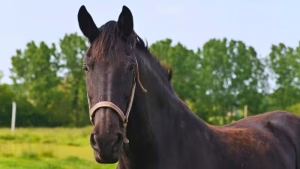
Few breeds are as instantly recognisable as the Friesian. The KFPS breed standard is unambiguous: every registered purebred Friesian is solid black, with no white markings permitted on the body other than a tiny star (no larger than 3cm) on the forehead.
- Height: 15.0 to 16.2 hands (152-167 cm); the KFPS minimum for the stamboek is 1.58 m (15.2 hh) for mares and 1.60 m (15.3 hh) for stallions at three years old
- Weight: 590-680 kg, classified as a light draught/baroque type
- Colour: Solid black only; a small star on the forehead is permitted
- Distinguishing features: Long, thick, untrimmed mane and tail; substantial feathering on the lower legs; arched, well-muscled neck; high head carriage; powerful hindquarters
- Lifespan: Typically 15-20 years; healthy Friesians regularly reach their early twenties, although the breed’s documented health predispositions mean some lines have a shorter average
The two recognised types within the studbook are the Baroque type (heavier, more substantial, traditional carriage-horse build) and the Sport type (lighter, taller, longer-legged, bred for modern dressage). Both must meet the same coat-colour and conformation standards before they can be registered.
Temperament and Trainability
Friesians are widely described as willing, sensible and people-oriented. They tend to bond strongly with one or two handlers and dislike being left in isolation. They are not as flighty as a hot-blooded Thoroughbred or Arabian but they are not stoic in the way of a heavy cob — they read the rider’s nerves carefully and amplify whatever they pick up.
For a sensible amateur rider with quiet hands and consistent expectations, a Friesian is forgiving and trainable. For a novice rider taking lessons at a riding school, they are usually too sensitive and too big to be a sensible first ride. The myth that Friesians are “easy beginner horses” because they look calm has put more than a few new owners over their head.
Movement and Gaits
Friesian movement is what wins competitions and sells calendars. The breed’s natural trot has high knee action, considerable suspension and a clear moment of float that judges and audiences both love. Under saddle this translates into an extravagant trot that’s a major asset in dressage and a guaranteed crowd-pleaser in showing classes.
The walk is purposeful but, in many lines, lacks the four-beat overstride that elite dressage judges look for at international level — this is one of the main scoring weaknesses for purebred Friesians at FEI level and one reason crossbreeding to warmbloods has become more common in modern sport breeding. The canter is rolling and uphill, helped by the breed’s naturally elevated head carriage and powerful hindquarters.
Uses and Disciplines
Dressage
Friesians have become serious dressage competitors over the past two decades. KFPS-approved stallions are bred specifically for dressage suitability, and Friesians regularly compete to medium and advanced medium level (Elementary to PSG/Inter I in British Dressage terms). A handful have reached Grand Prix internationally, but the breed’s canter and walk scores can be a ceiling at the very top of the sport — see also our British Dressage levels guide.
Carriage Driving
This is the Friesian’s traditional discipline and one where they remain world-class. The Dutch national team has used Friesians for decades in four-in-hand driving at the highest level. In the UK, the Friesian is the breed of choice for funeral directors, ceremonial coaches and royal processions because of its uniform colour, presence and reliability in harness.
Showing and Breed Classes
The British Friesian Horse Association (BFHA) and the affiliated UK KFPS-recognised inspections (keuring) provide a full ridden and in-hand showing structure in Britain. Annual KFPS keurings travel between regional locations and classify horses into Foal Book, Star, Crown and Model categories.
Leisure and Hacking
Many UK and SA Friesians live as much-loved hacking and leisure horses. They are sensible in traffic, willing on the road and have the substance to carry an adult rider all day. Just budget for the additional grooming time the mane, tail and feathering demand.
Film and Performance
Friesians remain the go-to film horse for medieval and fantasy productions — they have appeared in Ladyhawke, The Mask of Zorro, 300, The Witcher, Eragon and countless period dramas, almost always because the breed delivers a dramatic visual presence on camera at exactly the moment a director wants one.
Health and Genetic Conditions
The Friesian’s narrow gene pool, traced back to fewer than ten foundation stallions, means several genetic and structural conditions appear at noticeably higher rates than in the wider horse population. Anyone buying a Friesian should be aware of the following.
Dwarfism
Caused by an autosomal recessive mutation, Friesian dwarfism affects an estimated 0.25% of foals. Carriers are reportedly around 17% of the breed population. KFPS-registered breeders test for the gene before breeding decisions.
Hydrocephalus
Foals are born with severe cranial swelling and rarely survive. The causative mutation in B3GALNT2 is identifiable by DNA test, and breeders mating two carriers are now strongly discouraged by the KFPS.
Megaoesophagus
An inherited dilation of the oesophagus that interferes with normal swallowing. Affected horses regurgitate feed and water and are at high choke and aspiration risk. There is no cure.
Aortic Rupture and Aorto-Pulmonary Fistulation
Friesians are over-represented in cases of aortic rupture, particularly young geldings and mares aged 4-7. The condition is often fatal and is currently the subject of significant ongoing veterinary research at Utrecht University and the KFPS.
Skin Conditions
The heavy feathering is a magnet for chronic progressive lymphoedema (CPL), pastern dermatitis (mud fever, see our mud fever guide) and feather mites (Chorioptes). Daily inspection and prompt treatment are non-negotiable.
Retained Placenta and Reproductive Issues
Friesian mares have a higher-than-average rate of retained placenta after foaling (estimated 50%+ in some studies, compared to ~10% in other breeds), which is a veterinary emergency.
Care and Management
Feather Care
The feathering on the lower legs is the breed’s signature but it requires constant management. Daily check for heat, scurfing, scabs, mites or signs of CPL. Many UK owners use medicated shampoos (e.g. Hibiscrub diluted, NAF Mud Gard), zinc-based barrier creams in winter, and clip the underside of the feather to keep it clean. Trimming the visible feather is not permitted in KFPS showing classes.
Mane and Tail Maintenance
The mane and tail are never trimmed in the breed standard. Daily detangling, weekly conditioning (e.g. Cowboy Magic, Carr & Day & Martin Canter Mane and Tail) and protective plaiting for turnout are usual. Tail bags are commonly used in stables to prevent breakage and yellowing.
Feeding
Friesians are easy keepers and have a strong tendency to obesity if fed like a Thoroughbred. Most adults maintain on good-quality hay (or haylage — see our haylage guide), a high-fibre, low-sugar/low-starch balancer (Spillers Original Lite Balancer, Baileys Lo-Cal Balancer, Topspec Balancer) and turnout. Restrict spring grass and monitor body condition score monthly — see our body condition scoring guide.
Exercise and Workload
Friesians can be slow to mature physically — bone development continues into their fifth and sixth year — and the breed standard advises waiting until age four to start ridden work and avoiding hard galloping work before five. Gradual conditioning is essential because of the documented aortic risks in young Friesians.
Breeding, Registration and the KFPS
The KFPS is the world’s primary Friesian studbook with roughly 80,000 registered horses across more than 70 affiliated countries. Approved stallion status is granted only after extensive performance testing, X-rays, semen quality testing and a 50- or 70-day stallion test. In 2026, approved KFPS breeding stallions number under 80 worldwide at any one time — a deliberately tight gene pool that drives the breed’s consistency but also the health concerns above.
In the UK, registration is handled through the British Friesian Horse Society (BFHS) and the KFPS-affiliated NL-based central register. Foal book entry, star inspection and the move to Crown or Model status all take place at annual keurings.
Friesian Crossbreeds
Friesian crosses (sometimes registered as “Friesian Sport Horses” or “Friesian Sporthorses”) have become increasingly popular in the UK and South Africa as breeders look for the Friesian’s looks and temperament with improved gaits, longer stride or warmblood athleticism. Common crosses include:
- Friesian × Andalusian (Warlander/Friandaluz): classical dressage and high-school work — see also our Andalusian breed profile
- Friesian × Arabian (Arabo-Friesian): lighter, more refined, endurance-capable
- Friesian × Thoroughbred or Warmblood: sport horse for jumping and eventing
- Friesian × Cob/Gypsy Cob: heavier leisure mounts with substantial feathering
These crosses fall outside the KFPS studbook but are typically registrable in the Friesian Sporthorse Association studbook or as part-breds. Buyers should make sure the parentage is documented and that the Friesian sire is genetically tested for the major breed conditions before breeding.
Buying a Friesian Horse
Friesians are not cheap and the visible-luxury market makes mid-range pricing inconsistent. Indicative 2026 UK price ranges:
- Unregistered or part-bred foal: £2,500-£6,000
- Foal-book registered KFPS foal: £4,500-£10,000
- Star-rated youngster (3-4 years, broken to ride): £9,000-£18,000
- Crown or Model mare: £15,000-£40,000+
- KFPS approved breeding stallion: £50,000-£250,000+
South African pricing is broadly comparable: a registered Crown-eligible mare imported from the Netherlands sits in the R350,000-R750,000 range, with KFPS keuring inspections held annually by the Friesian Horse Association of Southern Africa.
Pre-purchase vetting must include a five-stage vet examination, KFPS dwarfism and hydrocephalus DNA tests, and ideally a screening cardiac auscultation given the aortic concerns. Insurance premiums on Friesians can be 20-40% higher than for a Thoroughbred or warmblood of equivalent value because of the documented health risk profile.
Frequently Asked Questions
Are Friesian horses good for beginners?
Generally no. Friesians are sensitive, big, strong and reactive to nervous riders. They are excellent for confident intermediate riders with experience handling forward, sensitive horses; they are usually not the right first horse for a true novice.
How long do Friesian horses live?
Average life expectancy is 15-20 years. The breed’s lifespan is shorter than the equine average (which sits closer to 25-30 years for many breeds) largely because of the documented genetic conditions, particularly aortic rupture in young adults.
How much does a Friesian horse cost in the UK?
In 2026, a Foal Book registered Friesian foal typically sells between £4,500 and £10,000. A trained, Star-rated riding horse is generally £9,000-£18,000, with Crown and Model mares fetching £15,000-£40,000 and approved stallions reaching £250,000+.
Why are Friesians always black?
The KFPS breed standard requires solid black coat colour with no white markings other than a small forehead star. The black-only registration has been the KFPS standard since 1879 and any horse showing a non-black base coat or significant white markings cannot enter the studbook.
What disciplines are Friesians best at?
Carriage driving (especially four-in-hand) and dressage to medium/advanced medium level. They also excel at parade and ceremonial work, classical riding, ridden showing classes and film/performance. They are less competitive in show jumping and eventing because of their substance and structure.
Are Friesian horses good for South African conditions?
Friesians cope reasonably well in temperate SA climates (Highveld, Cape) but the heavy coat, feathering and dark colour make hot, humid Lowveld conditions a challenge. Adequate shade, electrolyte management, regular feather inspection for mites and fungal issues, and careful workload planning in summer are essential.