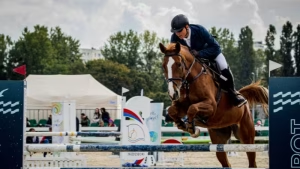
Walk into any showing class, racing yard or hunting field in Britain and the most common horse colour you will see is bay. Reddish-brown body, jet-black mane and tail, dark legs from the knee down — bay is the breed-standard “default” of the horse world, and one of the easiest coat colours to identify once you know what you’re looking for. Bay horses appear in almost every breed, from Thoroughbreds and Warmbloods to Welsh natives, and from heavy draft horses to Shetland ponies.
This guide explains what makes a bay horse a bay, the main shades — from blood bay to dark bay and seal brown — the genetics behind the colour, the breeds that carry it most prominently, and how to tell a bay from a brown, a chestnut or a sorrel. Useful for new owners, showing competitors, breeders and anyone trying to fill in a passport identification page accurately.
Table of Contents
What Is a Bay Horse?
A bay horse has a reddish-brown to dark mahogany body coat with black points — a black mane, black tail, black ear tips and black lower legs. Without those black points, a horse cannot be classified as a true bay. The body colour itself can range from a light, almost yellowy-tan through to a coat so dark it looks black at first glance, but the points must always be black for the horse to be identified as bay.
Bay is one of the oldest and most common base colours in the modern horse population. Cave-art pigments, ancient Greek descriptions and centuries of stud-book records all point to bay being a dominant coat type long before formal breed registries existed. Today, more registered horses worldwide are bay than any other single coat colour.
Shades of Bay: From Light Bay to Seal Brown
“Bay” is an umbrella term. Showing schedules, passports and breed registries recognise a number of named shades within it. Each variant shares the black-points rule, but the body coat and “muzzle, eye and flank” mealy areas differ.
Light bay
A pale, sandy or yellow-tinged body coat with the standard black points. Often described as “wheat” or “buckskin-bay” — but a true light bay is bay (with the black points), not buckskin (with the cream gene). Light bays are sometimes seen in Arabians, Welsh ponies and Thoroughbreds.
Standard bay
The classic reddish-brown that comes to mind when most people think “bay”. A medium-shade body coat, clean black mane and tail, black legs from cannon down, often with white face or leg markings.
Blood bay
One of the most striking shades. A deep, vivid red-mahogany body — almost cherry-red in good summer condition — with intense black points. The term “blood bay” is widely used in the UK and US showing scenes; it is not formally distinct from “bay” in genetic terms but is a recognised description on passports and judges’ notes.
Dark bay (mahogany bay)
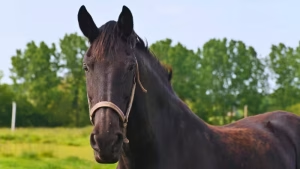
A deep, rich brown body coat that can be hard to tell from black at a glance. The reddish tones usually show clearly on the flanks, behind the elbow and around the muzzle. Dark bay is one of the most popular colours in the showing and dressage world for the way it absorbs light without looking flat.
Seal brown (sometimes “seal bay”)
The darkest end of the bay spectrum. The body coat looks black until you put the horse alongside a true black, when red-brown highlights appear on the muzzle, around the eyes, behind the elbow and on the flanks (the so-called “soft” or “mealy” points). Many “black” horses on first glance turn out to be seal brown on closer inspection. Modern genetics has shown most seal browns to be a variant of bay rather than a separate base colour.
Wild bay
A rarer variant in which the black points stop unusually low — sometimes only at the pasterns and the very base of the mane and tail. Wild bay is associated with the primitive A+ allele of the agouti gene, and is most often seen in primitive and primitive-influenced breeds such as the Exmoor and Konik.
“Modifier” bays — perlino, buckskin, amber and bay roan
The bay base coat can be modified by other genes, including some behind the rarest horse colours:
- Buckskin — bay + one cream gene. Yellow-gold body, black points.
- Perlino — bay + two cream genes. Cream body, paler points, blue eyes.
- Amber champagne — bay + champagne gene. Tan-pink body, dark points, pale skin.
- Bay roan — bay + roan gene. Even mix of white and red on the body, black points and head.
- Bay dun — bay + dun gene. Tan body with primitive markings — a dorsal stripe, leg bars, sometimes shoulder shadow.
- Bay tobiano / overo / sabino — bay base with white-spotting patterns.
Bay Horse Genetics in Plain English
Two genes control whether a horse is bay, black or chestnut: Extension (E) and Agouti (A). Set aside grey, dilution and white-spotting genes for a moment — bay comes from the simple interaction of these two.
- Extension (E) determines whether the horse can produce black pigment.
- EE or Ee — black pigment produced.
- ee — black pigment blocked. The horse will be chestnut, regardless of any other colour gene.
- Agouti (A) restricts where black pigment shows.
- AA or Aa — agouti is active. Black pigment is restricted to the points (mane, tail, lower legs, ears). The body coat is red-brown. Result: bay.
- aa — agouti is inactive. Black pigment covers the whole body. Result: black.
So a bay horse is, by definition, “E_A_” in the simplest terms — at least one Extension allele and at least one Agouti allele. Two bays bred together can produce bay, black or chestnut foals depending on which alleles each parent carries.
Wild bay (A+), seal brown (At) and standard bay (A) are increasingly recognised as variants of agouti, which is why some “bays” carry their black points lower or higher than others.
Bay vs Brown vs Chestnut: How to Tell Them Apart
Confusing the three is one of the most common identification mistakes. The black points rule sorts most of it out:
| Colour | Body coat | Mane & tail | Lower legs |
| Bay | Reddish-brown to dark mahogany | Black | Black (“black points”) |
| Brown / dark bay | Very dark brown, often near-black | Black | Black, with red highlights at flanks/muzzle |
| Black | Pure black body | Black | Black, no reddish areas at all |
| Chestnut | Reddish, ginger or copper body | Same colour as body, or flaxen | Same colour as body — never black |
| Sorrel | A US/Western term for chestnut, with no black | Same as body or flaxen | Same as body |
The simplest test in the field: black mane, black tail, black lower legs and a red-brown or browner body — bay. No black anywhere — chestnut or sorrel. Black everywhere with no red-brown highlights — a true black.
Breeds Where the Bay Coat Excels
Bay is the standard or near-standard colour in many breeds, and a permitted colour in nearly every other.
- Cleveland Bay — Britain’s oldest established breed, where bay is the only permitted colour. The Cleveland Bay must be a clean, solid bay with bay points and no white above the fetlock.
- Thoroughbred — bay is the most common Thoroughbred colour, with dark bay and brown close behind.
- Arabian — bay, grey and chestnut dominate.
- Hanoverian, Holsteiner, KWPN and other Warmbloods — dressage and showjumping rings are heavy with bays.
- Andalusian / PRE — predominantly grey, but bay is also recognised.
- Welsh Sections A, B, C and D — bay is the most common colour across all four.
- New Forest pony — bay dominates the breed.
- Exmoor pony — wild-bay variant with mealy muzzle.
- Shire, Clydesdale, Suffolk Punch and other heavies — bay is widespread, often with the heavier feathering of draft types.
- American Quarter Horse — bay is one of the most-registered colours.
Bay Horse Markings on the Face and Legs
White markings on the head and legs are common in bay horses and are recorded on the equine passport.
Common face markings
- Star — a small white area on the forehead.
- Stripe — a narrow vertical line down the face.
- Snip — a small white mark on or just above the muzzle.
- Blaze — a wide white mark down the face.
- Bald face — white covering most or all of the face.
Common leg markings
- Coronet — white just above the hoof.
- Sock / half-stocking — white extending up to the cannon.
- Stocking — white extending to the knee or hock.
- Ermine spots — small dark spots within white socks.
White markings do not affect the bay classification; they are recorded separately. Excessive white above the knee or hock is a points penalty in some breed classes (Cleveland Bay) but unrestricted in others (Welsh, Thoroughbred).
Famous Bay Horses
- Frankel — Britain’s unbeaten Thoroughbred champion, a bay racehorse considered by many the greatest of his era.
- Red Rum — three-time Grand National winner, a classic blood bay.
- Desert Orchid — although famously grey, his bay-and-grey siblings demonstrate the colour transitions in National Hunt royalty.
- Valegro — Charlotte Dujardin’s dressage hero, a dark bay KWPN gelding.
- Big Star — Olympic showjumper, a dark bay KWPN stallion.
- Hickstead — the late, great showjumping stallion, a bay Belgian Warmblood.
- Kauto Star — National Hunt champion, a bright bay.
Identifying a Bay Horse on a Passport
Equine passports issued under UK and EU regulations include a written colour description and a marking diagram. When entering “bay”, be precise:
- Use the recognised UK Defra colour list — bay, dark bay/brown, black, chestnut, grey and so on.
- Add a shade descriptor where possible — “bright bay”, “dark bay”, “blood bay”, “seal brown”.
- Confirm black points (mane, tail, lower legs, ear edges).
- Diagram all white markings, whorls and acquired marks.
- Have the description signed by the vet or trained passport-issuing officer.
Mis-identifying a dark bay as “black” or a seal brown as “bay” can cause issues on insurance claims, sales documents and competition entries. When in doubt, photograph the horse in good outdoor light and ask a vet for a second opinion.
Caring for and Showing a Bay Coat
Bay is one of the more forgiving colours to keep clean — dirt, sweat and stable stains rarely show as obviously as on a grey or palomino. The black mane and tail need slightly more attention than a chestnut’s because sun bleaching can turn a deep black mane orange-red over a long summer. Some practical pointers:
- Sun bleaching — UV rays bleach black hair. Stable during the brightest hours and use a hood for show horses.
- Mane and tail care — work conditioner through the mane and tail at least weekly to keep the black rich.
- Coat shine — diet matters more than any product. Linseed, omega-3 supplements and a balanced ration produce a deep, polished bay.
- Hot cloths and quartermarks — show producers use a hot, damp cloth in the cool-down to lift dander and bring up the coat. Quartermarks “set” beautifully on a clean dark bay or blood bay.
- Show day — a chalk block on a white sock, baby oil round the eyes and muzzle, and a careful trim of the bridle path. Bay horses photograph well — outdoor light brings out the red highlights.
Frequently Asked Questions
What is a bay horse?
A bay horse is a horse with a reddish-brown to dark mahogany body coat and black points — a black mane, black tail, black ear tips and black lower legs. Bay is one of the most common base coat colours, found in nearly every breed.
What is the difference between a bay horse and a brown horse?
“Brown” is sometimes used loosely to describe a dark bay or seal brown. Both share black points. A true brown / seal brown body looks black until you spot the red highlights at the muzzle, behind the elbow and on the flanks. A standard bay has a clearly red-brown body without those darker tones.
How do I tell a bay horse from a chestnut?
Look at the mane, tail and lower legs. A bay has black mane, black tail and black lower legs. A chestnut has the same colour all the way through — never black. If the mane is pale or “flaxen”, the horse is a chestnut, not a bay.
What is a blood bay horse?
Blood bay is a vivid, deep red-mahogany shade of bay with strong black points. It is not a separate genetic colour but a recognised showing description for an unusually rich, cherry-red bay horse.
What is a dark bay horse?
Dark bay (sometimes called mahogany bay) is a deep brown bay that can look black at a distance. The body coat is rich brown rather than red, but the standard bay rule still applies: black mane, tail and lower legs.
Are bay horses rare?
The opposite — bay is the most common coat colour in most modern horse breeds. It is the dominant colour in Cleveland Bays, very common in Thoroughbreds, Warmbloods, Welsh ponies and New Forest ponies, and widespread across nearly every other registry.
Can two bay horses produce a foal that isn’t bay?
Yes. Bay parents can produce bay, black or chestnut foals depending on what other alleles each parent carries at the Extension and Agouti genes. Two bays heterozygous at both loci can produce all three colours.