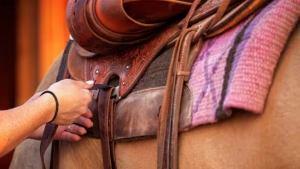
Knowing the parts of the saddle is the equestrian equivalent of knowing the parts of a car engine: most riders manage without it until something goes wrong, at which point not knowing the difference between a billet and a girth strap, or a pommel and a cantle, makes every conversation with the saddler twice as long. A saddle is a precision-engineered object made of perhaps 25 distinct components, and a good rider should be able to name and locate every one of them.
This guide covers the parts of the saddle on both the English saddle most common in the UK and the Western saddle, with diagrams in plain text and detail on what each part does, why it matters, and where it most commonly fails. The terminology used here follows the Society of Master Saddlers and the British Equestrian Federation, which is what your UK saddle fitter will use.
English Saddle vs Western Saddle: The Two Main Traditions
The English saddle is the standard for UK riding — dressage, showjumping, eventing, hacking, racing and pony club. It is lightweight, close-contact and designed for active riding with frequent and subtle weight shifts. The Western saddle developed for the cattle work of the American West and remains the standard for working stock, trail riding, reining, cutting and barrel racing. It is heavier, deeper-seated and built around the horn for roping work.
The two saddles share around half their structural anatomy — the tree, gullet, pommel, cantle and panels are common to both — but diverge on the rest. We'll cover both, with English in detail and Western with the key differences highlighted.
The English Saddle: Parts From Front to Back
Working through the English saddle from the front of the horse backwards, and from top to underside, the standard parts are as follows.
1. Pommel
The raised front arch of the saddle, sitting above the horse's withers. The pommel houses the head of the tree and the gullet opening. It must clear the withers when the saddle is loaded — the BSI / SMS guideline is two to three fingers' clearance with a rider mounted, neither pressing on the withers nor floating clear by a hand's breadth. A pommel that touches the withers is the single most common saddle-fit fault on UK yards. See our guide to the pommel for the etymology and historical variations.
2. Cantle
The raised back arch of the saddle, opposite the pommel. The cantle sits behind the rider and varies dramatically in height between disciplines — a flat racing exercise saddle has a barely-raised cantle, a high-school dressage saddle has a deep cantle that holds the rider in the seat. Cantle height drives how secure or how mobile the rider feels in the seat. See cantle for more.
3. Seat
The padded, dished area between pommel and cantle where the rider sits. Seat depth and shape vary by discipline — a dressage saddle has a deep, narrow seat that puts the rider into a vertical-thigh position, a jumping saddle has a flatter, more open seat that allows the rider to stand in the stirrups, and a general-purpose saddle compromises between the two. Seat size is measured in inches from the pommel nailheads to the centre of the cantle: 16.5", 17", 17.5" and 18" are the common UK sizes for adults, with 15"–16" for children and small adults.
4. Twist
The narrowest part of the seat at the front, where the rider's inner thighs sit. A narrow twist favours riders with closer-set legs and tends to feel "more on the horse," whereas a wide twist favours wider hip conformation. Twist is one of the most personal aspects of saddle fit and a reason why two riders of identical height can feel polar-opposite in the same saddle.
5. Knee Roll
The padded roll on the front of the flap, against which the rider's knee sits. Knee rolls have grown larger in modern saddles, particularly in dressage where deep blocks (sometimes called "blocks" rather than rolls) lock the thigh into position. Some riders find aggressive knee blocks restrictive; others find them essential. Removable Velcro blocks allow the choice without changing saddle.
6. Thigh Block (Calf Block)
A second support, behind the knee roll, found in modern jumping and eventing saddles. It supports the lower thigh during the moment of a jumping fence when the rider's weight comes forward and down.
7. Flap (Skirt)
The large outer leather panel that hangs below the seat and against which the rider's leg lies. Flap length varies by discipline: long for dressage to accommodate a long leg position, shorter and more forward-cut for jumping to make room for shorter stirrups and the forward seat. Flap forwardness is the angle of the flap relative to the vertical — a "forward-cut" flap is angled towards the horse's shoulder.
8. Sweat Flap (Inner Flap)
The smaller second flap underneath the outer flap, which protects the horse from the rider's stirrup leathers and from the metal stirrup leather buckles. Most modern saddles incorporate the sweat flap as an integral part of the saddle; older or specialist saddles may have a removable or short sweat flap.
9. Stirrup Bar
The metal hook bar, set into the tree under the skirt at the top of the flap, from which the stirrup leathers hang. UK saddles must by tradition use a "safety bar" that releases under a backward pull — the bar has a movable thumb-clip that should be in the down position when riding, so that in the event of a fall the leather slides off the bar and the rider does not get dragged. Always check the safety catch is down before mounting.
10. Stirrup Leather
The adjustable leather strap that runs from the stirrup bar around the stirrup iron and back up through a buckle. Stirrup leathers stretch with use and asymmetrically — most riders favour one side, gradually elongating that leather, which creates apparent saddle-fit problems. Swap stirrup leathers left to right monthly to even the wear.
11. Stirrup Iron
The metal frame in which the rider's foot rests. Traditional UK stirrups are plain Fillis irons in stainless steel; modern designs include offset stirrups, safety irons with a rubber band or hinged outer arm that release the foot in a fall, and specialised dressage or jumping designs. The stirrup must be wide enough to allow the foot to slip free in a fall but narrow enough that the foot cannot pass through to the boot heel — about 12 mm wider than the widest part of the rider's boot.
12. Girth Straps (Billets)
The straps hanging from beneath the saddle flap to which the girth buckles attach. Standard English saddles have three girth straps per side; the girth normally attaches to the first and third (front and rear) for stability. The middle strap is the spare. The straps are sewn into the tree at the "rigging point" and the strength of this attachment is one of the load-bearing critical parts of the saddle.
13. Girth
The strap that runs underneath the horse from one set of billets to the other, holding the saddle on. Girths come in many lengths (measured in inches) and materials — leather, synthetic, neoprene, fleece-lined — and in shaped or "anatomical" designs that relieve pressure behind the elbow. The girth must be tight enough to keep the saddle in place but not so tight as to interfere with breathing; the rule of thumb is two fingers' clearance between girth and horse at the lowest point.
14. Panel
The two padded cushions beneath the seat that sit on either side of the horse's spine. The panels are the load-bearing interface between saddle and horse — they distribute the rider's weight across the horse's back. Panels are traditionally stuffed with wool flock (which can be added to or removed by the saddler to adjust fit) or with foam, which gives a more consistent feel but cannot be re-fitted. Wool-flocked panels are standard for serious UK competition and SMS practice.
15. Gullet
The channel running down the length of the saddle between the two panels, sitting directly over the horse's spine. The gullet must be wide enough that the saddle does not contact the spinous processes — typically 7–10 cm depending on horse and discipline. A too-narrow gullet pinches the spine and produces sore-backed horses; a too-wide gullet allows the panels to fall in towards the spine and produces the same problem from the opposite direction.
16. Tree
The internal skeleton of the saddle, traditionally made of laminated wood or beech, in modern saddles often spring steel reinforced with synthetic composite. The tree gives the saddle its shape and determines its width fitting — narrow, medium-narrow, medium, medium-wide, wide and extra-wide are the standard UK width designations. A broken tree is a write-off — the saddle cannot be ridden in. Suspect a broken tree if the saddle suddenly creaks excessively, twists in the hand, or sits unevenly on the horse.
17. Head Plate (Gullet Plate)
The metal bar at the front of the tree that sits over the withers and determines the front width of the saddle. Some modern saddle systems (notably Wintec and Bates) have interchangeable head plates of different widths, allowing the same saddle to be fitted to different horses by swapping the plate.
18. Cantle Bar
The reinforcing metal bar at the back of the tree, opposite the head plate.
19. Saddle Pad / Numnah
Not part of the saddle itself but used with every English saddle in the UK — the fabric pad between saddle and horse. Numnahs are shaped to the saddle outline; "saddle pads" or "saddle cloths" are typically rectangular. They protect the saddle and the horse's coat, absorb sweat, and provide a small amount of shock absorption. A pad is not a substitute for correct saddle fitting — adding a pad to make a too-wide saddle fit is the equine equivalent of wearing socks to make shoes fit.
English Saddle Types and Their Distinctive Parts
Within the English tradition, several discipline-specific saddle types have evolved with subtly different parts and proportions:
- Dressage saddle: Deep seat, long straight flap, extended billet straps (the girth buckles below the rider's leg), deep knee blocks. Designed for the long, vertical leg position of high dressage.
- Jumping saddle: Flatter seat, short forward-cut flap, knee and thigh blocks, regular-length billets. Designed for short stirrups and the forward galloping seat.
- General-purpose (GP) saddle: Compromise design — moderate seat depth, slightly forward flap, suited to most pony club and leisure work.
- Eventing saddle: Variant of the jumping saddle, sometimes with a slightly deeper seat for the dressage phase. Cross-country saddles may have additional knee and thigh blocks for the secure seat needed at speed over solid fences.
- Show saddle (saddle seat): Very flat seat, straight flap, designed to display the horse rather than support active riding.
- Racing exercise saddle: Tiny and minimal — barely raised pommel and cantle, very short flap, weight as low as possible.
- Side saddle: A specialist design with a single offside flap and two pommels (the upright "head" and the leaping head below it) that hold the rider's right leg secure across the saddle.
The Western Saddle: Where the Anatomy Differs
The Western saddle is built on the same conceptual tree-pommel-cantle-panel structure but adds and modifies parts for stock work. The key Western-specific terms are:
- Horn: The vertical projection rising from the pommel, used to dally a rope when working cattle. The defining feature of the Western saddle and the part most never used by the modern UK Western rider.
- Swells (fork): The forward part of the tree under the pommel, equivalent to the head plate. Western saddles can be "slick fork" (low, simple) or "swell fork" (raised, providing more rider security in fast work).
- Skirt: The large rectangular leather panels that extend below the seat. Western skirts are decorative and weight-distributive — they spread the much heavier Western saddle's load over a larger area of the horse's back.
- Fender: The wide leather panel through which the stirrup leather runs, replacing the English stirrup leather as a single integrated unit.
- Stirrup: Larger and heavier than the English stirrup, often with a leather hood (tapadero) covering the front to protect the rider's foot from brush.
- Cinch: The Western equivalent of the girth — typically two cinches (front and rear or "flank") on a roping saddle; one on a pleasure or trail saddle. Connected via a wide latigo strap rather than buckle-and-billet.
- Rigging: The metal ring on the tree where the cinch attaches. Different rigging positions (full, 7/8, 3/4, centerfire) shift the cinch position forward or back along the horse to suit the work being done.
- Conchos: Decorative metal discs, often silver, set into the skirt and rear. Originally functional (holding leather components together) and now largely cosmetic.
Why Saddle Parts Matter for Fit
Every part of the saddle has a fitting implication and a failure mode. The Society of Master Saddlers in the UK, and the Master Saddlers Association in the US, both publish detailed fitting checklists. The key points UK owners can check on their own saddle before calling the saddler include:
- Pommel clearance: Two to three fingers above the withers with a rider mounted
- Gullet width: Spinous processes never contacted
- Panel contact: Even contact along the entire length of the panel, no rocking or bridging
- Saddle balance: Cantle should sit slightly higher than pommel or be level — never lower than pommel
- Tree width: Saddle sits centred on the spine, not tilted to either side
- Flap length: Should not extend past the horse's elbow
- Girth straps: No fraying, no stretched holes, both sides of equal length
- Stirrup bar safety catch: Down, with the catch lifting freely
A UK SMS Qualified Saddle Fitter visit costs typically £80–150 and should be carried out at minimum annually — more often for growing horses, for horses that have gained or lost significant condition, or after any significant change in workload. Saddle flocking can be re-balanced and re-stuffed by a qualified saddler; trees cannot be repaired.
Common Wear and Failure Points
The parts of an English saddle most likely to need attention or replacement over its working life are:
- Stirrup leathers — stretch first; check holes every six months
- Girth — webbing and stitching fail; replace annually if used heavily
- Girth straps (billets) — sewing at the rigging point fails; check before every long hack and replace at first sign of stitching wear
- Flocking — compresses with use; re-flock every 12–24 months
- Tree — rare but catastrophic failure; have the saddle inspected if a fall occurs or if the saddle is dropped from height
- Stirrup bar safety catch — gets stiff or seized; should always release with finger pressure
Frequently Asked Questions
What are the parts of an English saddle?
The main parts of an English saddle are the pommel (front arch), cantle (rear arch), seat, twist, knee roll, flap, sweat flap, stirrup bar, stirrup leathers and stirrup irons on the upper side, and the panels, gullet, tree, head plate, girth straps (billets) and girth on the underside. A standard UK English saddle has between 20 and 25 separately identifiable parts.
What is the front of a saddle called?
The raised arch at the front of the saddle is called the pommel on an English saddle, or the swell on a Western saddle. A Western saddle also has a horn rising from the pommel — used to dally a rope when working cattle. The pommel sits over the horse's withers and must clear them with two to three fingers' space when a rider is mounted.
What is the difference between an English and Western saddle?
English saddles are lighter, more close-contact, designed for active riding with subtle weight shifts, and are standard for UK dressage, showjumping, eventing and racing. Western saddles are heavier, deeper-seated, built around a horn for roping cattle, and use a single broad cinch (or two on roping saddles) rather than the English girth-and-billet system. They share the tree, pommel, cantle, gullet and panels but diverge sharply on the flap, stirrup and attachment hardware.
What is the cantle of a saddle?
The cantle is the raised arch at the back of the saddle, behind the rider's seat. Its height varies dramatically by discipline — flat on a racing exercise saddle, raised and deep on a high-level dressage saddle. The cantle height drives how secure the rider feels in the seat and how easily the rider can sit different gaits.
How many parts does a saddle have?
A standard English saddle has approximately 20–25 distinct parts, depending on how you count integrated components. A Western saddle typically has 25–35 parts because of the added horn, fender, skirt, cinches and rigging. Both share the underlying tree-pommel-cantle-panel-gullet structure but diverge on stirrup and girth hardware.
Understanding the parts of the saddle is the first step in being able to communicate properly with your saddler, fitter or coach. For more on related tack and how it fits together, see our guides on types of bits, the bridle, and our step-by-step guide to tacking up a horse.