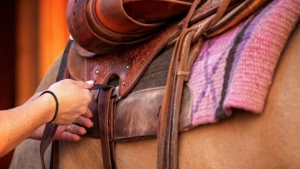
Horse rigging — the system that secures a saddle to the horse — is one of those subjects riders encounter without fully understanding until something goes wrong. A saddle that slips back, a girth that will not stay centred, a cinch that rubs: all of these trace back to how the rigging is set up. Whether you ride Western or English, understanding saddle rigging will help you fit your tack correctly, keep your horse comfortable, and choose the right equipment for your discipline. This guide explains every rigging position, the difference between Western and English systems, and how to choose the right one.
Table of Contents
What Is Horse Rigging?
Horse rigging refers to the hardware and attachment points that connect the saddle to the girth or cinch, which in turn wraps around the horse’s barrel to hold the saddle in place. The position and type of rigging determine where the girth or cinch sits on the horse’s body, how pressure is distributed across the ribcage, and how well the saddle stays put during work.
In Western riding, “rigging” specifically describes the rings, plates, or in-skirt hardware mounted on the saddle tree to which the cinch attaches. In English riding, the equivalent is the billet (or girth-strap) system: the leather straps hanging from the saddle that buckle to the girth. The principles are identical; only the terminology and construction differ. For a full breakdown of saddle anatomy, see our guide to the parts of the saddle.
Why Rigging Position Matters
Rigging position is not a minor detail — it dictates how your saddle behaves on the horse. Get it right and the saddle sits balanced and secure; get it wrong and you create slipping, pressure points, and an unhappy horse. Rigging position affects:
- Where the cinch or girth sits in relation to the horse’s elbow and natural girth groove.
- How the saddle is held down — whether pressure pulls evenly or tips the saddle forward or back.
- Saddle stability on hills, during stops, or when roping or working cattle.
- Pressure distribution across the back and ribs, which directly affects comfort and soundness.
- Freedom of the shoulder — a cinch set too far forward can interfere with the elbow and movement.
Types of Saddle Rigging Positions
Western rigging positions are described by a fraction that indicates where the rigging ring sits between the front of the saddle (the fork) and the centre of the seat. The further forward the ring, the further forward the cinch pulls. Here are the standard types of saddle rigging:
- Full rigging (Spanish rigging, position 1): The rigging ring sits directly below the fork/horn, the most forward position. This pulls the cinch well forward and holds the saddle very securely — favoured for roping and hard stopping, but it can crowd the elbow on some horses.
- 7/8 rigging: The ring is set very slightly back from full position. A popular all-round compromise that holds the saddle securely while easing pressure off the elbow a touch.
- 3/4 rigging: The ring sits roughly midway between the fork and the centre of the seat, placing the cinch further back in a more natural girth position. Comfortable and widely used for general riding and pleasure.
- 5/8 rigging: Set further back again, between 3/4 and centrefire, distributing pull more towards the centre of the saddle.
- Centrefire (center-fire / centre-fire) rigging: A single cinch positioned at the centre of the saddle, midway between fork and cantle. Common on some trail and historic styles, it balances the saddle from the middle but can allow more rocking front to back.
As a quick reference, the further forward the rigging (full and 7/8), the more secure and “anchored” the saddle for high-effort work; the further back (3/4, 5/8, centrefire), the more the cinch sits in the horse’s natural girth groove for everyday comfort.
Single vs Double Rigging
Rigging is also classed by how many cinches it carries:
- Single rigging: One cinch only. Lighter and simpler, common in centrefire and 3/4 set-ups for pleasure and trail riding.
- Double rigging (full double): A front cinch plus a rear (flank or back) cinch. The flank cinch stops the back of the saddle lifting under hard work such as roping. The two cinches should be connected by a hobble strap so the rear cinch cannot slide back into the flank.
If you ride a stock or Western saddle for working cattle or roping, a full double rig gives maximum security. For trail and pleasure, a single rig is usually plenty.
In-Skirt and 3-Way Rigging
Beyond ring position, modern saddles offer different ways of mounting the rigging itself:
- In-skirt rigging: The rigging hardware (often a flat plate or D-ring) is built directly into the saddle skirt rather than hung from the tree. This gives a slimmer, closer-contact feel under the leg and is popular on pleasure and trail saddles. It is less suited to extreme roping loads than tree-mounted rigging.
- Conventional (on-tree) rigging: Rigging plates or rings attached directly to the saddle tree, giving maximum strength for heavy work.
- 3-way (3-point) adjustable rigging: A versatile system that lets you attach the cinch at full, 7/8, or 3/4 position from the same saddle. Three-way rigging is invaluable if you ride different horses or disciplines, because you can fine-tune cinch position to suit each horse’s conformation without changing saddles.
Adjustable 3-way rigging has become a favourite precisely because it removes the guesswork: if a saddle slips or the cinch sits awkwardly, you simply move the attachment point.
The English Billet System
English saddles do not use rings — they use billets (girth straps). Understanding the English equivalent of rigging is just as important for fit:
- Billets / girth straps: Usually three leather straps per side, hung from the saddle. You normally girth up on two of the three, choosing which to use to influence saddle position.
- Point strap: The front billet is often attached directly to the point of the saddle tree (the “point strap”). Using the point strap helps hold a saddle forward and is useful on horses that push a saddle back.
- Balance / rear strap: The rearmost billet helps anchor the back of the saddle on horses that tip it forward.
- Long vs short billets: Dressage saddles use long billets and a short girth to remove bulk under the leg; jumping and general-purpose saddles use shorter billets and a long girth.
Choosing which billets to girth on is the English rider’s version of selecting a rigging position — both are about placing the girth correctly in the horse’s natural girth groove. Some saddles also offer a V-system or double girth arrangement for added stability. For correct girthing as part of the wider routine, see our guide on how to tack up.
How to Choose the Right Rigging
The right rigging depends on your horse’s conformation and your discipline:
- For roping and hard, fast work: A full or 7/8 double rig holds the saddle rock-solid.
- For trail and pleasure riding: A 3/4, 5/8, or centrefire single rig lets the cinch sit comfortably in the girth groove.
- For mutton-withered or forward-girthed horses: A rig that pulls the cinch further back (3/4 or centrefire) or an adjustable 3-way rig prevents the saddle being dragged forward onto the shoulder.
- For high-withered horses prone to a saddle slipping back: A more forward rig (full or 7/8), or using the point strap in English tack, helps hold it in place.
- If you ride several horses: An adjustable 3-way rigging is the most flexible single choice.
If you are unsure, a professional saddle fitter is worth every penny. In the UK, the Society of Master Saddlers can help you find a qualified fitter to assess both saddle and rigging for your individual horse.
Common Rigging Problems
- Saddle slipping back: Often a rigging set too far back, or a horse shape that needs a more forward rig or point strap.
- Cinch creeping forward into the elbow: Usually a rig set too far forward (full position) for that horse, causing rubs and restricted movement.
- Saddle rocking front to back: Can occur with centrefire rigging on the wrong back shape.
- Rear cinch riding up into the flank: A dangerous cause of bucking — always connect front and rear cinches with a hobble strap and keep the rear cinch snug but not tight.
- Uneven pressure and dry spots: Sweat patterns and dry spots after work signal poor pressure distribution often linked to rigging position. Check fit promptly.
Rigging vs a “Riggy” Horse
A quick but important point of confusion: the words “rig” and “riggy” have a completely different meaning when applied to the horse itself. A “rig” (or cryptorchid) is a male horse with one or both testicles retained inside the body rather than descended, so it may appear to be a gelding while still producing testosterone and showing stallion-like, or “riggy”, behaviour. This has nothing to do with saddle rigging — it is a veterinary and behavioural matter. If you suspect a gelding is behaving like a rig, your vet can carry out a blood test to check. For everything in this guide, “rigging” refers strictly to the saddle attachment system.
Frequently Asked Questions
What are the different types of rigging on a saddle?
Western saddles use rigging positions described as fractions: full (Spanish) at position 1, 7/8, 3/4, 5/8, and centrefire, depending on how far forward the cinch ring sits. Rigging can also be single or double (with a rear cinch), and mounted on the tree or built into the skirt (in-skirt). English saddles use a billet/girth-strap system instead.
What is 7/8 rigging on a saddle?
7/8 rigging places the cinch ring just slightly behind the full (most forward) position. It is a popular all-purpose set-up that keeps the saddle secure for active work while easing pressure off the horse’s elbow compared with a full rig — a good compromise for general Western riding.
What is in-skirt rigging?
In-skirt rigging mounts the cinch hardware (usually a plate or D-ring) directly into the saddle skirt rather than hanging it from the tree. This creates a slimmer, closer-contact feel under the rider’s leg and is popular on trail and pleasure saddles, though it is less suited to heavy roping loads than tree-mounted rigging.
What is the best rigging for trail riding?
For trail and pleasure riding, a 3/4 or centrefire single rigging is usually ideal, because it places the cinch comfortably in the horse’s natural girth groove and distributes pressure evenly for long hours in the saddle. An adjustable 3-way rig is excellent if you ride several different horses.
Does rigging mean the same as a “rig” horse?
No. Saddle rigging is the system attaching the saddle to the girth or cinch. A “rig”, or cryptorchid, is a male horse with an undescended testicle that may behave like a stallion despite appearing to be a gelding. They are unrelated topics that simply share a word.